I watched a contractor install $14,000 worth of "brass" letters on a bank entrance last year. Six months later, the corners were blistering and green streaks ran down the limestone. He didn't buy brass. He bought brass-plated zinc because the spec said "brass finish" and his supplier didn't ask questions. Don't be that guy.
I've burned my hands on hot acrylic, argued with suppliers about LED drivers, and welded more stainless returns than I can count. Brass letters look simple. They're not. Get the alloy, the finish, and the mounting wrong and you'll be back on a ladder with a putty knife in under two years.
This article is what I'd tell you over a beer after a 10-hour shift. No marketing. Just the stuff that matters when you're spending real money on architectural signage.
Look, "brass letters" is a garbage term. It covers three totally different products, and half the industry uses the names interchangeably because it makes the cheap stuff sound premium. You need to know the difference or you'll pay solid brass prices for pot metal.
Solid brass letters come from actual brass sheet or billet — a copper-zinc alloy that's heavy, dense, and naturally corrosion-resistant. These letters last 20 years on a building and develop that nice mellow patina if you let them. The factory sells brass and copper letters in thicknesses from 1.0mm to 3.0mm, same range as our stainless. They're not cheap, but they're the real thing.
Brass-plated zinc: you get a die-cast zinc core with a thin electroplated brass layer on top. The zinc core is cheap to cast, the plating makes it shiny, and from three feet away it looks identical. The ugly truth? The plating runs 1 to 2 microns thick. A fingernail can scratch through that in the wrong spot. Expose that zinc to air and moisture, and it corrodes fast—you get white powdery blooms under the letter edges.
Bronze is a copper-tin alloy, often with small amounts of zinc or lead. It's heavier than brass, more expensive, and turns a darker brown/black patina over time. It's the premium choice for plaques and memorial signs. If a client wants "brass" but they're specifying bronze, they usually mean the color, not the alloy. Verify before quoting.
Here's what nobody tells you: the alloy number matters as much as the metal type. C260 (cartridge brass) is 70% copper, 30% zinc. It forms and cuts beautifully. C280 (Muntz metal) is 60/40 and a little harder. C385 (architectural bronze) is actually a brass with lead added for machinability — and it's the alloy most shops use for extruded and cut letters in the US. So when a spec says "architectural bronze," they might just mean brass with lead in it. Ask for the UNS number. If the supplier can't give it to you, walk.
Weight matters. Stainless 304 density is 7.93g/cm³. Brass is about 8% heavier than that. For a 12-inch letter with 3mm thickness, you're looking at a solid chunk that requires real mounting hardware, not double-sided tape. Aluminum is much lighter — one-third the weight of steel — which is why cheap aluminum letters dominate strip malls. Brass means permanence. That weight also means freight costs more, which we'll get to in cost drivers.
Outdoor life: solid brass in a normal inland environment will easily go 15-20 years without structural failure, even if the finish dulls. 316 stainless has a 15+ year marine-grade reputation, and brass is in a similar league for corrosion resistance — perhaps better, because brass doesn't pit from chlorides the way stainless can. Brass-plated zinc fails in 12-18 months in any humid or coastal climate. That's not a durability issue; it's a design defect you're paying for.
The method changes the edge quality, the tolerance, and the price. For flat cut brass letters, CNC routing is the workhorse. It holds tolerances tight — our laser cutting runs ±0.1mm, and CNC is similar. For letters over 1/4 inch thick, you're either waterjet cutting or machining. Waterjet costs more per inch but doesn't heat-harden the edges, which matters if the client wants a brushed finish that wraps around the side.
Laser cutting brass is trickier than steel because brass is reflective. Cheap lasers bounce the beam and leave a ragged edge. You need a fiber laser with proper shielding gas. Ask your supplier what machine they use. If they say "plasma," that's for outdoor steel signs, not architectural brass. You'll spend an hour with a file trying to clean up the dross.
Casting is a different animal. For dimensional letters with sculpted details, serifs with depth, or complex logos, casting gives you a result no router can match. We offer cast metal signs in aluminum and bronze, and the same tooling works for brass alloys. Casting costs more upfront because of the mold, but the per-letter price drops dramatically for runs of 20 or more. That mold cost is a one-time fee, and you own it for future reorders.
If a client hands you a logo with fine script and wants solid brass, don't quote CNC first. Cast it. The detail will be crisper and the letters will feel substantial in the hand. A flat cut letter feels like a cutout. A cast letter feels like a product.
Brass tarnishes. That's not a defect; it's chemistry. The copper in the alloy reacts with sulfur compounds in the air and forms a dark brown or green patina. Some clients want that — it's the whole point of using real brass. Most clients want the shiny gold look forever, which is impossible, but you can slow it down a lot.
Common finishes: brushed (satin), mirror polished, patina (chemically aged), and lacquered. A good mirror polished letter starts with mechanical buffing, not a chemical dip. If the supplier calls it "bright brass" and the price is low, you're looking at lacquered zinc.
Clear coating is where most signs fail. A sprayed lacquer lasts 1-2 years outdoors before it yellows and cracks. A UV-resistant automotive clear coat can last 5-7 years, but it's more expensive. The best long-term solution for exterior brass is to skip the clear coat and let the patina develop naturally, then wax it once a year. If the client insists on permanent shine, specify a PVD coating — same process we use on stainless for a vapor-deposited titanium nitride layer that looks like gold but won't tarnish. PVD costs more, but it's the only truly durable option for high-traffic entrances.
I've seen this go wrong: a sign shop clear-coated brass letters with standard Krylon and installed them over a loading dock with diesel exhaust. Six weeks later, the coating was amber and peeling in sheets. The client ripped them out and went with painted aluminum. Test the clear coat on a sample in the actual environment before you commit to 200 letters.
Brass letters are heavy. A 12-inch letter from 3mm brass weighs around 2.5 to 3 pounds. Multiply that by a 20-letter sign, and you're hanging 60 pounds off a wall. That's not a double-sided tape problem. It's a stud-mount problem.
Mounting options: stud mount (threaded rods epoxied or welded to the back, through the wall, nut on the inside), flush mount with adhesive and silicone, and rail mount for removable letters. Stud mount is the standard for exterior brass. Use stainless steel studs, not zinc-plated steel — the dissimilar metal will corrode at the interface and the stud will snap. We have an entire line of stainless steel letters for comparison, and the mounting hardware is the same principle: match the fastener to the letter metal.
Here's the engineering data rookies skip. Adhesive shear strength for a good structural silicone is around 150-200 psi. For a 3-pound letter with a 6-square-inch bonding area, that's only a 50 psi shear load, which sounds fine. But wind load on a large flat letter can easily generate 20-30 pounds of uplift force. Add vibration from traffic or slamming doors, and the adhesive creeps. Use mechanical fasteners for anything over 6 inches tall or 1 pound.
Stud pattern templates are not optional. If you're drilling holes in a marble wall based on a paper template that shifted 1/16 inch, the letter won't seat flat. It'll rock, the adhesive will fail, and you'll get a call back. Our factory includes a full-size Mylar template with every stud-mount order, punched at the exact stud locations. Dimensional tolerance on the letter itself should be ±0.5mm. If the supplier can't hold that, the letters won't line up on a multi-line sign.
Wind load specs: for a wall-mounted sign in a 90 mph wind zone, you need to account for roughly 20 pounds per square foot of surface area. A 3-foot-tall by 2-foot-wide brass letter has 6 square feet of face area. That's 120 pounds of force trying to rip it off the wall. If you're using 1/4-inch threaded rods with plastic anchors, you're an idiot. Use toggle bolts into the substrate or epoxy-set anchors, and space them no more than 12 inches apart on any letter over 2 feet tall.
Solid brass letters are not cheap. Raw brass sheet costs 3-4 times more than aluminum and about 2 times more than 304 stainless. Our factory pricing for stainless non-lit letters runs $15-40 per letter depending on size and finish. Solid brass will run you 40-60% more than that, factory-direct. Brass-plated zinc is cheaper than stainless — sometimes as low as $8-12 per letter — which is why it floods the market. Bronze is the most expensive of the three, often 20-30% more than solid brass due to the copper and tin content plus higher casting costs.
That's the product cost. US retail installed price for solid brass letters typically runs $300-800 per letter depending on size and finish. When I see shops pay that and then tell me the factory price was $120, I want to send them a case of beer and a calculator. Factory-direct savings are 50-65% on product for most sign types. The same math applies to brass. Add ~30% US Section 301 tariff on top of the factory price, plus shipping (air freight $4-12/kg, sea freight $80-200/m³ LCL), and you're still ahead by a huge margin.
Look, the ugly truth? Most US sign shops mark up materials 3x and call it "fabrication." If you're buying 50 letters for a corporate lobby, you can afford to import them. MOQ of 1 piece in our factory means you can even test a sample before committing to the full order. Lead time about 5-15 days. That's faster than many domestic shops can schedule a CNC run.
When I evaluate a brass letter supplier — and I've rejected dozens — I look for four things, in order: material certs, finish consistency, dimensional accuracy, and packaging. If they can't provide a mill certificate for the brass alloy, they're not machining real brass. End of conversation.
Finish consistency: order two sample letters and hold them side by side under the same light. If the brushed grain direction doesn't match, or the mirror polish has haze in one corner, that's a QC failure. A good factory does 100% inspection before packing. We run every letter through an 8-12 hour aging test for LEDs, but for metal letters the equivalent is a visual check under controlled lighting against a master sample.
Certifications matter less than you'd think, but they're a good filter. CE marking costs 20,000-50,000 RMB and most factories will say they have it. Ask to see the certificate with today's date. ISO 9001 is more meaningful for metal fabrication because it requires documented process control. UL and ETL are for electrical signs, not relevant for non-lit brass. RoHS matters if the brass contains lead (C385 does) and the client is sensitive about environmental compliance.
Packaging: brass letters scratch. If the supplier ships them loose in a cardboard box, you'll spend an hour polishing out rub marks. We pack each letter in foam, then carton, then plywood crate for export. If the supplier doesn't do that, factor refinishing time into your quote.
Final rule: order a pre-production sample. Not a photo. Not a video. A physical letter from the same production line. It'll cost you $30-80 including express shipping. That's the cheapest insurance you'll ever buy in this trade.
"What's the difference between solid brass and brass-plated?"
I just spent 1,200 words explaining that. Solid brass is brass all the way through. Brass-plated is zinc with a thin skin of brass. One lasts decades; the other lasts about as long as a cheap phone case. If the price seems too good to be true, it's plated.
"How do I keep brass letters from tarnishing?"
You don't. You slow it down with a UV-resistant clear coat or PVD, or you accept the patina. If the client wants zero maintenance and permanent shine, they should buy stainless steel with a gold PVD finish, not brass. Brass will tarnish. It's the nature of the metal. Stop fighting it.
"Can I mount brass letters outdoors in a coastal area?"
Yes, if they're solid brass or bronze. They'll develop a green patina over years, but they won't structurally fail. If they're brass-plated zinc, the salt air will eat through the plating in under a year and you'll be replacing them before the warranty is up. For coastal, I'd actually recommend 316 stainless with a gold PVD finish — 15+ year marine grade and no tarnish. But solid brass works if the client wants the natural look.
"Why are brass letters so much more expensive than aluminum?"
Because the raw material costs more, it's heavier to ship, and it requires more careful fabrication and finishing. Aluminum is a third the weight and half the cost of the raw sheet. Brass is a premium material for clients who want permanence. If you're quoting a budget strip mall sign, use aluminum. If you're quoting a law firm or a bank, quote brass. The price difference is justified, and your client will see it in the feel and the longevity.

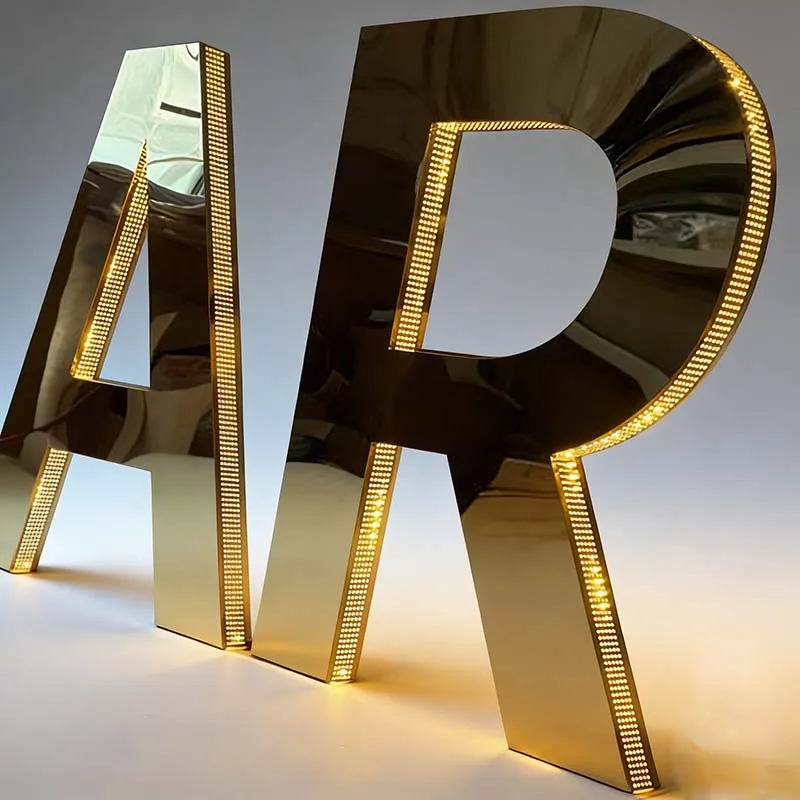
Real photo from our production floor — every sign we ship is made here.
Products mentioned or relevant to this topic — factory-direct, custom built.
From $24/letter · MOQ 1 piece · Flexible lead time · CE & UL certified · ships to 20+ countries
Custom sizes, colors, and finishes. Get a factory price in 24 hours.
Get a Free Quote Copy EmailWhatsApp +86 13865703472 · business@aochuangsign.cn