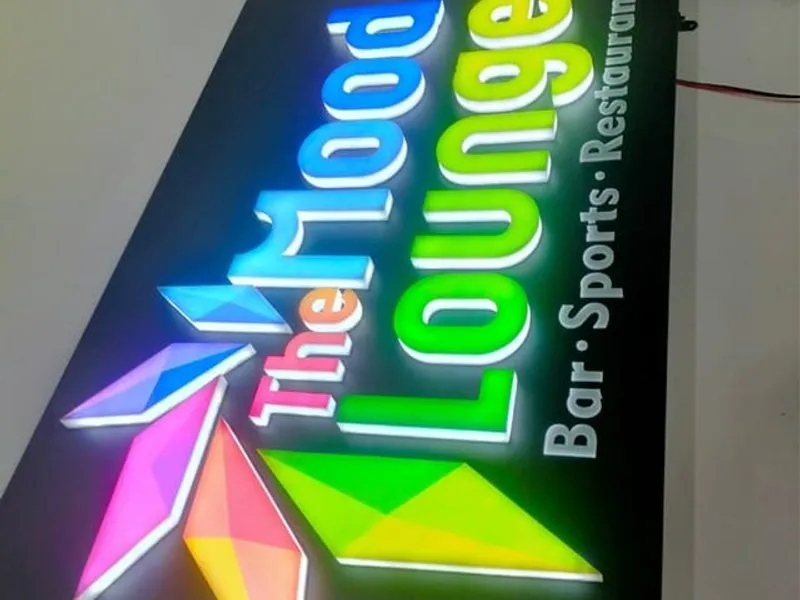
It's 11 p.m. and I can still smell the neutral silicone from the sealing station.
That's the trade. I've been on this floor since 2010, and I've watched too many buyers overpay for letters they could've sourced for half the price. If you're hunting a channel letter manufacturer, you don't need another glossy brochure or a quote form that hides the real numbers. You need someone to tell you how the sausage gets made, what actually drives cost, and where the cheap crap hides.
So here it is.
This article is 1,500 words of factory-floor truth. No corporate speak. If you can't handle a little grease on the page, go read a spec sheet.
Let's start with the part everyone lies about: price.
Look, if you're ordering front-lit channel letters from a domestic fabricator and paying $500 a letter, you're not buying better quality. You're buying somebody's rent in a strip mall in Ohio.
Our factory price for a front-lit channel letter runs $20 to $80, depending on size, return depth, and acrylic face. A back-lit halo letter runs $35 to $120. Stainless steel non-lit letters? $15 to $40. The same front-lit letter installed in the U.S. goes for $200 to $700 retail. Per letter. That's not a difference of craftsmanship. That's a difference of labor cost, overhead, and markup.
The savings aren't magic. They're structural. Our facility in Lu'an, Anhui is 3,000 square meters with 50-plus skilled workers. We don't have a showroom with marble floors. We have TIG welders and a laser cutter that holds ±0.1mm. That's why factory-direct pricing lands 50 to 65 percent below installed retail.
But here's the ugly truth: some factories advertise $15 letters and ship you aluminum foil with LEDs hot-glued to the back. The price has to match the material spec, not just the photo. I'll get to materials in a minute.
One more number. Light boxes run $80 to $250 per square meter. Neon flex signs run $30 to $200 per sign. If a quote is wildly below that, something's wrong. Nobody's losing money to be nice.
Here's what nobody tells you: most sign buyers obsess over LED brand and completely ignore the acrylic face. That's a rookie mistake.
If you're ordering acrylic LED letters, the face material controls everything. Our UV-resistant acrylic from Mitsubishi or Degussa transmits 90 to 92 percent of light and lasts 5 to 8 years outdoors. Domestic acrylic starts yellowing in 1 to 2 years. You can't see that in a catalog photo. You see it six months after install when the white letter looks like old teeth.
Thickness matters too. We use 2mm, 3mm, or 5mm. Any letter face over 2.5 meters should be 5mm or thicker. A 3mm face cuts 92 percent of light output. A 2mm face cuts 90 percent. Your customer won't notice the 2 percent difference, but they will notice the 40 percent cost bump for 3mm when you don't need it. Don't pay for thickness you don't need.
Then there's metal. For stainless steel letters, 304 is the workhorse: 18 percent chromium, 8 percent nickel, 10-plus years outdoors. If you're near salt water or industrial fallout, pay the 20 to 30 percent premium for 316. The ugly truth is, a strip mall in Ohio doesn't need 316, but a Miami Beach sign absolutely does. I've watched signs fail in three years because somebody saved $40 per letter by using 304 on the coast.
Aluminum is a different animal. It's one-third the weight of steel and naturally rust-proof. We use 1.0 to 1.6mm sheet. It'll give you 8 to 12 years outdoors. For most channel letter returns, aluminum is the smarter choice than steel because it doesn't need paint to survive. But if you want a mirror finish, you're back to stainless.
LEDs: the industry standard is SMD 2835 at 100 to 150 lumens per watt. For RGB, SMD 5050. For maximum brightness, SMD 5730 at 40 to 60 lumens per chip. Quality modules from Samsung, Osram, or Blueview run 5-plus years real lifespan. Cheap no-name modules last 12 to 18 months. Want to spot the difference before you buy? Look at the solder joints. Dull gray solder means the module won't last two winters. Shiny silver means proper lead-free solder.
Color temperature is a decision, not a default. 3000 to 3500K for hospitality. 4000 to 5000K for corporate and retail. 6000 to 6500K for industrial and highway. If the customer says "just white," they don't know what they want. Ask them where the sign lives and what mood they're selling.
Look, a channel letter isn't a sticker. Our production line runs 10 steps: design confirmation, laser cutting, bending and TIG welding, grinding and polishing, acrylic face CNC, LED assembly, sealing with neutral silicone, an 8 to 12 hour aging test, 100 percent QC inspection, and export packaging with foam, carton, and plywood crate. That's 7 to 15 working days if everything is approved on day one.
But here's what nobody tells you: the fastest way to blow a lead time is to change the design after the laser cutter has already run. The laser cuts aluminum and stainless to ±0.1 millimeter. Once those returns are bent, you don't just "tweak" a letter. You scrap it and cut again.
The aging test is where cheap manufacturers cut corners. We run every assembled sign for 8 to 12 hours before it leaves the floor. If an LED module is going to fail early, it usually fails in the first 8 hours under load. Skipping that test is how you end up with a 40-foot channel letter pylon that has three dead letters on day four. I've seen this go wrong: a shop in Texas bought from a factory that "saved" a day by skipping the burn-in. They spent $3,000 on a crane to pull the sign down and replace a power supply that never should've shipped.
Sealing matters more than you think. We use neutral silicone because acidic silicone eats the LED solder joints over time. If a factory uses acidic silicone, the sign looks fine for six months, then the LEDs start flickering. That's not an LED problem. That's a chemistry problem.
And packaging. LCL sea freight means your crate gets handled 6 to 8 times between our dock and yours. Every touch is a chance for damage. If the factory wraps letters in newspaper and throws them in a cardboard box, you're buying freight damage. We use foam, double-wall carton, and plywood crates for anything over a few letters.
The ugly truth is, buying overseas isn't always cheaper. You have to do the math on freight and duties, not just the unit price.
Express shipping runs 7 to 15 days and costs $30 to $100 for small orders. Air freight is 10 to 20 days at $4 to $12 per kilogram. Sea freight is 50 to 70 days. LCL costs $80 to $200 per cubic meter. A full container runs $1,200 to $3,000. On top of that, U.S. Section 301 tariffs add about 30 percent to the invoice value.
So a $120 halo letter from our floor might land at $156 after tariff. That's still a third of the $400 to $1,000 installed price from a U.S. shop. But if you're ordering one small sign and paying $250 in express shipping, the math goes sideways. That's why our minimum order is one piece. We'll ship it. Just don't be surprised when the freight exceeds the product cost.
Here's what nobody tells you: sea freight LCL is harder on your sign than the lighting. Your crate gets handled 6 to 8 times. Every forklift operator is having a bad day. We pack for that, but if you choose a cheap factory that doesn't crate, you'll get a box of aluminum shavings and sorry.
Also, don't compare factory price to factory price without checking the tariff code. Some manufacturers quote a lower price and then ship under a generic code. When customs flags it, you're paying back duty plus penalties. That's not a savings. That's a surprise.
If you're sourcing for a project, factor 30 percent tariff into your budget, not as an afterthought. And order early. Sea freight takes two months. The sign you need for a grand opening in July should be in production in April, not June.
CE marking costs 20,000 to 50,000 RMB and takes 2 to 8 weeks. Everybody in China says they have it. Ask for the certificate with today's date and the factory's name on it. Watch them sweat.
Our shop holds CE, RoHS, and ISO 9001. That's not decoration. ISO 9001 means our production process is audited. RoHS means the LEDs and power supplies don't leach lead into the landfill. CE means the sign meets EU safety standards. But a piece of paper doesn't test the sign on your wall.
For the U.S. market, the certification that matters is UL 48. It costs $4,000 to $15,000 and takes 4 to 9 months, with quarterly audits after. ETL is a cheaper alternative—10 to 30 percent less—and widely accepted. But here's what nobody tells you: UL certification doesn't mean every sign a factory ships is UL-listed. It means the factory is authorized to apply the UL label to signs built to the listed construction. If the factory deviates from the listed design, that label is meaningless.
IP ratings are another trap. IP65 means dust-tight and protected against water jets from any direction. It's the minimum for outdoor signs. IP66 means powerful jets, which matters in coastal or high-rise exposure. IP68 means submersible—extreme weather or flood zones. The ugly truth is, IP65 sounds impressive. It does NOT mean your sign survives a Florida hurricane. I've watched customers think IP65 is bulletproof and then act shocked when a Cat 4 rips the letters off the facade. That's not a waterproofing failure. That's wind load, and no IP rating covers wind load.
If you're in the U.S., the electrical install has to meet NEC Article 600. If you're mounting tactile signs for ADA compliance, mounting height is 48 to 60 inches from floor, with non-glare finish and Grade 2 Braille. Those are hard numbers. Don't let someone sell you a "compliant" sign without checking the mounting height.
Look, there are 5,000 factories in China that will tell you they make channel letters. Maybe 50 of them actually know what they're doing. Here's how to sort them out in 10 minutes.
Ask for a video of the factory floor, not a brochure. If they won't show you the laser cutter and the aging test rack, they don't have one. Ask for three recent client photos with the client's name visible in the background, not just a close-up of the sign. Then call one of those clients and ask what went wrong on the order. Every order has something go wrong. If they say "nothing, it was perfect," they're lying or they've never actually ordered.
Check the warranty. We offer 2 years on LEDs and 1 year on power supplies. If a factory offers 5 years on cheap LEDs, they're betting you won't come back. A power supply lives 3 to 5 years in a hot return. We warrant it for one because we know where it sits and what it does. A two-year warranty on the power supply is a marketing stunt, not an engineering decision.
Request a sample before you commit to 200 letters. A single 12-inch front-lit letter costs $20 to $80. Pay the $80. It's the cheapest insurance you'll ever buy. If the sample shows dull solder, a warped return, or a face that doesn't sit flush, multiply that by 200 and walk away.
And for the love of everything, don't ask for a "custom" quote and then send a screenshot from Pinterest. Send vector artwork. Send the exact dimensions. Tell us the mounting surface, the voltage, and the city. The more you make me guess, the more my quote includes a stupidity buffer.
Finally, decide whether you need a manufacturer or a project manager. If you're ordering 1 to 10 letters for a small business, you can order directly from us with MOQ of one piece and have it in 7 to 15 days by express. If you're ordering 400 letters for a corporate rollout, you need someone to handle the artwork, the permits, and the freight. That's a different conversation. But don't pay project-manager prices for a factory-direct transaction.
Can you match my exact PMS color on the acrylic face?
Yes, but there's no true color matching in translucent acrylic. We match as close as the material allows. If your brand person shows up with a Pantone book and a spectrophotometer, tell them to order a printed sign. This is not interior decor.
Why is shipping more than the letters?
Because a 40-pound sign in a wooden crate travels across an ocean and through customs. Express freight costs $30 to $100 for a small box. Sea freight costs $80 to $200 per cubic meter but takes 50 to 70 days. You're not paying for distance. You're paying for speed and handling. If you want cheap shipping, order 6 months early and fill a container.
Can I get a UL-listed sign for my restaurant?
UL 48 certification costs $4,000 to $15,000 and takes 4 to 9 months. We can build to UL-listed construction if we hold the certification for that specific design. If a supplier says "UL approved" without a file number, ask for the file number. Then check it on UL's website. Cheap signs with fake UL labels are a thing, and your inspector will catch it before your grand opening.
What's the real lifespan of an outdoor channel letter?
With UV-resistant acrylic and Samsung or Osram LEDs, you're looking at 5 to 8 years before the face shows wear and the LEDs still run. Cheap domestic acrylic yellows in 1 to 2 years. Cheap LEDs die in 12 to 18 months. Stainless steel 304 lasts 10-plus years. The sign's lifespan isn't one number. It's the shortest lifespan of the weakest material in the stack. Don't ask me how long the sign lasts. Ask which part will fail first, and I'll tell you the acrylic face.

Real photo from our production floor — every sign we ship is made here.
Products mentioned or relevant to this topic — factory-direct, custom built.
From $24/letter · MOQ 1 piece · Flexible lead time · CE & UL certified · ships to 20+ countries
Custom sizes, colors, and finishes. Get a factory price in 24 hours.
Get a Free Quote Copy EmailWhatsApp +86 13865703472 · business@aochuangsign.cn