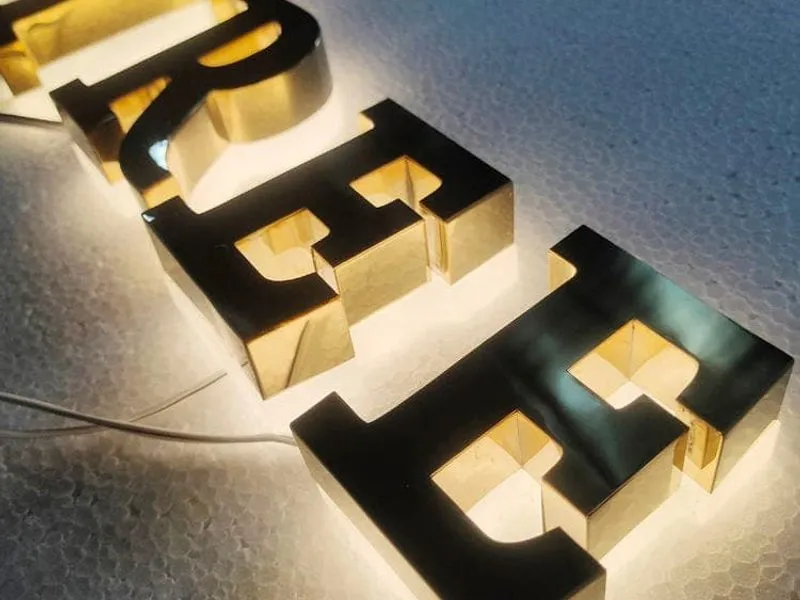
The return is the side of the letter. That's it. The 3-dimensional wall between the face and the back. It's not sexy. Nobody takes a photo of it. But here's what nobody tells you: the return is where your sign fails first. It's where water gets in, where rust starts, where light bleeds out, and where cheap fabrication shows its teeth after two winters. I've cut, bent, welded, and flanged returns in aluminum, 304 stainless, and acrylic for almost three decades. This isn't a theoretical debate. It's about what's going to still look clean when your client's lease is up for renewal.
Look, a welded return isn't a return. It's the entire can of the letter. We take a flat sheet of metal — usually 304 stainless, 1.2mm to 2.0mm thick — laser-cut the letter shape with a central void, then bend the sides up on a press brake. The corners meet. Then we TIG weld every seam, grind it back flat, and polish until you can't find the joint. When we're done with stainless steel letters built this way, they look like they were poured from a single mold. That's the aesthetic. The practical side? No seam means no place for water to sit and freeze, no capillary action wicking moisture into the LED compartment. If you're buying a sign for a bank headquarters or a hospital that's going to be there longer than you'll be alive, weld the returns. I've got 10-year-old front-lit channel letters out in Ohio with welded 304 returns that still look like month two under a pressure washer. The ugly truth is most shops don't offer welded because it takes a real metalworker and an extra day per letter. They'll pitch you flanged and tell you it's "just as good." It's not.
For 316 stainless, weld it. No question. That alloy's got molybdenum in it for a reason. If you try to flange 316 in a marine environment, the screws or tabs become the corrosion points. You need a hermetic shell. So we weld every seam and then passivate the whole letter. That's a $120 letter instead of $80, but it's still half what your local sign shop charges. Trust me, I've seen this go wrong: a hotel on Miami Beach ordered flanged stainless letters with a "marine-grade" coating. Three years later, the returns popped off the faces because the screws rusted to dust. They paid me twice — once for the original cheap version and once for welded 316 replacements.
Here's what nobody tells you: flanged returns are the reason I can ship a 24-inch front-lit letter for $60 and still make payroll. We cut the return as a strip with a flange tab bent along the bottom edge. This tab slots into the backplate or gets screwed from behind. For aluminum returns — which, by the way, weigh a third of steel and won't rust — flanging is the smart play. Our standard acrylic-faced letters use 0.040" aluminum returns, flanged, with a simple lap joint at the corner. No welding. The face is sealed with neutral silicone (the stuff that doesn't eat the acrylic) and the whole thing passes an 8-hour rain test without a drop inside. That's a $45 letter doing the same job a $150 welded letter would do, on a strip mall where nobody's looking at the seams from 3 inches away.
Look, the trick with flanged returns is the corner treatment. A rookie mistake — and I see this on samples from competing factories every month — is cutting the flange as a single continuous piece and just bending it around the letter form. That leaves a gap at every corner you could lose a USB drive in. We miter the corners. That means the return strip stops exactly at each vertex, and the flange is folded under at a 45-degree angle so the two pieces nest together. Then a tiny dab of silicone seals it. If your supplier isn't mitering flanged corners, the sign will leak light at every point and look like a child's cereal box project after dark.
1. Material expansion. Aluminum moves. A 6-foot sign face can grow nearly a quarter-inch between a freezing night and a hot afternoon sun. Welded steel returns don't budge, so the acrylic face gets stressed along the edge. I've pulled 3mm red acrylic faces off welded aluminum letters that had spider cracks radiating from the return seam because the acrylic couldn't keep up with the metal's yoga. Flanged returns have a little give. That's not a flaw — that's physics saving you from a warranty call.
2. Light bleed. I said welded returns are seamless, and they are. That matters for halo-lit signs. When you're backlighting back-lit halo letters and aiming for that perfect 2-inch glow on the wall behind, any gap in the return creates a hotspot. Flanged seams will always leak a sliver of light if you're not obsessive with the foil tape and silicone. Welded, you paint the inside matte white and forget about it.
3. Shipping survival. The ugly truth is that LCL sea freight handling means your crate gets bounced between forklifts six to eight times before it lands. A flanged return assembly with screws can loosen. I've had customers call me furious because their letters arrived with returns rattling inside the crate. Not a defect — a design choice that didn't survive the journey. Welded monoliths don't come apart. When a sign's crossing the Pacific, I weld the returns even if the spec says flange, because I'd rather eat an hour of labor than a replacement shipment.
4. Repairability. A welded return is forever. If an LED module fails, you're drilling out the silicone and fishing the module out with tweezers. A flanged return with a screwed backplate? Five minutes with a drill, swap the module, reseal, back on the wall. For a casino that changes their branding every three years, flanged is the only answer. For a monument sign at a corporate campus that will never be touched, weld it.
Here's some nonsense that circulates at trade shows: "UL 48 requires welded returns." No it doesn't. UL 48 cares about electrical fire safety, not fabrication method. I've passed UL inspections with flanged returns and screwed

Real photo from our production floor — every sign we ship is made here.
Products mentioned or relevant to this topic — factory-direct, custom built.
Factory-direct since 2010. Free quote within 24 hours — no obligation.
Get a Free Quote → Copy EmailMOQ: 1 piece · Flexible lead time · 2-year warranty · Worldwide shipping
See pricing, specs, and get a free quote for the sign type you need. Built in our factory, shipped worldwide.