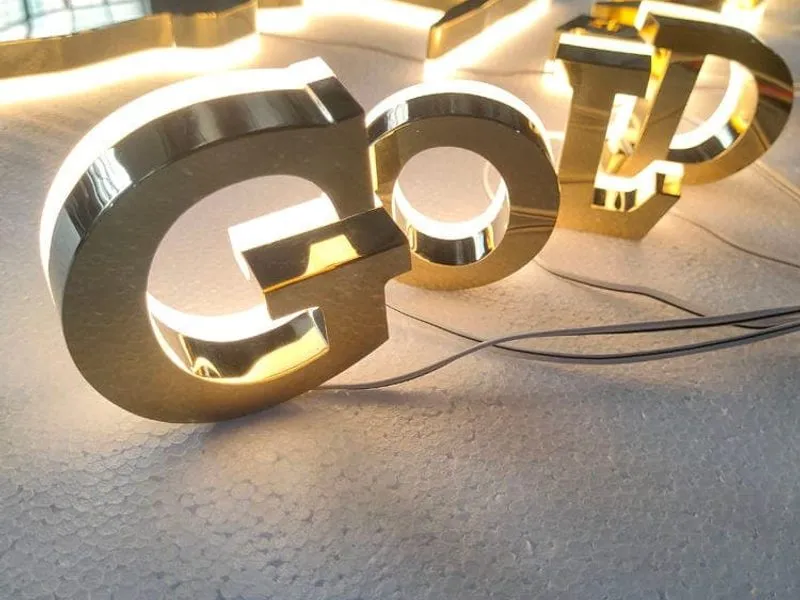
Quality LEDs, decent acrylic face—both useless if the return can’t hold its shape on a windy Tuesday. I’ve watched a 4-foot letter rip off a pylon because the flanged seam popped. Nobody talked about the weld, the flange depth, or the alloy. Just blamed the installer. The return isn’t sexy. It’s a strip of bent metal. But choose wrong, and you’re reordering in 14 months. At Aochuang, we’ve shipped both welded and flanged returns worldwide, so I’m not here to sell you one. I’ll tell you what I’d use if that sign were going on my own shop in Lu’an.
A channel letter return is the side wall—the 3D depth that turns a flat acrylic face into a light box. You can anchor that side wall to the face using a flange (a 90-degree lip bent inward and screwed or siliconed to the face), or you can weld the return directly to the back can with no lip at all. That’s it. Two paths. The flanged method means you laser-cut the return strip, notch bend points, add a 3/8” to 1/2” lip, then rivet or silicone the acrylic face onto that lip. The welded method has no lip. The return edge butts against the backing plate or face rim, and a TIG welder fuses them into one continuous skin.
Flanged returns dominate the budget market. We can knock out 200 letters a day if the design is simple. Welded? Maybe 30 a day with two skilled guys on the floor. That labor gap explains everything about cost, lead time, and why a welded return on a big stainless steel letter adds $15-40 to factory price but can mean a decade more outdoor life.
I’ve seen this go wrong: a California chain ordered 120 flanged letters, all 24” tall, white acrylic face, SMD 2835 LEDs. Installer rushed. Silicone bead skipped in two spots per letter. Within six months, Pacific moisture crept in, LEDs corroded, and half the sign glowed a sickly green. They blamed the LEDs. The modules were fine. The flange bent in shipping, gap opened up, water followed. Welded returns don’t have a lip seam at the face, so that path doesn’t exist. The only intrusion points are the wire knockout and the power supply entry, which we seal with neutral silicone after the 8-hour aging test. If you’re installing a front-lit channel letter anywhere with rain or pressure washing, the lack of that front seam is a bigger deal than IP66 ratings on paper.
Here’s a number that keeps project managers awake: a flanged return on a 5mm acrylic face using only silicone bond has a peel strength around 15-20 lbs per linear foot when new. Add thermal cycling, UV, vibration, and three years later that bond can drop below 8 lbs. A TIG-welded 304 stainless return on a 1.5mm backing? You’ll break the acrylic before the weld lets go. That’s why we weld all returns on any letter over 36” tall, no exceptions, unless the client signs a waiver. Which they almost never do after I explain it this way.
Look, welded returns aren’t inherently superior. They’re superior in the right context. A luxury hotel lobby with 16” brushed stainless steel letters? Weld, grind, polish to mirror #8 finish—looks like a solid billet of metal because it practically is. A 42” highway pylon letter with wind loading? Weld the 2.0mm aluminum return to a frame, and you’ve got a monocoque structure that laughs at 90 mph gusts. For back-lit halo letters where the light spills out the back, we weld the return to the face and leave a clean, flange-free edge so the glow is even, no shadow lines. That’s a specification that instantly elevates a corporate lobby from “strip mall” to “architectural.”
Our TIG welding stations run at 40-80 amps on stainless, using 308L filler rod. Every inch of bead gets a pass with a 120-grit flap wheel, then progressively finer grits if it’s a polished finish. It takes time. A 24” capital “M” in brushed #4 stainless with welded returns, from flat sheet to QC, runs about 90 minutes in fabrication. The flanged version? 35 minutes. That ratio gets worse as letters get bigger because welding heat distorts thin metal if you rush. I’ve seen factories slap a heavy weld on 0.8mm aluminum, warp the entire can, then pack it. We won’t do it. If the metal gauge is under 1.0mm, we’ll push you toward flanged anyway, because welding that thin stock without oil-canning requires a skill level most production lines can’t sustain in volume.
Small letters under 18” tall. Anything where the return depth is 1” or less. Interior-only signs where rain isn’t a variable. These are all flanged territory and I’d be lying if I said welded was better there. A flanged return with proper notching, precise CNC bends, and a continuous bead of Dow Corning 995 silicone will outlast the LEDs inside it. For a coffee shop menu board sign or an office directory, you’d never recoup the welding cost. Our MOQ is one piece, so we’re happy to do either, but a contractor ordering 50 rimless channel letters for an indoor tenant space will pay roughly $22 per letter with flanged fabrication versus $38 welded. Over 50 units, that’s $800 staying in your pocket, and the sign will still look perfect ten years from now under fluorescent lights.
The flange itself isn’t invisible. On a rimless letter with a 3/8” lip, you’ll see a faint glue line if backlit strongly. On standard front-lit letters with trim cap, the flange hides behind the trim. This is the kind of nuance that separates a shop order from a headache. I’ll straight up tell you: if your client will stare at the return edge from six inches away, spec welded. If the sign is 12 feet above a door, flange all day.
A welded return letter is a rigid, fixed-depth box. It cannot be nested, collapsed, or flattened. A flanged return letter can sometimes have the return folded slightly or shipped unassembled with the face separate, cutting freight volume by 30-40%. Sea freight LCL out of Shanghai runs $80-200 per cubic meter to the US. If your order of 100 letters measures 2.5 m³ packed, that’s $200-500 in freight. Switching from welded to flanged-assembly-flat can drop that to 1.6 m³. On a $4,000 order, saving $180 in freight might not matter. On a container load, it’s thousands. We pack every welded letter in foam-lined cartons with plywood crating for the big ones, no shortcuts. Flanged letters get the same foam but the cartons can be slimmer. Neither method lets you skimp on packaging—I’ve seen a US importer save $80 on crating and lose $3,400 in dented returns. That’s not a trade I’ll make.
Look, a hotel chain spends $120k on a rebrand, new logo, custom PMS colors, and the sign shop delivers letters with hairline light cracks around the flange. At night, the “W” glows like it’s wearing a cheap halo. That’s a flanged return where the silicone shrank because the metal wasn’t degreased before assembly. Welded returns physically can’t leak at the face—there’s no gap. On dual-lit channel letters where both front and back emit light, any pinhole becomes a laser show. We weld every dual-lit return by default. If a client insists on flanged for a backlit or dual-lit job, I send photos of a failed install I keep on my phone. Nine times out of ten they change the spec.
For standard front-lit letters, a properly flanged return with opaque trim cap blocks light better than a welded return with a poorly fitted trim. The failure mode isn’t the method; it’s the execution. When you order from Aochuang, both methods get a 100% QC dark-room test: we power every letter for 30 minutes in a blacked-out booth and photograph any light bleed. Our reject rate is under 2%, but that 2% almost never ships.
Here’s the cheat sheet I give our sales team. Outdoor letters taller than 24 inches, exposed to wind or rain: welded returns, minimum 1.5mm 304 stainless or 1.6mm aluminum. Coastal installations within 3 miles of salt water: 316 stainless welded only—flanged 316 still has a crevice at the silicone line where chloride corrosion starts. The price premium for 316 is 20-30% over 304, but a 316 welded return will look factory-fresh at year 15 while 304 in Miami starts pitting at year 5. Interior corporate identity, high-end retail, or any application where the sign is below eye level: welded returns on the face side for flawless aesthetics. Budget-sensitive strip malls, interior wayfinding, temporary promotional signs: flanged returns will give you 95% of the function at 60% of the metal fab cost.
The one scenario where I won’t sell you welded is when you spec under 1.0mm aluminum. Aluminum that thin warps under TIG heat no matter how careful the welder. We can do it, but we’d rather lose the order than ship a wavy letter. In that case, we’ll recommend flanged with mechanical fasteners plus silicone, or we shift to 1.2mm material and eat a few dollars of margin. Your call.
I’ve worked in shops that steered every customer to flanged because they’d sold their TIG welder years ago. At Aochuang, we run six TIG stations and three flanged production lines in parallel. A 24-foot container can hold 50% welded letters, 50% flanged—same lead time. The about 5-15 days we quote doesn’t stretch just because you want welds. What does change is cost. You’ll see it reflected in the quote as a per-letter labor adder, not hidden in some “premium” markup. For a 24” front-lit logo, welded returns typically add 25-35% to the letter price. On stainless steel fabrication, it’s a smaller percentage because the base material cost is high anyway. On acrylic channel letters with domestic LEDs, the adder can feel steep, which is why we always break it out so you can decide.
We’ve shipped welded returns to a museum in Dubai that needed letters resistant to 120°F heat and sand abrasion. We’ve shipped flanged interior rimless letters to a coffee chain in Seattle where moisture is constant but the letters sit indoors. Both are still up. The difference is the engineering choices around the return, not some blanket “welded is better” slogan.
I’ve seen this go wrong: a factory in Shenzhen welded every return because “it looks premium.” They welded 0.8mm aluminum using too much filler rod, then ground the welds flat—now the metal is half its original thickness. First windstorm, the letter cracked at the weld bead. That’s not fabrication. That’s metal surgery with a butter knife. A weld should be a reinforcement, not a weak spot. Our QC checks include spot thickness measurements on ground welds; if it dips below 85% of base material thickness, we scrap the letter. This is the kind of thing no client asks about but every good installer notices when the letter doesn’t flap in the wind.
When you’re ordering a sign, ask the factory: “What gauge material do you start with after grinding?” If they can’t answer, their welding is cosmetic. If they can, they’re a partner, not a vendor. We’ll send photos of welds mid-process, beads before grinding, thickness gauge readings—whatever you need to trust the metal.
Send us your design files, tell us where the sign lives—indoor, outdoor, coastal, high-altitude UV—and I’ll recommend the return method before we talk price. You don’t need to be a sheet metal expert. If the letters are under 18” and indoors, I’ll say “flanged, save your budget for better LEDs.” If they’re 36” mounted on a concrete facade 40 feet up, I’ll push welded and show you the wind load calc. Our MOQ of one piece means you can order a single sample letter both ways, test it yourself, then commit to the final spec. Nobody does that because it’s expensive to ship one letter. We’ll do it. Because once you’ve seen a welded return in person, you know what you’re paying for, and once you’ve installed a properly flanged budget letter, you know where the savings live.
For premium architectural signage where every dollar shows, our backlit halo letters with welded returns and Samsung LEDs are the standard spec. For a quick storefront rebrand on a tight timeline, our standard channel letters with flanged returns ship in 10 days and cost under $40 a letter. Both have the same 2-year LED warranty, same packaging, same factory backing. The return is just one decision in a long chain. I’d rather you get it right the first time than impress you with a cheap price that falls apart.

Real photo from our production floor — every sign we ship is made here.
Products mentioned or relevant to this topic — factory-direct, custom built.
From $24/letter · MOQ 1 piece · Flexible lead time · CE & UL certified · ships to 20+ countries
Custom sizes, colors, and finishes. Get a factory price in 24 hours.
Get a Free Quote Copy EmailWhatsApp +86 13865703472 · business@aochuangsign.cn
See pricing, specs, and get a free quote for the sign type you need. Built in our factory, shipped worldwide.