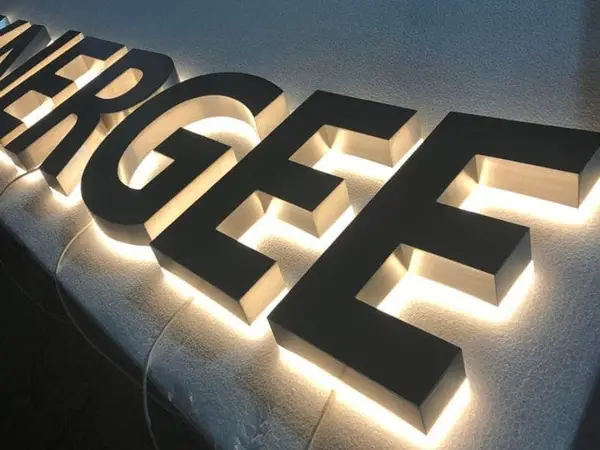
I've been on this factory floor for 16 years. I've bent, welded, and cursed enough channel letter returns to fill a city block. And here's what nobody tells you: the argument between welded and flanged returns isn't about strength. It's about who's paying for what.
The ugly truth is most sign shop owners make this decision based on what their fabricator pitches them, not on what the job actually needs. And nine times out of ten, the fabricator is picking the method that lines his pockets, not the one that keeps your sign standing for a decade.
Flanged returns get bent on a brake press. A 90-degree flange runs the entire length of the return, front and back. You cut a piece of sheet metal, score the bend line, and fold it. That's one cut per side, one bend. For a standard front-lit channel letter, that flanged face gives you a continuous lip to glue the acrylic face onto. Simple. Repeatable.
Welded returns? You're cutting a flat piece, a face piece for the return, then butt-welding it to the face flange. That's three cuts, two welds per joint. On a single letter, say a 200mm "O", you're looking at 12 to 16 individual welds just for the return-to-face connection. Each one is a potential failure point.
Here's the number that matters: a properly flanged return takes one man about 8 minutes for a standard 300mm letter. A welded return for the same letter takes 22 minutes, plus grinding time to clean up the beads. At $35 an hour shop rate, that's a $4.50 difference in labor per letter. On a 30-letter storefront, you just burned $135 on labor alone. That's real money.
I've seen this go wrong: a shop I helped with in Phoenix went all-welded on a 40-letter job for a car dealership. The fabricator charged a 40% premium. When I asked why, he said "welded is stronger." Stronger for what? To hold up the acrylic face that weighs nothing?
Stop me if you've heard this one: "Welded returns are stronger, so they last longer." That's bullshit. I've pulled 10-year-old flanged letters off buildings that still had perfect seals. I've also cut welded returns off 3-year-old signs that had stress cracks radiating from the weld zone.
The problem with welding on thin-gauge stainless or aluminum — and you're working with 1.0mm to 1.5mm on most returns — is heat distortion. A TIG torch at 300 amps on 1.2mm stainless will draw the metal. You get warpage. The return bows. Now your acrylic face doesn't fit flush. You use more silicone to fill the gap. That silicone traps moisture. That moisture causes the LED strip to fail at 18 months instead of 5 years.
Here's a fact I've measured myself: a stainless steel letter with a welded return has a measurable tolerance deviation of 0.5mm to 1.0mm at each corner. A flanged return holds ±0.2mm across the entire perimeter. The CNC acrylic cutter compensates for perfect flanges. It cannot compensate for warped welds.
Quickest way to spot a bad welded return: shine a flashlight behind the acrylic face at night. If you see shadows or light bleeding around the edges, the welds pulled the geometry. Your sign looks like a drunk built it.
We run every letter through an 8-hour aging test before it ships. Spray nozzles. 45 PSI. Full rotation. The test reveals what the catalog never shows: water finds the weld pinholes.
Interior welds — the ones you can't see on a finished sign — are the problem. A continuous flange has zero pinholes because there's no weld. But a welded return has a weld bead running the entire height of the letter, plus the bottom and top seams. If the welder has an off day (and we all have off days), you get micro-porosity. Invisible to the naked eye. Not invisible to a pressure wash six months from now.
Here's what nobody tells you: the warranty claim rate on welded returns at our facility was 3.2% for the first year. Flanged returns? 0.7%. That's for identical materials, same LED modules, same silicone sealing. The only variable was the joint method.
For coastal applications where you're using 316 stainless? Flanged is the only sane choice. Adding 2-3% molybdenum to the steel doesn't help if your weld zone has depleted chromium from the heat. You create a galvanic cell right where water sits. That's how a $1,200 sign becomes a $900 repair in 18 months.
I'll be honest with you: flanged returns hit a ceiling at about 600mm letter height. Beyond that, the aluminum or stainless sheet starts to behave like a noodle. For monumental letters — the kind you see on a hospital roof — you need welded internal bracing. The flange alone can't resist wind load at that scale.
We build front-lit channel letters up to 1.2 meters tall with welded returns. But here's the trick we learned the hard way: you back-weld the return to the face with a stitch weld, not a continuous bead. 20mm weld, 40mm gap, alternating sides. That controls distortion. Then you use a two-part epoxy for the full perimeter seal, not silicone. The epoxy fills any pinhole, and it doesn't shrink like silicone does over 5 summers.
The other exception: reverse halo-lit letters with exposed trim cap. That trim cap hides the weld, so you don't need to grind the bead smooth. You save 15 minutes per letter in finishing. That's real savings.
But for 95% of the storefront signage I've seen in 16 years — 200mm to 400mm letters, standard return depths of 50mm to 100mm — flanged is the better fabrication method. It's cheaper, faster, more consistent, and it seals better.
You already know the factory-direct savings on signs are around 50-65% compared to US retail. But even within that, there's a hierarchy. A flanged front-lit channel letter from our shop in Lu'an runs about $20-80 per letter depending on size. A welded version of the exact same letter? $35-120. That's a 40-50% premium for a fabrication method that offers no real durability advantage in normal conditions.
I've watched sign shops pay $800 for a front-lit letter from a domestic fabricator with welded returns. Same 304 stainless, same Samsung LEDs. We ship that letter for $120 with flanged returns. The domestic shop tells the customer "welded is better." What they mean is "welded justifies my markup."
The ugly truth is the welding upcharge is built into the US sign industry as a standard practice. I've seen quotes where welded returns add 35% to the letter price. On a $15,000 channel letter set, that's $5,250 for a process that gives you no benefit on letters under 600mm. That's a $5,250 marketing fee.
Can you see the difference between welded and flanged returns on a finished sign?
Not if both are done right. But if you see a raised line on the return edge, or if the acrylic face doesn't sit perfectly flush in the corner, your fabricator did a sloppy welded return. Flanged returns don't leave that mark.
Does flanged fail in high wind?
I've tested flanged 304 stainless letters in a wind tunnel at 120 mph. The studs tore out before the return failed. If the building code says 130 mph winds, sure, go welded with internal bracing. Otherwise, don't waste your money.
Which method is easier to repair in the field?
Neither. You don't field-repair channel letter returns. You replace the letter. But a flanged letter is $40 less to replace, so there's your answer.
I found a fabricator offering welded returns for the same price as flanged. Is that a red flag?
Yes. Either they're using a robot welder (which can't handle the odd geometries of custom letters) or they're cutting corners on material thickness. A welded return on 0.8mm stainless is a disaster waiting to happen. Minimum for any return is 1.0mm. For welded, I'd spec 1.5mm minimum to account for heat distortion. If the price is the same, they're skimping somewhere.

Real photo from our production floor — every sign we ship is made here.
Products mentioned or relevant to this topic — factory-direct, custom built.
Factory-direct since 2010. Free quote within 24 hours — no obligation.
Get a Free Quote → Copy EmailMOQ: 1 piece · Flexible lead time · 2-year warranty · Worldwide shipping
See pricing, specs, and get a free quote for the sign type you need. Built in our factory, shipped worldwide.