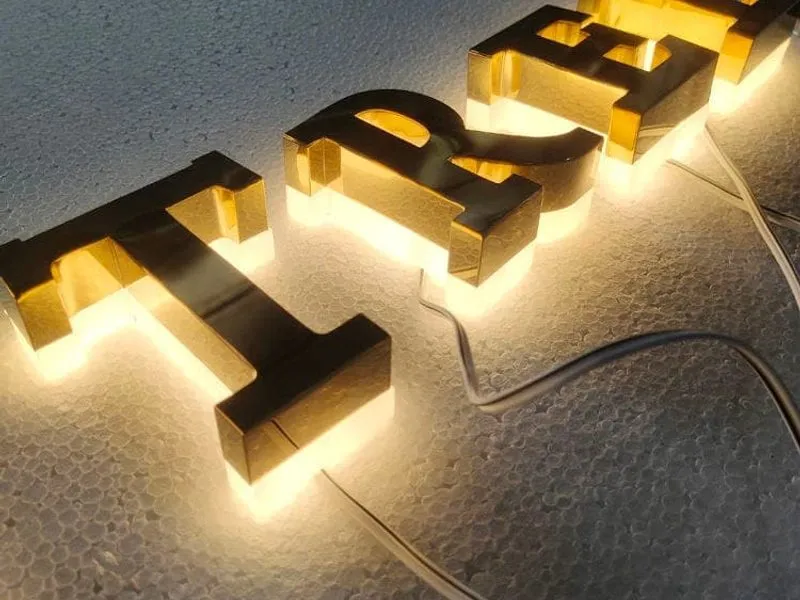
A channel letter is a hollow metal can with an acrylic face, lit from the inside by LEDs. That's the front-lit version. Back-lit (halo) pushes light through the back of the metal, giving you that ghostly glow on the wall.
Quality acrylic – Mitsubishi or Degussa – gives you 90–92% light transmittance and holds UV resistance for 5 to 8 years before yellowing. Domestic acrylic? You'll see yellow after 1 or 2 years. That's an extra $20–40 per letter if you go cheap, but you'll be replacing faces in 18 months.
The real channel letter price range: front-lit $20–80 per letter factory-direct. Back-lit $35–120. Stainless steel non-lit $15–40. Aluminum $10–25. At US retail, you're looking at $200–700 per letter front-lit. That's a 50–65% markup over factory-direct. Most buyers don't realize that the material cost on a standard 6-inch tall front-lit letter is about $8–12. The rest goes to labor, overhead, and the installer's truck payment. If you're paying retail, you're subsidizing a lot of coffee runs.
Brutal honesty: LCL sea freight feels like a money saver until your crate gets handled 6–8 times between our dock and yours. Every touch is a chance for a dent or a broken LED module. I've seen crates arrive looking like they fell off a forklift twice. Shop floor. That's not in the brochure. For small orders under 3 cubic meters, air freight at $4–12/kg might actually get you a sign that isn't bent.
We pack with foam, carton, and plywood crates – but we can't control the dockworker's mood. So if you're ordering channel letters from overseas, budget for inspection and potential rework. Or stick with local fabrication for small runs where shipping risk outweighs the price difference.
Let me break this down: a pan-faced sign is one big metal box with a single printed acrylic face. It's like a giant light box, and it costs $80–250 per square meter factory-direct. Sounds cheap, right? It is.
But here's the problem: it's a sealed container, the LEDs inside generate heat, and acrylic expands like crazy. Over 2.5 meters wide, we spec 5mm acrylic minimum – otherwise the face bows out and catches wind like a sail. I've had contractors call me after six months saying their pan sign is whistling in the wind because the face warped.
Channel letters, on the other hand, are individually sealed cans. Each letter is its own micro-environment. Heat dissipates better because each can is smaller. You don't get that one giant hot spot that fries the LEDs in the center. The tradeoff? More seams, more wiring, more labor to install. If you need a sign with a lot of text – like a long business name – pan-faced is faster and cheaper per square foot. But if you want that three-dimensional pop, the shadows, the premium look? Channel letters. No contest.
Most buyers don't realize that pan-faced signs are absolute nightmares for coastal locations. Moisture gets in through the tiniest pinhole in the silicone seal, and then you've got condensation cooking inside the box. Seal fails. We seal every channel letter with neutral silicone – not the acetic stuff that smells like vinegar – and we still run an 8-to-12 hour aging test to make damn sure the seal holds. Pan signs? They often skip the aging test because the box is too big to fit in the test chamber. That's an industry lie they won't tell you.
If you want letters that look like they're cut from a solid block, you're talking about fabricated letters. We make them by laser cutting metal (tolerances as tight as 0.1mm), then welding, grinding, and finishing. Stainless steel requires passivation to prevent corrosion, which adds cost.
The price spread is real: flat cut letters (non-illuminated, no forming) run $5–15 per letter for aluminum, $10–25 for stainless. Three-dimensional fabricated letters – with returns, rivets, and a formed face – can jump to $30–100+ per letter, depending on complexity and finish. The remaining project-specific details depend on the approved design, installation conditions and local code; confirm them before ordering.

Real photo from our production floor — every sign we ship is made here.
Products mentioned or relevant to this topic — factory-direct, custom built.
From $24/letter · MOQ 1 piece · Flexible lead time · Project-specific compliance documents · ships to 20+ countries
Custom sizes, colors, and finishes. Get a factory price in 24 hours.
Get a Free Quote Copy EmailWhatsApp +86 13865703472 · business@aochuangsign.cn
See pricing, specs, and get a free quote for the sign type you need. Built in our factory, shipped worldwide.