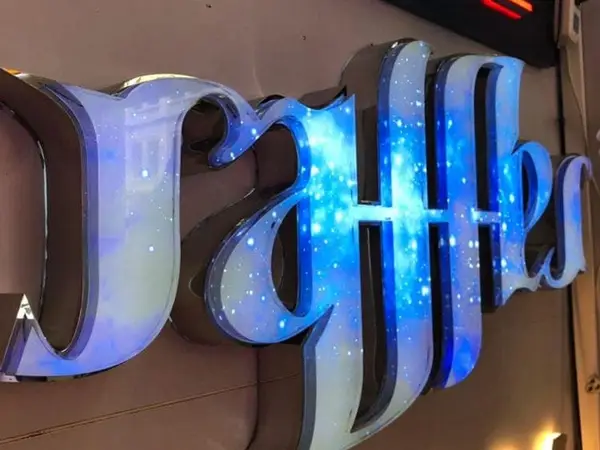
Here's what nobody tells you: "cheap custom signs" is a trap. Not because cheap means bad — but because most buyers don't know which corners to cut and which ones to leave alone.
I've spent 16 years in the sign business, the last 14 running a 3,000 m² factory in Lu'an, Anhui. I've watched importers save $4,000 on a project, then lose $12,000 on installation callbacks. I've also watched smart buyers get factory-direct pricing and build a business around it. The difference isn't luck. It's knowing what actually matters.
This guide is the honest version. I'll tell you exactly where to save money and where spending a little more prevents a disaster.
---
Start With The Face — Acrylic Is Where Most People Screw Up
The ugly truth is that 80% of the "yellowing" problems you see on signs are cheap acrylic, not bad LEDs. The material your light shines through matters more than the light itself.
Acrylic comes in two tiers. Mitsubishi and Degussa sheets hit 90-92% light transmittance and survive 5-8 years of UV exposure before showing their age. Domestic Chinese acrylic? You'll see yellowing in 1-2 years. The price difference is maybe 15-20%. That's not a saving, that's a future complaint.
For
channel letters, common thickness is 2mm to 3mm. If your design exceeds 2.5 meters, jump to 5mm or the face will ripple like cheap plastic. I've seen this go wrong more times than I can count.
Here's the smart move: order your prototype with the good stuff, but ask for a side-by-side quote on domestic acrylic. If the sign is for a short-term campaign — less than 18 months — domestic is fine. If it's permanent signage, the 5-8 year UV resistance of Mitsubishi pays for itself before your first maintenance visit.
---
Your choice of metal determines whether your sign looks premium for a decade or rusts into an embarrassment by year three.
Stainless steel 304 is the workhorse. 10+ year outdoor life, 18% chromium, 8% nickel. Density of 7.93g/cm³ — heavy, solid, premium. Common thickness is 1.0 to 3.0mm. Brushed #4 finish is the standard, but mirror #8 looks like jewelry if you're willing to pay for the polishing. PVD and powder coating give you color options.
For coastal locations, Miami Beach, any salt air — you need 316 stainless. The 2-3% molybdenum content makes it marine grade, and that 20-30% cost premium over 304 is the cheapest insurance you'll ever buy. For a strip mall in Ohio? 304 is overkill. Money wasted.
Aluminum letters are the budget-smart choice. One-third the weight of steel, naturally rust-proof, and 8-12 year outdoor life. Common thickness is 1.0-1.6mm. Anodized, powder coated, or brushed — each works. If you're shipping internationally, the freight savings on aluminum alone can be 40% compared to steel.
Look, if your customer wants luxury, push brass or copper. But for 90% of projects — storefronts, corporate lobbies, retail — a well-finished 304 stainless or powder-coated aluminum letter gets the job done without the premium markup.
---
LED Modules — The Difference Between Two Years and Seven
Here's a number that should scare you: a cheap SMD 2835 module puts out 100-150 lumens per watt. A quality Samsung or Osram module does the same. The difference is lifespan.
Quality modules from Samsung, Osram, or Blueview run L70 for 50,000+ hours — that's 5+ years of real-world operation. Cheap modules? Twelve to eighteen months. I've pulled apart signs where the LEDs died in nine months because the factory used off-brand chips to save 30 cents per letter.
IP65 is the minimum outdoor rating — dust-tight and protected against water jets. Most factories will happily sell you "IP65" modules. Ask to see the test certificate. Better yet, ask for the IP68 modules for coastal or flood-prone areas. The price difference is small; the midnight callbacks from a dead sign are expensive.
SMD 5050 modules do RGB. SMD 5730 chips are the brightest — 40-60 lumens per chip. For most front-lit channel letters, the 2835 is the industry workhorse. Don't overthink it, just don't under-spec the brand.
---
What "Cheap" Really Should Cost
I've watched sign shops pay $800 for a front-lit letter. Same 304 stainless, same Samsung LEDs. We ship that letter for $120. The markup isn't quality — it's layers of distribution.
Factory-direct pricing for front-lit channel letters runs $20-80 per letter. Back-lit halo letters are $35-120. Stainless steel non-lit letters: $15-40. Aluminum letters $10-25.
Light boxes $80-250 per square meter. These are the numbers that let you win bids while keeping 40-50% margin.
US retail installed prices are $200-700 per letter for front-lit and $400-1,000 for halo-lit. That means factory-direct gives you a 50-65% cost advantage. That's not a discount. That's a business model.
---
Shipping, Tariffs, and Hidden Costs That Eat You Alive
The ugly truth is that the sign cost is half the equation. Freight and duties can wreck your deal if you don't plan.
Express shipping (about 5-15 days) costs $30-100 for small packages. Air freight runs $4-12 per kilogram, about 10 days. Sea freight takes about 65 days, but you pay $80-200 per cubic meter for LCL or $1,200-3,000 for a full container.
Here's what nobody tells you: US Section 301 tariffs add roughly 30% on import. That's brutal if you forgot to calculate it. Smart buyers factor it into the quote and focus on the 50-65% factory savings that remain.
For small orders, can you bundle your signs with another importer's shipment to share a container? It's not a clean solution, but it works. For large orders, the math still works in your favor even with tariffs and freight.
---
Certifications — What Actually Matters and What's Just Paper
CE marking costs 20,000-50,000 RMB and takes 2-8 weeks. Most factories say they have it. Ask to see the certificate with today's date.
UL 48 certification runs $4,000-15,000 and takes 4-9 months. It also requires quarterly factory audits. If a factory claims UL, ask about the audit records. ETL is a legitimate alternative that's typically 10-30% cheaper.
For US electrical work, you need NEC Article 600 compliance. That's about how the sign is wired. If your factory doesn't know what that is, that's your red flag.
For ADA compliance — tactile signs mounted 48-60 inches high, non-glare finish, Grade 2 Braille — you need to specify it at the design stage, not as an afterthought.
---
What We Can Do — And What We Can't
I'm not going to pretend we're something we're not. Aochuang Sign has a 3,000 m² facility and 50+ skilled workers. We started in 2010 and ship worldwide. We have CE, RoHS, ISO 9001. We'll do a single piece as easily as 500.
What we can do: standard channel letters,
stainless steel letters, aluminum fabrications, acrylic light boxes, and neon flex signs. We do dual-lit letters for customers who need both day and night visibility — those
dual-lit channel letters are the best value in the industry if you want my opinion.
We can do
stainless steel letters that will outlive your customer's business. We can do
neon flex signs for that modern look without the fragile glass tubes.
What we can't do: custom cast metal letters with complex 3D shapes can't be made in 3-4 days. Impossible. We also can't match a perfect Pantone color if the artwork quality is bad. Garbage in, garbage out — it's a law of physics.
We can't compete with a Chinese factory that quotes 40% below us. Neither should you. That factory will skip the 8-12 hour aging test, use the cheap acrylic, and tell the customer "IP65" is the same as IP68. I've seen this go wrong.
---
Print Quality — The Difference Between Photoshop and Reality
Here's a customer story about an importer who sent us a logo file rendered in 72 DPI. We warned him. He approved the artwork anyway. The printed sign face looked like a potato image at close range. He's paying to reprint.
Send vector files. AI, CDR, PDF. Send your artwork in at least 300 DPI. Confirm your fonts are converted to outlines — otherwise, your typeface will default to something generic, and "Mount & Sons" becomes "Mount Sans."
For sign makers: absolutely insist on a digital proof. It takes one day. Your production: laser cutting with ±0.1mm precision, bending, TIG welding, grinding, polishing, and careful sealing.
---
Why Signage Quality Fails — Sorry, Two Common Factory Tricks to Watch Out For
While signing, someone said something to me about this. These are the tricks that factories use to make their signs hard to notice:
The first is "false waterproofing." Sealing the LED channels with cheap sealant that crumbles in 6 months. We use neutral silicone applied by hand, a full day spent ensuring every seam is watertight. If a factory says "it's already sealed with IPX5," run.
The second is "LED brand confusion." They claim "Samsung LEDs" but show you modules with Samsung color temperature chips glued to cheap drivers. The result is a sign that looks good for 6 months but dims quickly because the drivers are garbage.
---
Doing Your Own QC — The Inspection Playbook
You can't be in China for every order. So either hire a good SGS-like third-party inspector at $300-500, or run your own checklist on video — but you absolutely must have it performed before the goods ship.
Video-Call Quality Checks:
- Check the LED modules: Look for any dark spots, flicker, or yellowing from the moment the sign lights up.
- Check the acrylic: No bubbles, no scratches, no visible color shift under the light.
- Check the metal finish: No scratches, no rust spots, correctly brushed or glossy.
- Check the seam: The seam where the face meets the back should be invisible from 5 feet.
Will we do this with you? Yes — the operations manager will walk you through the full check on Google Meet. Just ask for it before production begins.
---
Final Honest Advice — Choose Thickness for Longevity
If you're buying stainless non-lit letters, you might be tempted by 1.0mm thickness. For interior use, it's fine. For outdoor, especially in wind or against salty air, 1.2mm or 1.5mm is much sturdier — and the cost difference is negligible.
If you're buying
back-lit halo letters, you're paying for the effect — make sure you ask for a mirrored backing or a translucent diffuser so the glow is uniform, not spotty.
If you're buying
front-lit channel letters — never skip the aging test. Ask for 8-12 hours of run time before sealing. That's what separates a letter that dies in month two from one that runs for years.
---
Okay, Let's Land This Plane
Here's what nobody tells you: cheap custom signs aren't cheap if you have to buy them twice. The best deal is the one that shows up on time, looks right, and doesn't need a service call.
Buy smart. Choose the right material, the right LED brand, and the right factory — and don't be afraid to ask for proof of what you're getting.
If you want a quote, send us your vector file and ask for a video walkthrough of a previous production run. We'll walk you through what you need — and what you don't.