I've been on the factory floor in Lu'an, Anhui since 2010. I have a scar on my forearm from a 200°C acrylic edge that didn't get deburred because someone was in a hurry. Most shops comparing custom channel letter manufacturers ask about price first and quality third. That order is backwards.
Before you ask for a quote, know what you're buying.
I've watched shops order signs without a permit package, then beg the fabricator for structural drawings after the inspector shows up. Don't be that shop.
Look, a custom channel letter isn't a printed face stuck on a cabinet. Think of it as a fabricated enclosure: metal returns, an acrylic face, LED modules, wiring, and a silicone seal that either holds or fails.
We cut returns on a laser at ±0.1mm because a 0.5mm gap throws shadows across the face. Then we TIG weld, grind, and polish the returns before routing the acrylic on a CNC. After assembly, every letter runs an 8-12 hour aging test at the factory. If a manufacturer skips that test, guess who's doing it in the field?
The full flow: design confirmation in 1 day, laser cutting in 1-2, bending and welding in 1-2, grinding and polishing in 1-2, acrylic face on CNC in 1, LED assembly in 1-2, sealing with neutral silicone in 1, then that 8-12 hour aging test and 100% QC inspection. Real lead time: about 5-15 days. Anyone quoting 3 days is skipping steps.
Most custom work falls into a few categories.
If you're ordering front-lit channel letters for a storefront, you're buying the workhorse: acrylic face, metal returns, LED inside. Factory price runs $20-80 per letter. That's not retail—that's FOB Lu'an.
Architectural jobs often spec back-lit halo letters because the light washes onto the wall and looks expensive. Those cost more—$35-120 per letter. Halo letters need standoffs, thicker returns, and cleaner welding because you can see the back side.
Non-lit 304/316 stainless steel letters are a different animal. No LEDs, no face, just fabricated metal with a brushed, mirror, or PVD finish. 304 lasts 10+ years outdoors. 316 lasts 15+ in coastal air.
For interior or color work, acrylic LED letters are versatile enough to cut custom shapes, edge glow, or backlight. But don't order them for harsh outdoor use unless the supplier seals them properly with neutral silicone and rated power supplies.
Nobody mentions this, but the acrylic face spec matters more than the LED brand behind it. UV-resistant acrylic from Mitsubishi or Degussa holds clear for 5-8 years outdoors. Cheap domestic acrylic starts yellowing in 1-2 years.
A 2mm acrylic face transmits about 90% of the LED light. A 3mm face transmits 92%. Your customer won't notice that 2% difference, but they'll absolutely notice a 40% cost bump if you over-spec 5mm on a standard storefront letter.
Once you're over 2.5 meters in letter height, you need 5mm+ acrylic or a braced face. Below that, save your money.
For metal returns, 304 stainless is the default: 18% chromium, 8% nickel, 1.0-3.0mm thickness, 10+ year outdoor life. Brushed #4 and mirror #8 are the most common finishes; PVD and powder coating give you color without paint failure. If the job is coastal or industrial, specify 316 stainless. 316 stainless contains 2-3% molybdenum and runs 20-30% more, but it won't pit in three years on Miami Beach.
Aluminum weighs one-third as much as steel, won't rust, and lasts 8-12 years outdoors with an anodized or powder-coated finish. Use 1.0-1.6mm thickness for most channel letter returns.
Here's the ugly truth: plenty of overseas quotes say "stainless" without a mill cert. Get a cert showing 18% chromium and 8% nickel for 304. If they can't produce it, you're not buying 304. Demand certs.
Our 3,000m² facility has 50+ skilled workers, and the paperwork backs it up: CE, RoHS, and ISO 9001. That doesn't make us the only option. But you get a real documented process, not a guy with a grinder and a phone.
I've seen this go wrong: a shop buys the cheapest modules available, fills a 40-foot pylon, and then gets callbacks in 14 months. Cheap LEDs die at 12-18 months because the solder joints corrode or the phosphor degrades.
Quality SMD 2835 modules from Samsung, Osram, or Blueview run 100-150 lumens per watt. L70 is 50,000 hours or more. That's five-plus years of real-world lifespan, not the inflated spec sheet number.
Quickest way to spot bad modules? Look at the solder joints. Dull gray means the solder wasn't lead-free and won't last. Shiny silver is proper lead-free solder.
SMD 5730 chips pump out 40-60 lumens per chip and are the brightest option for oversized letters. SMD 5050 is what you want for RGB because each module runs red, green, and blue independently. For standard single-color storefront work, 2835 is the industry standard.
Color temperature isn't a preference debate. 3000-3500K is warm and works for hospitality. 4000-5000K is neutral and what you spec for corporate and retail. 6000-6500K is cool, industrial, or highway. Pick it before production and don't change your mind halfway through the run.
Thermal management is the boring part that saves you. Aluminum returns pull heat away, but only if you mount the LED modules with proper thermal tape or screws. Overdriving modules to hit a lumen spec kills a 50,000-hour LED in 18 months.
IP65 sounds impressive. You get a dust-tight enclosure that handles water jets from any direction. You don't get a sign that survives a Florida hurricane, and you don't get IP66. Coastal jobs need IP66; IP68 is for submersible or extreme weather. Specify the right rating, not the biggest number.
Most factories will say they have a UL listing. Ask them to produce the actual certificate with today's date and your project name. Watch the silence.
UL 48 is the standard for electric signs in the US. It costs $4,000 to $15,000 to obtain, takes 4-9 months, and requires quarterly audits. ETL is a recognized alternative and can run 10-30% cheaper. CE marking costs 20,000-50,000 RMB and takes 2-8 weeks—but CE is not a US safety listing.
NEC Article 600 covers the electrical requirements for signs and outline lighting. If your installer doesn't know it, find a new installer.
Before you pay a deposit, require a permit package: structural drawings, wind load calculations, backer plate details, and the power supply spec. A factory that can't produce these isn't a manufacturer—it's a metal shop that owns a laser cutter.
For ADA accessible signage, the rules change. You mount tactile signs between 48 and 60 inches, with non-glare faces and Grade 2 Braille. A channel letter isn't automatically ADA compliant just because it looks nice.
Look, I've lost bids because I told a client their requested spec would fail inspection. That's cheaper than winning the bid and eating a re-fabrication order after the inspector red-tags the wall.
I've watched sign shops pay $800 for a front-lit letter from a domestic fabricator. Same 304 stainless return, same Samsung LEDs, same IP65 seal. We ship that letter for $120 factory-direct.
Factory prices for custom channel letters run $20-80 per letter for front-lit, $35-120 for halo-lit, and $15-40 for non-lit stainless. US retail installed prices run $200-700 per letter for front-lit and $400-1,000 for halo-lit. Buy factory-direct and you'll save 50-65% before shipping and tariff.
Most "manufacturers" you find on a Google ad are brokers. They don't own a plant. They own a website and a markup, and they're sourcing from the same 3,000m² facilities in Lu'an, Anhui that you could call directly.
Our MOQ is one piece. Production takes about 5-15 days after design approval. Warranty is 2 years on LEDs and 1 year on power supplies.
Freight is where rookies bleed cash. Express shipping for small samples runs about 5-15 days and $30-100. Air freight runs about 10 days at $4-12 per kg. Sea freight runs about 65 days and $80-200 per cubic meter LCL, or $1,200-3,000 for a full container. Don't forget Section 301 tariffs on US-bound signs run about 30%.
LCL sea freight changes hands 6-8 times between our dock and yours. Every touch risks damage. That's not in the brochure. Crate accordingly, or pay for air.
One-off signs are easy. A 50-location rollout will expose every weakness in your specification, your supplier, and your installer.
Write one spec and apply it everywhere: 304 stainless returns, 3mm UV-resistant acrylic faces, SMD 2835 modules at 4000K, IP65 sealing, baked paint in your RAL color, and a specified power supply brand. Don't let each franchisee "help" by tweaking the design.
Then order production batches, not site-by-site. A 7-15 day production lead is fine, but sea freight adds about 65 days. If you have 20 openings in a quarter, don't ship each one air freight and then wonder why your budget is blown.
Ask your supplier for a pre-production sample and a golden sample. The pre-production sample catches fabrication issues. The golden sample becomes the standard you measure every future batch against.
Spec spare parts: extra power supplies, a few LED modules, and touch-up paint. Power supplies fail at a higher rate than LEDs—that's why the warranty is only one year on power supplies. Keep spares in a labeled box at the facility, not in the corporate office.
Finally, don't buy from a supplier who won't give you written timeline sign-off per batch. If 15 letters are missing in week six, you don't need an apology—you need a production photo with today's date.
What's your minimum order? One piece. Yes, one. We're a factory, not a country club.
Can you match a specific brand color? Baked paint matches any RAL color. Send the code, not a phone photo of a wall.
Do you have UL listed signs in stock? UL 48 isn't a stock item. It costs $4,000-15,000 to certify and takes 4-9 months. If the project requires it, we handle it. Don't expect every factory to have a blanket listing.
How fast can I get 40 letters? Production runs about 5-15 days. Air freight is about 10 days, sea is 50-70. If you call me on Tuesday for a Friday install, I'll tell you the truth: no.

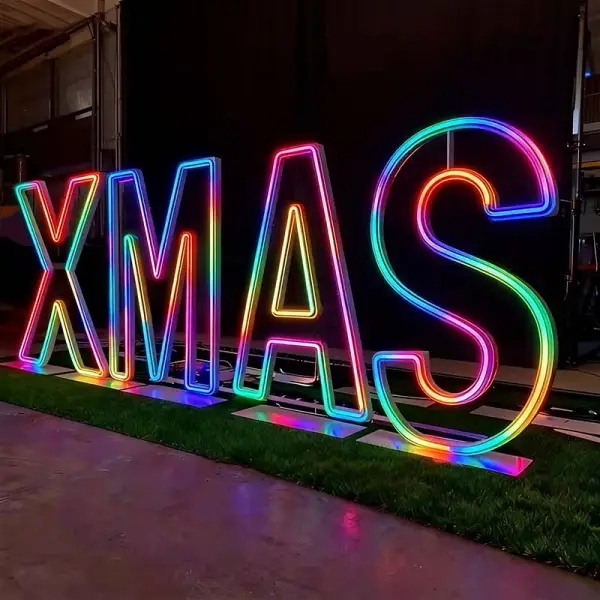
Real photo from our production floor — every sign we ship is made here.
Products mentioned or relevant to this topic — factory-direct, custom built.
From $24/letter · MOQ 1 piece · Flexible lead time · CE & UL certified · ships to 20+ countries
Custom sizes, colors, and finishes. Get a factory price in 24 hours.
Get a Free Quote Copy EmailWhatsApp +86 13865703472 · business@aochuangsign.cn