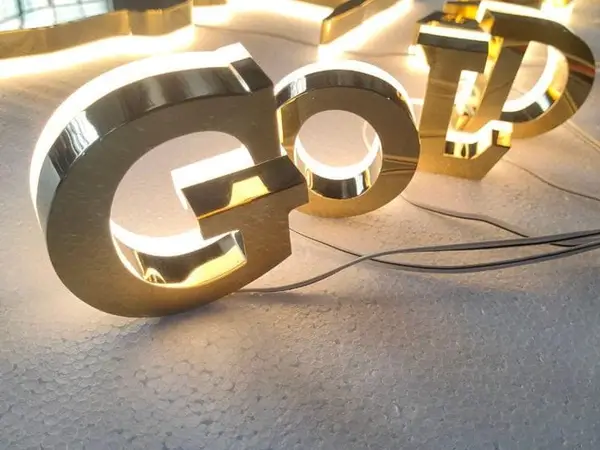
Here’s a truth that’ll save you thousands: most sign shops over-engineer lobby signs. They spec 3mm stainless steel when 1.5mm with a hidden structural backing does the job better. It’s lighter, cheaper to ship, and easier to install. I’ve watched guys wrestle 50-pound letters onto drywall when a 20-pound assembly with a steel spine could have been done in half the time. The difference? Knowing your materials and your factory.
In this guide, I’m pulling back the curtain on custom laser cut metal signs for office lobbies. We’ll cover material selection, cost breakdowns, finishing, lighting integration, and installation best practices. Every number here is real — not marketing fluff. If you’re a sign shop owner, contractor, or commercial buyer importing signage, this is your playbook.
Lobby signs demand precision. A 1mm misalignment on a 10-foot logo is a disaster. Your client’s CEO walks past it every day. So does every visitor. That’s a $50,000 impression — good or bad.
Laser cutting delivers ±0.1mm accuracy. That’s tighter than a human hair. Compare that to waterjet cutting, which hits ±0.2mm to ±0.5mm depending on material thickness. Waterjet also leaves a slightly rougher edge, requiring more post-processing. CNC routing? Fine for wood or acrylic, but on metal, it’s slower and less precise. For complex logos with tight radii and fine serifs, laser is the only game in town.
Here’s the factory-floor reality: at Aochuang Sign, our laser cutters run 1-2 days per job. We use a 10-step process that starts with design approval (1 day) and ends with export packaging. Total lead time: about 5-15 days. That includes laser cutting, bending, welding, grinding, polishing, and a full 8-12 hour aging test before QC. Speed doesn’t mean rushed — it means a streamlined workflow.
The thing is, not all laser cutting is equal. Fiber lasers cut faster and cleaner on reflective metals like brass and copper. CO2 lasers are fine for stainless and aluminum. Always ask your vendor what type they use. A good shop will tell you.
Your material choice determines everything: cost, weight, lifespan, and visual impact. Here’s the breakdown based on real-world performance in commercial lobbies.
| Material | Thickness Range | Outdoor Life | Weight | Cost per Letter (Factory) | Best For |
|---|---|---|---|---|---|
| Stainless 304 | 1.0-3.0mm | 10+ years | 7.93g/cm³ | $15-40 (non-lit) | Corporate lobbies, high-traffic |
| Stainless 316 | 1.0-3.0mm | 15+ years (marine) | ~8.0g/cm³ | $18-48 (20-30% premium over 304) | Coastal or industrial environments |
| Aluminum | 1.0-1.6mm (0.040-0.063") | 8-12 years | 1/3 of steel | $10-25 | Large signs, weight-sensitive mounts |
| Brass | 1.0-3.0mm | 10+ years (with clear coat) | ~8.4g/cm³ | $30-60 | Luxury/hospitality, warm tones |
| Copper | 1.0-2.0mm | 10+ years (patina) | ~8.96g/cm³ | $40-80 | Patina finishes, art deco designs |
For most office lobbies, stainless steel 304 is the sweet spot. It’s durable, corrosion-resistant (18% chromium, 8% nickel), and takes a beautiful brushed #4 finish. If your lobby faces a coastal highway, upgrade to 316 — the 2-3% molybdenum content shrugs off salt spray.
Aluminum is your weight-saver. A 1.0mm aluminum letter weighs about one-third of a 1.0mm stainless letter. That matters on a 6-foot lobby wall where every pound adds to installation labor. Aluminum is naturally rust-proof and can be anodized or powder coated. But it’s softer — don’t go below 1.0mm for any sign over 2 feet tall, or you risk warping.
Brass and copper are for the high-end jobs. They patina naturally, which some clients love. But they cost 2-3x more than stainless. And they scratch easily. I’ve had clients insist on mirror-polished brass, only to complain about fingerprints a week later. Always recommend a clear protective coating for indoor brass or copper.
Finish is where a sign goes from “good” to “damn, that’s quality.” Here’s what I’ve learned from 15 years of factory tours and field failures.
Brushed (#4 finish): The workhorse. A linear grain pattern that hides scratches. Standard on stainless 304. Looks professional in any corporate lobby. Cost: included in most factory pricing.
Mirror (#8 finish): High-gloss, reflective. Stunning for logos with negative space. But it shows every smudge, scratch, and dust particle. Only use in low-touch areas or with a daily cleaning schedule. The client needs to know this upfront.
PVD (Physical Vapor Deposition): A thin-film coating that adds color — gold, bronze, black, even blue. Extremely durable. I’ve seen PVD-coated stainless letters last 8+ years in a mall lobby without fading. But it’s expensive: add 15-25% to material cost.
Powder Coating: The most common way to match corporate Pantone colors. Durable, scratch-resistant, and available in any color. The catch? Color consistency. If your logo uses a specific PMS 2945 blue, you need to send a physical sample to the powder coater. Even then, batch-to-batch variation happens. Always order extra material — 10-15% overage — for touch-ups.
Here’s a hard-won tip: never powder coat stainless steel without a proper pretreatment. The powder won’t bond to the chromium oxide layer. Your factory needs to either sandblast or apply a chemical etch first. Otherwise, that beautiful blue logo will peel in 6 months.
A backlit metal sign in a lobby is a statement piece. But it’s also a technical challenge. You’re cutting through metal to let light pass, then sealing it against dust and moisture.
Here’s the standard approach: laser cut the metal face with the logo pattern, then back it with a translucent acrylic diffuser and LED modules. The metal acts as the mask — light only shines through the cut-out areas. For a halo-lit effect (light glows around the letter edges), you weld a reverse channel behind the metal face and mount LEDs facing inward.
LED selection matters. For lobby installations, use SMD 2835 modules. They deliver 100-150 lumens per watt — industry standard for even, energy-efficient lighting. Color temperature depends on the brand vibe: 3000-3500K (warm) for hospitality, 4000-5000K (neutral) for corporate, 6000-6500K (cool) for industrial or tech lobbies.
Quality LEDs from Samsung or Osram last 5+ years real-world. Cheap modules? 12-18 months, then you’re replacing them behind a sealed sign. At Aochuang, we spec L70-rated LEDs with ≥50,000 hour lifespan. That’s the standard for commercial signage — and it’s backed by a 2-year warranty on LEDs, 1 year on power supply.
The seal is critical. Use neutral silicone — not acidic — to avoid corroding the metal. Then run an 8-12 hour aging test. This catches early failures before the sign ships. I’ve seen shops skip this step. They regret it when a lobby sign goes dark during a CEO’s ribbon-cutting ceremony.
Let’s talk money. If you’re buying from a US sign shop, a front-lit channel letter for a lobby runs $200-700 per letter installed. A halo-lit letter? $400-1,000 per letter. For a 10-letter company name, that’s $4,000 to $10,000.
Factory-direct pricing from a Chinese manufacturer like Aochuang Sign: front-lit letters $20-80 per letter, halo-lit $35-120. That’s a 50-65% savings on product cost. Add shipping and US Section 301 tariff (~30%), and you’re still well ahead.
Here’s a realistic example:
Volume discounts apply. For orders of 50+ letters, expect 10-15% off. For full lobby systems with light boxes, the savings scale even more. Light boxes from factory: $80-250 per square meter. US retail: $400-1,000.
I’ve seen $10,000 signs ruined by $200 installation. Here’s how to avoid that.
Anchoring systems: For drywall, use toggle bolts rated for the sign’s weight. For concrete or brick, use expansion anchors. Never use plastic wall plugs for metal signs over 5 pounds — they’ll pull out. For a 20-pound stainless steel logo, minimum 4 anchors, evenly spaced.
Leveling: Use a laser level, not a bubble level. A 0.5-degree tilt over 8 feet is 0.8 inches off. That’s noticeable. Mark your mounting points with a template — many factories provide one. If not, make one from cardboard before drilling.
Wall protection: Install standoffs (1/2 to 1 inch) to create a shadow gap. This hides wall imperfections and prevents moisture trapping. For backlit signs, standoffs also allow airflow for LED cooling.
Fire codes: NEC Article 600 applies to all electric signs in the US. If your sign has internal wiring, use UL-listed components. UL 48 certification costs $4,000-15,000 and takes 4-9 months. ETL is a valid alternative, 10-30% cheaper. For non-electrical metal signs, no special code — but ADA still applies for tactile signs (mounting height 48-60 inches, non-glare finish, Grade 2 Braille).
Maintenance: Wipe down brushed stainless with a microfiber cloth and mild soap monthly. For powder-coated signs, avoid abrasive cleaners. PVD finishes just need dusting. Budget 30 minutes per year for LED inspections — replace any flickering modules immediately.
1. What is the minimum thickness for a laser-cut metal sign to avoid warping in a lobby?
For stainless steel, never go below 1.0mm (20 gauge) for letters under 2 feet tall. For letters over 2.5 feet, use 1.5mm or thicker. Aluminum warps more easily — stick to 1.2mm minimum for small signs, 1.6mm for large. Warping happens during laser cutting due to heat. A good factory uses water-cooled beds and nitrogen assist gas to minimize thermal distortion. If you’re designing complex shapes with thin sections (e.g., a logo with fine lines), add 0.5mm to the standard thickness. The extra cost is negligible compared to a redo.
2. How do I ensure color consistency when powder-coating laser-cut letters for a corporate logo?
Send a physical color chip — not a digital Pantone reference. Powder coating formulas vary by manufacturer, and screen colors lie. Order 10-15% extra material from the same batch. If the job is critical, ask for a sample coupon (4x4 inch piece cut from the same metal batch, coated with your color). Approve it before production. Also, specify a gloss level (e.g., 60% gloss for corporate, 30% for matte). Gloss affects color perception — a matte version of the same Pantone will look lighter.
3. Can laser-cut metal signs be combined with acrylic or wood for a mixed-material lobby display?
Absolutely. Mixed-material signs are trending. Common combos: stainless steel letters on an acrylic backplate (backlit), or brushed aluminum letters on a walnut wood panel. The key is thermal expansion — metal expands differently than acrylic or wood. Use flexible mounting brackets and avoid rigid adhesives. For LED backlighting, the acrylic diffuser must be UV-stabilized (Mitsubishi/Degussa acrylic: 5-8 years before yellowing; domestic acrylic: 1-2 years). Never cheap out on acrylic for a lobby sign — yellowing looks terrible.
4. What turnaround time should I expect for custom laser-cut metal signs with complex designs?
From a Chinese factory like Aochuang Sign: about 5-15 days total, including design confirmation (1 day), laser cutting (1-2 days), bending/welding (1-2 days), grinding/polishing (1-2 days), acrylic face CNC (1 day), LED assembly (1-2 days), sealing (1 day), aging test (8-12 hours), QC inspection (1 day), and packaging (1 day). Express shipping adds 7-10 days. Air freight: about 10 days. Sea freight: about 65 days. Plan accordingly — lobby installations often have 6-8 week lead times for custom work. Rush orders are possible but add 20-30% to the price.
5. Are there any fire code or safety regulations for metal signs installed in commercial lobbies?
Yes. In the US, NEC Article 600 governs all electric signs. If your sign has internal wiring (LEDs, transformers), it must be UL 48 listed or ETL certified. Non-electric metal signs are exempt from NEC, but local fire codes may require non-combustible materials in exit corridors. Check with the building’s fire marshal. For ADA compliance: if the sign includes tactile elements (e.g., raised letters for accessibility), mounting height must be 48-60 inches from the floor, with non-glare finish and Grade 2 Braille. Also, ensure the sign doesn’t protrude more than 4 inches from the wall in circulation paths — that’s a tripping hazard.

Real photo from our production floor — every sign we ship is made here.
Products mentioned or relevant to this topic — factory-direct, custom built.
From $24/letter · MOQ 1 piece · Flexible lead time · CE & UL certified · ships to 20+ countries
Custom sizes, colors, and finishes. Get a factory price in 24 hours.
Get a Free Quote Copy EmailWhatsApp +86 13865703472 · business@aochuangsign.cn
See pricing, specs, and get a free quote for the sign type you need. Built in our factory, shipped worldwide.