I've been in sign fabrication since 1998. Twenty-seven years of calloused hands and arguments with LED suppliers. When I hear a factory claim “MOQ 1 piece,” my first thought is always: what's the catch? Usually it's a bait-and-switch. They'll quote you one letter at $45, then hit you with a $200 “custom engineering fee” before the CNC even powers up. Not here.
Aochuang Sign has a genuine 1-piece minimum order. Why? Because we built our floor for short runs. Our laser cutters switch CAD files in under two minutes. We don't batch letters like a giant screen printer; we treat each order like its own project. That's the factory reality, not marketing fluff. Our facility in Lu'an runs 3,000 square meters with 50-plus workers who are just as comfortable welding a single 16-inch stainless steel letter as they are a full 200-piece corporate sign package.
Look, I'm not saying every order should be one piece. You'll pay more per letter on a single unit than you would on 10 because setup time is fixed. But if you're a sign shop trying to satisfy a picky restaurant owner who only needs one back-lit address number, or an importer testing a new design sample before committing to a container, we won't turn you away. We'll send it out in 7 to 15 days just like any other job.
The ugly truth is most so-called 1-piece MOQ factories are trading companies operating from a Guangzhou office with a laptop and a phone. They don't own a single bending brake. They take your order, mark it up 40%, and forward it to guys like us. The product they ship is real, but the accountability isn't. When an acrylic face yellows in 12 months, they've already changed their WeChat name.
We're the factory floor. I can walk out of my office right now and watch someone TIG-weld a 304 stainless steel return on a front-lit channel letter. The acrylic we use for faces isn't the cheap domestic stuff that starts looking like old teeth after two years. Our UV-resistant Mitsubishi and Degussa acrylic holds 90-92% light transmittance and stays clear for five to eight years outdoors. That's a fact backed by material data sheets, not a promise from a salesman who's never smelled methyl methacrylate.
I've seen this go wrong: a contractor in Dallas ordered ten rimless channel letters from a “low MOQ” website. Three months later, the LEDs started flickering like a disco. He opened a return to find unbranded chip-on-board modules with no conformal coating. The cost to remove, rewire, and reinstall those letters was triple what he saved. Buy from a factory that will show you the LED reel labels. We use SMD 2835 modules from Samsung, Osram, or Lanjing with an L70 rating of 50,000 hours. The real-world lifespan? Five-plus years. The cheap stuff dies in 12 to 18 months.
Here's what nobody tells you: factory-direct pricing on a single letter is not a magic bullet, but it's still 50-65% below what a US sign company charges installed. I'll give you the real numbers from our floor.
A basic front-lit channel letter, 12 inches tall, stainless steel 304 return, 3mm UV acrylic face, white LED illumination. Factory price: $40-$55. That same letter, installed in a Chicago strip mall, retails for $200-$400. A premium back-lit halo letter of the same size, with standoff mounts, clear acrylic face, and rear LED illumination runs $65-$100 from us. Installed, it's a $400-$700 job. For a full set of ten back-lit letters reading “BOUTIQUE,” you're looking at $650-$1,000 ex-factory versus $4,000-$7,000 from a local installer.
Metal letters without lighting are cheaper. 304 stainless steel fabricated letters, 0.5mm to 1.5mm thick, brushed or mirror finish, start at $15 for a small 8-inch letter and go up to $40 for a 24-inch polished behemoth. Aluminum letters, which weigh a third of steel and are naturally rust-proof, cost $10-$25 per letter. If you're in a coastal area, I always recommend springing for 316 stainless. It adds 20-30% to the material cost, but the molybdenum content means your sign won't pit after three seasons of salt spray. For Miami Beach, that's not an upsell; it's a necessity.
Don't forget light boxes. A single acrylic light box, 2m x 1m, with internal LED strips and a UV-printed face, costs $80-$120 per square meter from us. If you only need one, we'll crate it and ship it. The MOQ doesn't change just because it's a big piece.
CE marking: 20,000 to 50,000 RMB, 2-8 weeks to obtain. I've watched factories put a CE sticker on a power supply that never passed an EMC test. Ask for the certificate with today's date and the testing lab's contact info. We have it, valid and current.
UL 48, the standard for electric signs in the US, is a different beast. It costs $4,000-$15,000 to certify, takes 4 to 9 months, and requires quarterly factory audits. I'll be brutally honest: if you order one custom LED sign, modifying the design to comply with UL 48's component spacing rules adds time and cost. We can do it, but for a single non-standard letter, a full UL sticker might double your lead time. For anything going into a national chain or a city with a strict electrical inspector, UL or ETL (the cheaper alternative, about 20-30% less) is non-negotiable. Tell us upfront what your inspector requires, and we'll tell you if it's worth it for one piece.
IP ratings are another lie I smell every week. IP65 means the enclosure is dust-tight and protected against water jets. It does not mean your sign survives a Florida hurricane or being submerged. If your client is on a beachfront, ask for IP66 minimum: protection from powerful jets. For a sign that might face temporary flooding, IP68 submersible rating. I've had a customer mount an IP65 sign on a rooftop in Vancouver. Six months later, driving rain rotted the internal connections because the weep holes were drilled wrong. Pay for the right rating, not the marketing.
Our production line doesn't stop for one letter. It adapts. Here's the exact sequence, every time, no shortcuts.
Day one: you send artwork and dimensions. Our engineer confirms vectors and material specs within 24 hours. Laser cutting starts immediately. Our CNC laser cuts stainless steel or aluminum to ±0.1mm tolerance. For a single letter, cutting finishes in half a day. Bending and TIG welding take another day. Grinding and polishing the returns to a brushed finish? Another day. The acrylic face is router-cut on a CNC, then fitted into the letter can. LED assembly and wiring follow, with all solder joints heat-shrunk and sealed. The whole module gets bedded in neutral-cure silicone and left to cure. Then every single sign, even a lone 6-inch letter, goes through an 8-12 hour aging test where we power-cycle the LEDs continuously. A 100% visual QC inspection happens under shop lights and again under UV light. Foam, carton, then plywood crate. The process takes 7 days minimum, 15 days max. It's the exact same rigor for one piece or one hundred.
I've seen this go wrong: a startup asked us to rush a single back-lit “X” logo letter for a tradeshow. They wanted 3-day turnaround. I refused. You can't cheat the silicone cure time or aging test. The LED adhesive has to off-gas. You'll get a letter that looks perfect and fails inside a month. I'd rather lose the order than ship a ticking time bomb.
Look, a 5kg package of one medium channel letter can go express via DHL or FedEx for $30-$100 depending on box dimensions. That's door-to-door in about 5-15 days. If you're ordering a single large sign, say a 1.5m acrylic light box, express becomes insane. You'll want air freight at $4-$12 per kg, arriving in about 10 days. For a crate that size, budget $150-$300. Sea freight is for full pallets and containers. LCL (less than container load) runs $80-$200 per cubic meter, but transit takes about 65 days to the US West Coast. A single letter via sea is a terrible idea; the consolidation fees will eat you alive. Trust me on that.
And yes, the US Section 301 tariff on Chinese signs is still about 30%. That's on the declared value, not retail. On a $50 letter, you're paying $15 duty. Build that into your landed cost, and don't let anyone tell you “no duties, we mark it as a gift.” That's customs fraud, and it'll get your shipment seized.
We manufacture in Lu'an, Anhui, exporting worldwide. Our logistics team knows exactly what HS codes to use, what valuation documentation US customs wants, and how to package a single fragile letter so it survives a FedEx driver's Monday morning. I've shipped one aluminum letter to a contractor in Omaha. It arrived in eight days, no dings, no drama.
Mistake one: choosing cool 6000K white for a law firm's lobby. 6000-6500K is for industrial parks and highway signs. It's harsh, blue-white. Use 3000-3500K warm white for hospitality or 4000-5000K neutral white for corporate and retail. Your client might not know the difference until their $30,000 renovation looks like a tire shop at night. I always ask where the sign is going and what feeling they want before quoting a color temperature.
Mistake two: spec'ing 2mm acrylic on a letter over 2.5 meters wide. It'll sag and crack. Anything above that height gets 5mm minimum. I don't care if it saves you $12. The face will fail, and you'll be back on the phone in two years, and I'll be saying “told you so” but in a way that still costs you money.
Mistake three: believing every factory that says “yes we can do ADA tactile signs.” ADA-compliant interior wayfinding signs need Grade 2 Braille, non-glare finish, and precise mounting heights (48-60 inches). If a factory sends you a quick quote without asking for finish specs, access symbols, or state addenda, they've never cut Braille beads on a router. We have, and we're honest when a custom design pushes the bounds of compliance.
Buying one custom LED sign from a manufacturer like Aochuang is smart when you're replacing a broken letter, testing a new material sample for a restaurant group, or creating a prototype for a franchise brand. The savings hold, and you get the same build quality as a bulk order. It's also smart when your client has a weird architectural requirement—like a single 316 stainless halo number for a condo entrance—that local shops price like a moon landing.
It's dumb if you're buying one letter now and three more next month, paying separate shipping and brokerage each time. Combine the order if you can. Even a set of three letters gets better per-unit pricing because we only set up the bending jigs once. I'll tell you that straight, even if it means less frequent but larger invoices for us. I'm not here to bleed you on logistics fees.
We can't provide a UL 48 sticker on a one-off, non-standard letter in seven days. We can't beat a local sign shop's speed if you need the sign installed tomorrow morning. We can't control your import duties, and we can't guarantee that a $20 single-letter order shipped via sea freight will arrive without costing more than it's worth. We also can't fix a design that has 2-inch letter strokes and expects IP68 rated illumination—physics says no.
We also can't read your mind. If your drawing says “red” but you meant PMS 186C, say so. Our powder coating and painting team can match RAL, Pantone, or physical color chips, but they need a target. On one-piece orders, I've seen clients get sloppy with specs because “it's just one letter.” That's when mistakes happen. Send a vector file, specify the material, the LED color temp, the mounting type, and the required IP rating. Do that, and a single piece leaves our factory cleaner than most bulk orders from competitors who slash quality to pad margins.
Look, I've got nothing to hide. You want one custom front-lit channel letter with Samsung LEDs, 304 stainless returns, UV acrylic face, IP65 silicone seal, crated and shipped to Ohio. I'll quote you $48 plus shipping. You want ten, the price drops to $38 each. You want one back-lit halo letter in 316 stainless for a coastal hotel, I'll quote $95-$120, and it'll last 15 years. Our 2-year warranty on LEDs and 1-year on power supplies is standard, not a sales trick. If a module fails within that period, we ship replacements at our cost. I've worked on factory floors where warranty meant “good luck.” I don't run that kind of shop.
We are not the cheapest. There's always a factory in a back alley that will quote $12 for an aluminum letter with LEDs that flicker before the invoice clears. We are the factory that picks up the phone when the sign arrives and you want to verify mounting patterns. I'm 52 years old, burned my hands on acrylic plenty of times, and I stand behind every sign that leaves this building—even if it's just a single letter “J” for a boutique named Josephine. That's what a real MOQ 1 piece factory looks like.
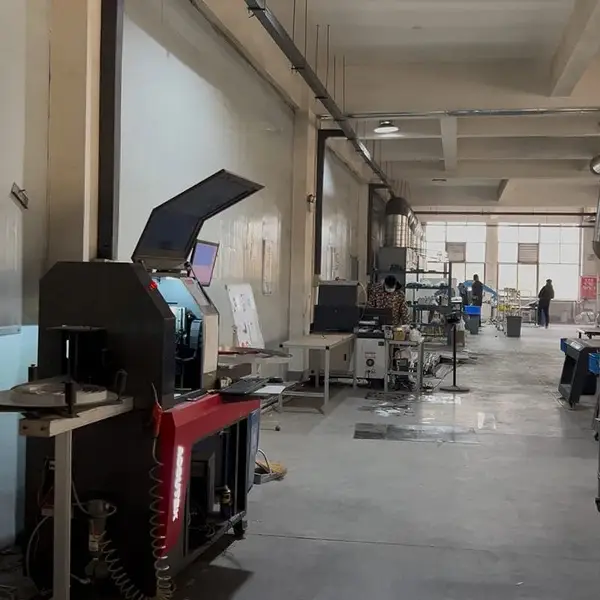
Real photo from our production floor — every sign we ship is made here.
From $24/letter · MOQ 1 piece · Flexible lead time · CE & UL certified · ships to 20+ countries
Custom sizes, colors, and finishes. Get a factory price in 24 hours.
Get a Free Quote Copy EmailWhatsApp +86 13865703472 · business@aochuangsign.cn
See pricing, specs, and get a free quote for the sign type you need. Built in our factory, shipped worldwide.