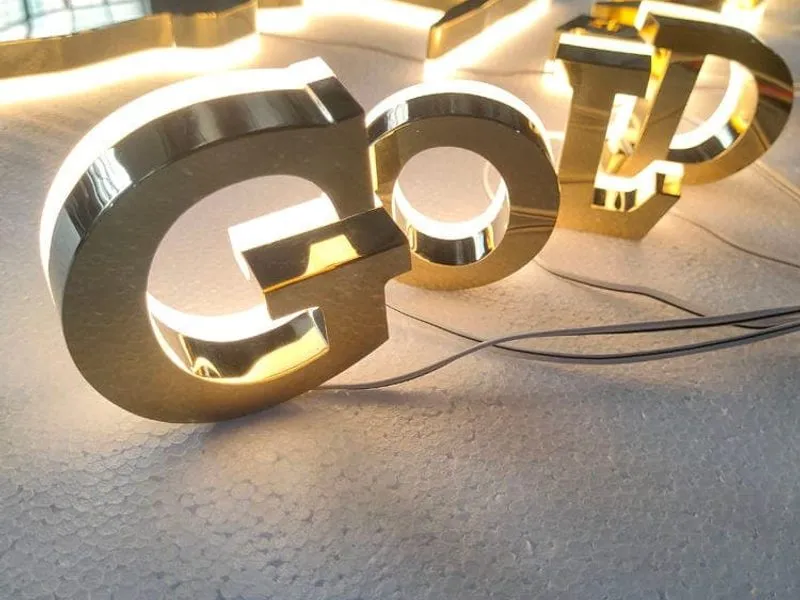
Let's cut the crap. You're here because you're tired of paying retail markup for metal letters. Maybe you've already priced out a job and choked on the quote. Or maybe you've been burned by a broker who promised one thing and delivered another.
I've spent 16 years in this industry. I've watched sign shops pay $800 for a single front-lit letter that we ship for $120. Same 304 stainless. Same Samsung LEDs. The only difference was a middleman taking 60% for doing nothing but forwarding a file.
Here's what nobody tells you: buying custom metal signs online factory direct is smart. But doing it wrong will cost you more than the markup ever would. You need to know exactly what you're getting into before you wire money to the other side of the planet.
This isn't a sales pitch. It's a field guide from someone who's been on the factory floor, welded your letters, tested your LEDs, and packed your crates.
Factory direct saves you 50-65% on product cost. That's not a gimmick, that's the reality of cutting out distributors who slap their logo on the paperwork and triple the price.
But it only works if you're buying the right thing. If you need one custom logo piece with hand-finished details and a week to do it, buy local. If you're outfitting a strip mall with 40 channel letters, factory direct makes you the smartest person on the job.
The buyers who succeed treat their factory like a partner. They send clear files, ask the right questions, and understand that a factory in China can't read minds.
Let's break down the two workhorses of the metal letter world, because these are what you'll order most.
Stainless steel letters are the gold standard for outdoor durability. We're talking 304 grade — 18% chromium, 8% nickel — that shrugs off rain, snow, and direct sun for a decade plus. The #4 brushed finish is what you see on most high-end storefronts. The #8 mirror finish is the bling option that costs a bit more but turns heads.For coastal jobs, you need 316 grade. The 2-3% molybdenum makes it nearly bulletproof against salt corrosion. It runs 20-30% more than 304, but if you're installing near the ocean, that's not a luxury, it's a requirement.
Aluminum letters are the budget-smart choice. They weigh one-third of steel, so shipping drops dramatically. They're naturally rust-proof, last 8-12 years outdoors, and mate powder coating beautifully. For interior signs or shorter-term exterior jobs, aluminum gets it done without bleeding your budget.The honest breakdown:
Factory direct pricing per letter, all in:
Compare that to US retail installed prices of $200-700 per letter for front-lit and $400-1,000 for halo-lit. I've seen flagpole signs sell for more than an entire restaurant sign package costs factory direct.
The minimum order is one piece. Not fifty, not ten. One. If you need two stainless letters for a lobby wall, we'll make them.
Here's what nobody tells you: the quoted product price is only half the equation. Shipping will bite you if you're not prepared.
Your three options:
Express: 7-10 days, $30-100 for small packages. This is for samples and small logo pieces that fit in a box. Air freight: about 10 days, $4-12 per kilogram. The sweet spot for mid-size orders. If you're doing a storefront package that weighs 50kg, budget $200-600. Sea freight: about 65 days, $80-200 per cubic meter for LCL (less than container load). Full containers run $1,200-3,000. This only makes sense for huge orders or regular volume.Here's the kicker: US Section 301 tariffs add roughly 30% to your landed cost. That's a hard number. Plan for it or get blindsided.
A full stainless steel letter package for a typical storefront — say 10 letters, non-lit — weighs 30-60kg. Air freight lands you at $175-650. That's real money, but spread across the life of a sign that lasts a decade, it's pennies a day.
There's a dirty little secret in this industry: some factories quote you 304 stainless and ship you 201. They look similar, they cost less, and they rust in two years. I've seen it go wrong.
Ask any factory for their material certs. If they can't produce mill certificates with the heat number and exact composition, walk away. It's that simple.
For acrylic, the difference between Mitsubishi or Degussa and domestic Chinese material is night and day. The premium stuff transmits 90-92% of light and resists UV for 5-8 years. Cheap domestic acrylic starts yellowing in 12-24 months. A sign that looks dingy in year two is a sign that gets replaced in year three — and a client who doesn't pay their invoice in year six.
If you're ordering front-lit channel letters, insist on the good acrylic. The cost difference is maybe 10-15%. The lifespan difference is 400%.
The ugly truth is LED quality is a lottery unless you buy by spec, not by promise.
Real quality modules from Samsung, Osram, or Lan Jing run at L70 for 50,000 hours. That's five-plus years at typical usage. Cheap modules with no brand name die in 12-18 months.
SMD 2835 chips deliver 100-150 lumens per watt — that's your industry standard. SMD 5730 chips are brighter, hitting 40-60 lumens per chip, but they run hotter and need proper heat management.
Here's what I tell every customer: ask for the module datasheet. If the factory can't show you a spec sheet with lumen output, color temperature, and L70 ratings from the chip manufacturer, you're buying a mystery.
For our factory, it's simple: we use quality modules, we offer a 2-year warranty on LEDs and 1-year on power supplies, and we mean it. Cheap factories don't warrant anything because they know the failure rate.
CE marking costs 20,000-50,000 RMB and takes 2-8 weeks. Guess how many factories fake it? A lot. Ask to see their certificate with the current date and their actual factory name. Not their export company. Their factory.
For the US market, UL 48 is the big one for signs. But here's what nobody tells you: UL listing costs $4,000-15,000 and takes 4-9 months. It also requires quarterly factory audits where UL reps come and inspect your production line. Only serious factories go through that. ETL (Intertek) is a legitimate alternative that runs 10-30% cheaper, and most US inspectors accept it.
The ones you actually need for outdoor:
You want IP65 minimum. Trust me, I've watched clients cheap out on this and call back crying when the sign shorts out after the first thunderstorm.
For US electrical work, make sure your contractor follows NEC Article 600. The sign can be perfect but if the wiring isn't code, it doesn't matter.
If you're doing ADA-compliant signs, remember: tactile letters at 48-60 inches mounting height, non-glare finish, Grade 2 Braille. These are the rules, not suggestions.
Our process takes about 5-15 days total. Here's where your money actually goes:
That aging test is critical. Cheap factories skip it. They ship signs that die on your install day, and then you blame yourself. We burn them in so we don't have to hear from you later.
Here's what nobody tells you: buying direct means you're the project manager. We're the factory. We make good signs, fast. We don't hold your hand through permitting, installation, or code inspections.
We cannot:
If you're a sign shop owner, that's fine — you already handle that stuff. If you're a business owner buying for your own store, budget for a local installer who knows the drill.
First: ordering without samples. If you're doing a brand-critical installation, spend $30-100 on express freight for a sample letter. You'll see the welding, the finish, the polish. This isn't an option, it's a requirement.
Second: communicating in vague wishes. "Make it look premium" means nothing to a production manager. "304 stainless with #4 brushed finish, 1.2mm thickness, 5mm return depth, 2mm acrylic face" means everything.
Third: trusting the pretty quote. The cheapest quote is cheap for a reason. Downgraded materials, thinner gauges, no aging test, domestic acrylic. It'll cost you clients and callbacks.
Fourth: forgetting about the return depth. A 10mm deep letter looks cheap. A 30mm deep letter looks premium. The difference in manufacturing cost is minimal. The difference in perceived value is massive.
Fifth: ignoring environmental conditions. Miami Beach needs 316 stainless. Phoenix needs UV-cured inks on your acrylic. Chicago needs seals that handle freeze-thaw cycles. Buy for your climate.
Here's what I tell every customer before they send a file:
Keep it simple. A standard commercial font with clean lines cuts faster, welds cleaner, and paints better than a script with tiny connections. Intricate letterforms with thin bridges are the plastic surgery of the sign world — you might like them, but they're fragile and they'll break.
Use a vector file (AI, PDF, EPS, CDR) with fonts converted to curves. If you send a JPEG, your letters will have jagged edges you'll blame us for.
For stainless letters, brushed #4 finish is the sweet spot between looks and maintenance. Mirror finish (#8) looks incredible for about six months, then shows every fingerprint, smudge, and water spot. PVD and powder coating options last longer and let you match brand colors.
Fabricated 3D letters with returns give you that dimensional depth that makes signs look expensive. We call it "wow factor." A 20mm deep letter versus a 4mm flat cut letter can double your perceived value without doubling your cost.
If you're looking for that illuminated premium look, check out back-lit halo letters. That silhouette effect against dark materials looks high-end and the technology is definitely proven. Your customers see it and think "money." That's what halo lighting says.
You can find a thousand factories on Alibaba. That's not the same as getting quality factory-direct work.
I've had clients tell me about their Alibaba adventures like they're war stories. Bad welding. Thin metal. Packaging that looks like a kid wrapped it.
Here's the thing: we export worldwide. We have certifications. We have a physical manufacturing facility at 3,000 m² with over 50 skilled workers. We show you the actual factory, not a showroom.
Send me a serious inquiry and I'll send you our real product catalog with real pricing. Start small if you're uncertain — three letters, five letters, a test order. We've been at this since 2010 because we understand that trust is earned, not assumed.
The ugly truth is this market is full of traps. But the good news is that the people who do their homework get an incredible deal.
You can get custom metal signs that cost 50-65% less than retail, last a decade or more, and look every bit as good as the premium local shop's work. The ones who win are the ones who:
The ones who lose are the ones who chase the cheapest quote, skip samples, and trust pretty promises over hard specs.
We make 10,000 square feet of signs every month. We ship around the world. Our letters are on storefronts from New York to Dubai. We're not the cheapest and we're not the most expensive — we're the factory that knows what it's doing and it pays off for our clients.
The sign business is about building trust with your customers. Trust us to build your letters, and you'll have trust to sell your sign.
Send us your file. We'll show you exactly what's possible — and exactly what it costs. No surprises, no marketing fluff, just straight answers from people who've been welding metal since before you probably owned a smartphone..

Real photo from our production floor — every sign we ship is made here.
Products mentioned or relevant to this topic — factory-direct, custom built.
From $24/letter · MOQ 1 piece · Flexible lead time · CE & UL certified · ships to 20+ countries
Custom sizes, colors, and finishes. Get a factory price in 24 hours.
Get a Free Quote Copy EmailWhatsApp +86 13865703472 · business@aochuangsign.cn
See pricing, specs, and get a free quote for the sign type you need. Built in our factory, shipped worldwide.