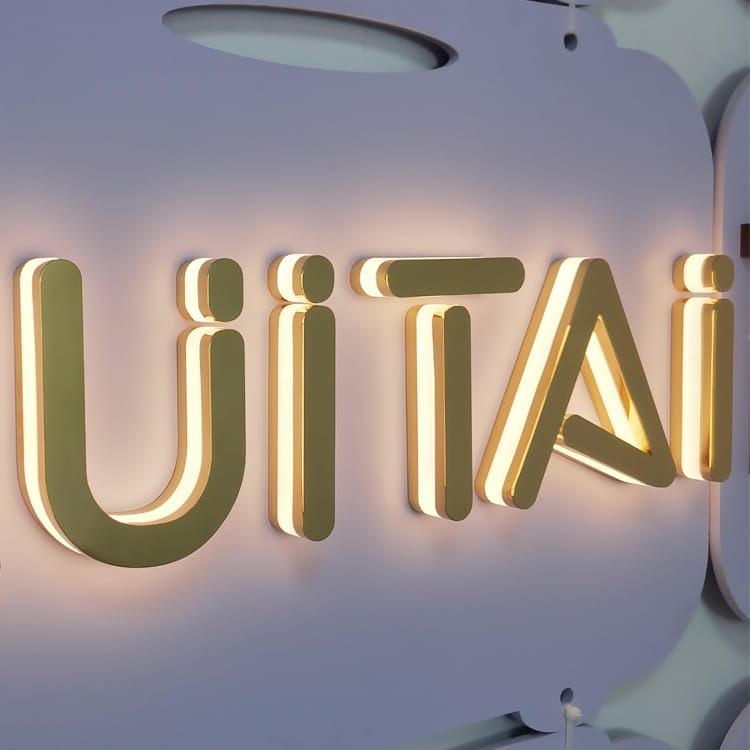
The ugly truth is most sign buyers are overpaying by at least 50 percent. I've spent 16 years on the factory floor — 13 of those in China running Aochuang Sign — and I've watched US sign shop owners buy the exact same letters we manufacture at a fraction of what they pay domestic fabricators. The difference isn't quality. It's knowing how factory direct pricing actually works and how to negotiate without being an asshole.
Here's what nobody tells you: the price a Chinese factory quotes you is never the final number. Shipping, tariffs, wire transfers, and your own specification gaps always add 10-20% on top. You need to plan for that before you get excited about a $40 letter.
But the savings are real. I'll show you what to ask for, what to avoid, and exactly where the money hides.
How Factory Direct Pricing Actually Works
The factory quote covers three things: materials, labor, and factory overhead. That's it. There's no US sales rep commission, no showroom rent, no middleman markup. The same front-lit channel letter that costs $200-700 installed in the US leaves our floor for $20-80. That isn't a trick. It's a completely different economic model.
Look, when you buy factory direct, you're not paying for a brand. You're paying for raw materials, a skilled worker's hourly wage, and a slice of the electricity bill. A 304 stainless steel letter with brushed finish costs us roughly $2-4 per inch depending on thickness. A back-lit halo letter runs $35-120 because of the extra acrylic, LED channel, and two-stage welding.
Most buyers don't understand that the factory quote is not a starting haggling point. It's a calculated number with maybe 10-15% profit margin. If you kick it down 30% out of habit, you're either getting a worse product or you're about to be ghosted.
What You're Actually Paying For
Let's break down a typical order of
front-lit channel letters so you see where the money goes.
Material costs:
- Aluminum backing: $10-25 per letter
- 3mm acrylic face: $5-15 depending on size and UV resistance
- LED modules (Samsung or Osram): $8-20 per letter
- Transformers, wiring, clips: $3-8 per letter
- Neutral silicone sealant, screws, packaging: $2-5 per letter
Labor costs:
- Laser cutting: $2-4 per letter
- Bending, welding, grinding: $5-10 per letter
- Acrylic CNC routing: $1-2 per letter
- LED assembly and wiring: $3-6 per letter
- Sealing and testing: $2-3 per letter
Add it up. A decent 12-inch front-lit letter costs us around $30-50. We quote you $45-60. The same letter from a US shop runs $200-600 because their overhead is brutal — shop rent, taxes, health insurance, a sales guy on commission, and a 40% gross margin to stay alive.
Here's a hard number: factory direct savings on product typically run 50-65% versus US wholesale. But you're trading some of that back in freight and customs.
Shipping and tariffs are where most buyers lose their savings. Express courier for small samples costs $30-100 and arrives in 7-10 days. Air freight is $4-12 per kilogram and takes about 10 days. Sea freight is $80-200 per cubic meter LCL and takes about 65 days. A full container runs $1,200-3,000. And the US Section 301 tariff currently adds about 30% on top of your product value.
Here's what nobody tells you: you can often ship larger letters knocked down (KD) to save on volume. That means the letters ship flat and you assemble them on site. It's a pain, but it can cut sea freight cost by half.
What Really Drives the Price Up
Materials are the biggest variable. I've seen too many sign buyers specify "stainless steel" without saying which grade. You get what you pay for.
-
Stainless steel letters in 304 grade with 18% chromium and 8% nickel are fine for a strip mall in Ohio. Ten-year outdoor life. Brushed #4 or mirror #8 finish.
- 316 stainless has 2-3% molybdenum and costs 20-30% more. That's for Miami Beach, coastal towns, or anywhere they salt the roads. Fifteen-year life. If you don't need it, don't pay for it.
-
Aluminum letters are one-third the weight of steel, rust-proof naturally, and run $10-25 per letter. For interior signs or dry climates, they're a no-brainer.
LED quality is another trap. Industry standard SMD 2835 modules give you 100-150 lumens per watt. Genuine Samsung or Osram modules last 5+ years at L70. That's 50,000 hours of light. Cheap modules will start fading in 12-18 months. You'll see the difference in the warranty.
Our standard warranty: 2 years on LEDs, 1 year on power supplies. If you want 5 years on LEDs, that's a premium. Ask for it explicitly. Don't assume.
Negotiation Tactics That Actually Work
The worst way to negotiate with a factory is to send an aggressive email with a lowball price and no context. We get those daily. They go in the recycled folder.
Negotiating well is about information.
First, get multiple quotes from different factories — but send the exact same spec sheet to every one. Same dimensions, same materials, same LED brand, same packaging, same quantity. If you change the spec, you're comparing apples and oranges, and the negotiation game is lost before you start.
Second, ask the factory to break down the quote by material, labor, and shipping. If they won't, that's a red flag. A transparent factory will show you where the cost sits. Use that breakdown to decide where you can compromise. For example, if your big cost is a 5mm acrylic face, ask if 3mm works for your size. On a letter under 2.5 meters, it usually does.
Third, consolidate your order. One order of 20 letters always costs less per piece than five orders of four letters. Tooling, setup, and paperwork don't scale linearly. Factories are happy to discount 10-15% for a larger single order.
Fourth, time your order around factory holidays. Chinese New Year is a disaster for lead times. But January before the holiday or March after — you'll get better attention and faster handling. Factories are desperate to fill capacity in February and March.
Here's a story: A contractor in Texas once called me with a spec for 12 back-lit halo letters. He'd been quoted $1,200 per letter by a US shop. He sent me his drawings, asked for a material breakdown, and mentioned he'd already ordered from us before (he hadn't). I quoted him $180 per letter. He came back saying "other factory quoted $140." I knew my numbers. I told him to ask the other factory for the LED module datasheet and whether they use UV-resistant acrylic. He came back next week and ordered from us at $170. The cheaper quote was using domestic acrylic that yellows in 18 months.
The negotiation wasn't about me matching $140. It was about showing him the cost of quality.
Negotiation Tactics That Waste Everyone's Time
Skip the "future big orders" lie. Every factory has heard "if this batch goes well, we'll be ordering thousands." We all know that's a fantasy. Don't use it as a bargaining chip. Instead, say "we'll need repeat orders monthly if this works." That's believable. And if you actually build a relationship, you'll get better pricing over time.
Don't ask for free samples of a full-size letter. That's ridiculous. A small sample with the same materials and finish is enough to judge quality. We'll make you a 6-inch sample for the cost of shipping and materials, then deduct it from your first order. That's standard.
Don't expect a big discount on a one-off 3-letter job. The factory still has to program the laser cutter, do the acrylic tooling, and run the assembly line. Minimum profit per order is the same whether it's 1 letter or 50. Be realistic.
Common Rookie Mistakes — Brutal Honesty Edition
I've seen this go wrong more times than I can count: a buyer sends us a photo of an existing sign, says "make me this," and then gets upset when the finished letters don't match. Photographs don't show depth, material thickness, LED color temperature, or spacing. You need actual vector files or at minimum a dimensioned drawing.
Here's another lie the industry pushes: "IP65 is outdoor-rated, so your sign will survive anything." IP65 means dust-tight and protected against water jets. It does NOT mean hurricane-proof, or that water won't condense inside over time. For coastal areas, you need IP66 at a minimum. For submersion, IP68. I've seen a $40,000 exterior sign fail in two years because the buyer saved $200 on waterproofing.
And a third rookie mistake: ignoring the aging test. Every good factory runs 8-12 hours of burn-in on the LEDs and checks for solder failures. Ask about it. If the factory can't tell you how they test, they don't test.
When Factory Direct Is NOT the Right Move
I'll be straight with you. There are situations where you should absolutely not buy from China.
Urgency is one. If you need a sign in 3 days, factory direct is dead on arrival. Our standard lead time is about 5-15 days, plus shipping. That can stretch to 25 days with sea freight on a tight schedule. If your sign has to be in the ground before the store opens next Friday, buy local.
Another is complex permitting. If you're dealing with a US municipality that requires UL 48 certification, you have to ask for it specifically. The UL listing costs $4,000-15,000 and takes 4-9 months, plus quarterly factory audits. Few Chinese factories have it. ETL is an accepted alternative, 10-30% cheaper, but not every local inspector accepts it. Check before ordering.
Also, if you can't write a clean spec sheet, don't go overseas. Language barriers will eat you alive. You need to communicate thickness, finish, LED color temperature, mounting method, and power requirements in writing. We provide templates, but you need the basics.
And don't order
back-lit halo letters for a first project if you've never installed them. The wiring and mounting require some skill. If you're a sign shop owner, fine. If you're a business owner trying to save money by managing the install yourself, you'll probably end up paying more in electrician costs than you saved on the letters.
What You Should Expect to Pay (2025 Reality Check)
Factory-direct price ranges per letter, from a China factory with decent materials:
- Front-lit acrylic/clamp letters: $20-80
- Back-lit halo: $35-120
- Stainless steel non-lit: $15-40
- 3D fabricated (welded, brushed, painted): $40-120
- Aluminum non-lit: $10-25
- Light boxes: $80-250 per square meter
- Neon flex signs: $30-200 complete
In the US, installed retail runs $200-700 per front-lit letter and $400-1,000 per halo letter. So even after freight, customs, and your markup, you're looking at saving 30-50% on total project cost. That's not chump change.
But don't forget the tariff. On a $2,000 order, the Section 301 tariff adds about $600. On a $10,000 order, that's $3,000. The best way to manage this is to make sure your invoice value is declared accurately. Don't ask the factory to under-invoice. That's fraud, and customs sniff it out quickly.
How to Ask for a Quote That Gets You the Right Price
Send me a spec sheet that includes these seven things:
1. Type of sign (channel letter, halo, light box, etc.)
2. Letter height and depth (in inches or cm)
3. Font style or vector file (PDF, AI, or CorelDraw)
4. Material (stainless 304/316, aluminum, acrylic — specify thickness)
5. LED brand if you care (Samsung, Osram, or generic) and color temperature (3000K warm, 4000-5000K neutral, 6000-6500K cool)
6. Quantity (obviously)
7. Destination country and whether you need UL/CE/RoHS
The more precise you are, the less time we spend quoting and the better price you get. Vague inquiries get treated like tire kickers. Specific inquiries get priority.
Acrylic light boxes are a different animal. For those, you need to specify the frame depth, light source, and whether it's single or double-sided. It's not just a "light box." It's an engineering spec.
The Real Secret: Relationships, Not Haggling
I've watched this industry for 16 years. Factories don't have loyalty to a first-time buyer who squeezes every penny. They have loyalty to a repeat customer who pays on time, communicates clearly, and calls out problems politely.
Here's what nobody tells you: if you become a sticky customer — two or three orders a year — the factory will start making suggestions that save you money. We'll tell you "this LED module is overkill for interior," or "you can drop the backing from 2mm to 1.5mm without losing structural strength." That's when the real savings start.
Long-term customers also skip small fees. Rush orders, extra packaging, custom sizing — it's all negotiable when you have history. But you don't get there by lowballing on the first contract.
So treat the first order like a tryout. You're testing our quality, lead time, and communication. We're testing your payment reliability and honesty. Split the initial batch into two smaller orders if you're unsure. We allow a 1-piece MOQ specifically so you can evaluate a
neon flex sign or a letter at low risk.
Final Advice From a Factory Owner Who's Seen It All
Stop thinking of factory direct as a gamble. It's a supply chain decision that needs the same due diligence as any vendor. Check certifications. Ask for real photos — not glamour shots, but photos of the production floor with your product in progress. We send those daily. Ask for a video call if you're placing a big order. We do that too.
Look, if you're a sign shop owner, factory direct isn't a threat to your business. It's your margin. I've seen shops double their profit by importing the letters and focusing their own labor on installation, permits, and service.
The only buyers who lose money are the ones who chase the cheapest price, ignore specs, and expect Chinese factories to read their minds. Don't be that buyer. Give me a clean spec, agree on a fair price, and I'll bet you'll still be ordering from us in five years. That's not marketing. That's how the industry works when both sides stop playing games.