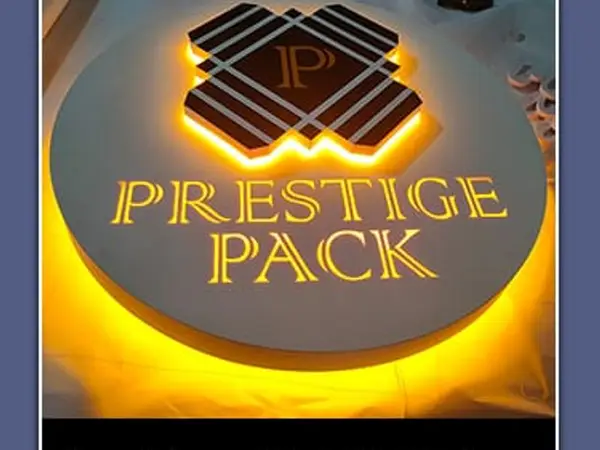
Here's what nobody tells you: the front-lit
channel letters you're sourcing through a US broker carry a 50-65% markup. That's not the broker being greedy. That's the reality of a distribution chain that runs through three or four hands before the letters hit your job site.
The ugly truth is: most sign shop owners have never actually priced factory direct. They've priced "factory direct" through a company that claims to be a factory but is really a trading company with a website and a fake warehouse photo. Trading companies aren't evil. Some do good work. But if you're serious about cutting your cost per letter, you need to know who's actually doing your cutting, bending, welding, and sealing.
Contract with a broker, and you're paying for their sales rep, their office, their liability insurance, their marketing, and the importer before you're paying for steel, acrylic, and LEDs. I've watched sign shop owners pay $800 per letter for a job that we quote at $120 FOB. The shop passed that entire cost to the client and still made margin. They could've made more. Or bid more competitively. Either way, they left money on the table.
I'm a factory guy. Aochuang Sign, Lu'an, Anhui. 16 years in this industry, 3,000 square meters of production floor, 50+ workers, and we've shipped worldwide since we opened in 2010. I've burned my hands on hot acrylic and argued with LED suppliers about binning quality. This is the breakdown I wish every buyer had before they call me.
What Factory Direct Actually Means
Look, factory direct means you deal with us and we build your sign. No reseller. No import broker taking a cut. But it doesn't mean you're getting the price we'd give a distributor, and it doesn't mean we can put your sign on a truck in Shenzhen tomorrow.
Our MOQ is one piece. We'll build you a single letter. But the reality is shipping one letter is stupid — freight eats the savings. You want to bundle. A full storefront set, that's where factory direct shines.
And factory direct doesn't mean your timeline shrinks. Lead time is about 5-15 days of production. Then express is 7-10 days, air is 10-20, and sea is 50-70. If you need a sign installed by Friday, buy local. If you're planning a grand opening next quarter, call us.
Here's what nobody tells you about factory pricing: the price difference between a good factory and a cheap one is smaller than you think. The difference in your results is huge. A cheap factory uses domestic acrylic that yellows in a year, LEDs that die in 12-18 months, and sealant that peels in one rainy season. They'll shave 30% off our price and cost you triple in service calls.
The Real Numbers on Channel Letters
Let's talk actual dollars, because that's why you read this far.
Our factory pricing for
front-lit channel letters runs $20-80 per letter. That's the complete unit: stainless or aluminum returns, acrylic face, SMD 2835 LED modules, wiring, transformer, mounting holes. For a standard storefront with 12-inch letters, you're usually in the $30-45 range per letter FOB.
Back-lit halo letters run $35-120 per letter. These are the premium architectural look — the letters float off the wall and glow from behind, like a ghost sign. Everyone makes them. Not everyone makes them right. The acrylic face, the halo gap, the gasket that keeps water from getting behind the face — that's where competence shows. Done right, they're beautiful. Done wrong, you get a flickering glow and water ingress in six months. If you want that floating halo effect done properly,
back-lit halo letters are worth the money when the client demands that look.
Stainless steel non-lit letters are $15-40. Aluminum $10-25. These are simpler because there's no wiring, but the finish matters. 304 stainless runs 18% chromium, 8% nickel, and carries 10+ years of outdoor life. Brushed #4 or mirror #8 — each has its place. Add PVD coating and the price climbs.
For comparison, US retail installed runs $200-700 per letter front-lit, $400-1,000 halo-lit. Factory direct savings of 50-65% on the product. That's the headline. But the product is only half the story.
The Part Everyone Forgets: Shipping and Tariffs
The ugly truth is: freight and duty can eat your entire savings if you're not smart.
Express (DHL/UPS/FedEx): 7-10 days, $30-100 for small packages. This is for samples and emergency replacements, not full signs. Air freight: about 10 days, $4-12 per kilogram. A 50kg set of letters runs $200-600 to the door. Fast, but you pay for speed. Sea freight: about 65 days, $80-200 per cubic meter for LCL.
Here's a real example. A typical channel letter set for a strip mall — eight letters, 18 inches tall — comes in about 2-3 cubic meters. At sea, that's $160-600 in freight. Spread across eight letters, it's an extra $20-75 per letter. Still a screaming deal compared to US retail. Ship a full container — $1,200-3,000 FCL — and the freight cost per letter collapses entirely.
Now the elephant in the room: Section 301. The US tariff on Chinese signs sits around 30%. That's not hidden. I'm telling you now so you don't get blindsided at the customs broker.
Some US suppliers selling you "factory direct" pricing are actually undervaluing their customs declarations or routing through third countries to dodge the tariff. That's a beautiful way to get a CBP investigation and a warehouse raid. Don't do that. Pay the duty, price it into your bid, and you'll still beat the local supply chain by a mile.
Materials: Where the Cost Goes and Where It Pays
The biggest decision you'll make is material specification, and it's where most buyers go wrong.
I've seen this go wrong: buyers spec
stainless steel letters and then choose domestic acrylic to save $20. That domestic sheet lasts 1-2 years before it yellows. Mitsubishi or Degussa acrylic carries 5-8 years of UV resistance at 90-92% light transmittance. Same letter, $20 more in material. If your client expects the sign to look brand new beyond year two, pay the difference. Your warranty calls will thank you.
For coastal sites, spec 316 stainless. It contains 2-3% molybdenum, which resists salt corrosion. 15+ years of outdoor life in marine air. Costs 20-30% more than 304. For a strip mall in Ohio, 304 is the right call. For Miami Beach, 316 is not negotiable.
Aluminum runs about one third the weight of steel, is naturally rust-proof, and lasts 8-12 years outdoors. Anodized, powder coated, or brushed — it's a solid choice for large signs where weight matters. At $10-25 per letter, it's the cheapest option we make. And lightweight means cheaper freight, which matters more than most buyers think.
The LEDs matter more than the face. Quality modules from Samsung, Osram, or Lan Jing 5+ years of real life. Cheap imports off Alibaba die in 12-18 months. We test every sign for 8-12 hours before it ships, and we back standard builds with 2 years on LEDs and 1 year on power supplies. That warranty is only possible because we don't buy bottom-bin components. We have an IP65 rating as our minimum for outdoor — dust-tight, water jets from any direction — and IP66 or IP68 for coastal or extreme weather. But the rating is not a force field. It prevents water ingress. It doesn't prevent a hurricane from ripping the wall apart.
What the Bells and Whistles Should Cost
Light boxes: $80-250 per square meter for a quality build — acrylic face, LED modules, aluminum frame. If someone quotes you $500 per square meter FOB China, they either don't want the job or they think you're a tourist. Our
acrylic light boxes land in the middle of that range and handle storefront duty for a decade.
Neon flex: $30-200 per sign. This is the modern LED look — flexible tubing that echoes glass neon without the fragility or the high voltage. Actual glass neon is a dying craft for a reason. It breaks, the gas leaks slowly, and good benders are getting rare. If a client wants that classic glow but needs something that lasts,
neon flex signs are the answer.
And if you're a restaurant client, check the
food menu signs — they're a different beast entirely, with custom frames and LED strips designed for daily reading, not just branding. But that's a separate conversation.
Don't walk into a quote without asking for material specs in writing. If a supplier tells you "quality acrylic," you're getting a domestic sheet that yellows in a year. If they say Mitsubishi or Degussa, that's a different product. Same for LEDs — ask the brand. Ask the lumen output. SMD 2835 runs 100-150 lm/W and is the industry standard. SMD 5730 pushes 40-60 lm/chip for maximum brightness. Know what you're buying.
Certifications: What Actually Matters
CE marking is the cheapest, most abused paperwork in the industry. Everyone claims it. Legitimate CE testing runs 20,000-50,000 RMB and takes 2-8 weeks, and the certificate carries the factory's name and the product model. Ask to see the certificate with today's date on it. Most "certified" factories can't produce one.
We hold CE, RoHS, and ISO 9001. That covers what we build and how we build it.
I've seen this go wrong: US buyers demand UL certification without understanding what it costs. A single UL 48 sign listing runs $4,000-15,000 and takes 4-9 months, plus quarterly factory audits. We don't have UL. That's the honest truth. ETL is a UL alternative that runs 10-30% cheaper, but the question is whether your local authority accepts it. NEC Article 600 governs signage wiring in the US, so whether we're UL listed or not, your electrical inspector signs off on the install — not the factory.
So if your project explicitly requires a UL-listed sign, I'll tell you to buy domestic. We won't fake it, and we won't pretend. But if your project accepts CE-compliant components and your local inspector follows NEC Article 600, we can build you a sign that's every bit as safe for a third of the cost.
How to Order Without Getting Screwed
Here's how the process works, and how to make it work for you.
You send us a design. Day one is confirmation. We laser-cut with ±0.1mm precision — that's days two and three. Bending and TIG welding take another one to two days. Grinding and polishing, one to two days. Acrylic face CNC routing, one day. LED assembly, one to two days. Sealing with neutral silicone, one day. Then an 8-12 hour aging test, 100% QC inspection, and export packaging with foam, cartons, and plywood crates. Total: about 5-15 days.
Don't ask for "cheaper." Ask where the cost breaks are — that's the conversation worth having. Material downgrade, LED quality, finish type, and acrylic