You’re a small business owner. You’ve got a storefront that needs a sign, and you’ve heard the horror stories: $800 per letter, “lifetime” LEDs that die in 18 months, permits that take forever. I’ve been installing commercial signs for 20 years across 30 states. I’ve watched hundreds of small businesses throw money at custom signage and get nothing but headaches in return. So here’s the real deal—no fluff, no textbook nonsense, just what the manual doesn’t cover.
We’re talking ROI. Not the kind that consultants put in a spreadsheet. The kind that shows up in your monthly sales numbers and doesn’t leak out through a corroded power supply. Let’s get to it.
Don’t make the mistake I made early in my career: assuming that a low upfront price means you’re winning. I’ve installed signs that looked great on day one and were falling apart by month six. The culprit is almost always the LED modules and the acrylic.
The quickest way to spot bad LED modules: look at the solder joints. Dull gray = won’t last 18 months. Shiny silver = proper lead-free solder. Cheap factories use the dull gray stuff because it’s a penny cheaper per module. That’s why you’ll see “SMD 2835” LEDs advertised at 100 lm/W on the box, but in the real world, they’re pushing 60 after six months. Real quality modules from Samsung or Osram have an L70 rating of 50,000 hours—five-plus years of real lifespan. Cheap ones? Twelve to eighteen months, max. I’ve replaced them that often.
Then there’s acrylic. You want the Mitsubishi or Degussa stuff with 90-92% light transmittance and UV resistance that holds for five to eight years. Domestic acrylic? You’ll see yellowing in one to two years, especially on that south-facing wall. I’ve pulled letters off buildings where the acrylic looked like old butter. The client paid $40 per letter “savings” and then shelled out $300 per letter to replace everything. That’s not ROI. That’s a tax on bad decisions.
Here’s what the permit office won’t tell you: the biggest markup in signage isn’t in installation—it’s in the middleman. Your local sign shop buys from a fabricator, marks it up 200-300%, and calls it a day. I’ve watched sign shops pay $800 for a front-lit letter from a domestic fabricator. Same 304 stainless, same Samsung LEDs. We ship that letter for $120. Factory direct. That’s 65-80% savings on the product itself.
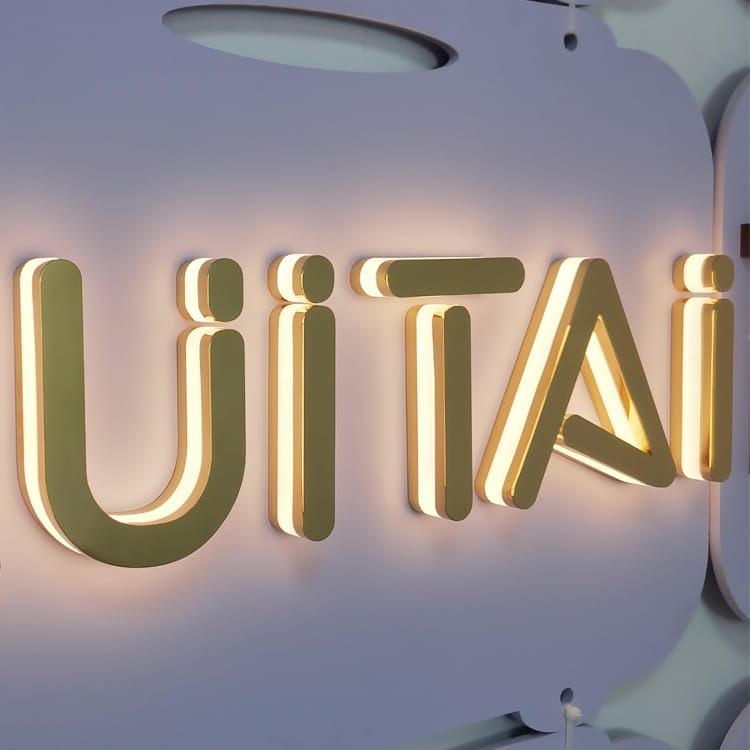
I’ve installed this from a factory in China called Aochuang Sign—they’ve been doing it since 2010, 50-plus workers, 3,000 square meters of production space. CE, RoHS, ISO 9001 certs. They’ll make you one letter if that’s all you need—MOQ is one piece. Lead time is seven to fifteen days. The pricing is real: front-lit channel letters at $20-80 per letter factory. Back-lit halo letters $35-120. Stainless steel non-lit $15-40. If you’re seeing US retail prices of $200-700 per letter, you’re paying for convenience and overhead, not quality.
Pro tip: ignore all the “agent” websites and go straight to a manufacturer with an existing export record. Ask for their CE certificate with today’s date on it. Most factories can’t produce one. Watch them sweat. A real factory has the paperwork—it costs them 20,000-50,000 RMB to get it, so they keep it current.
You found a great factory. Now you have to get the sign here. Shipping choices: express (7-10 days, $30-100 for small stuff), air freight (about 10 days, $4-12/kg), or sea (about 65 days, $80-200 per cubic meter LCL, or $1,200-3,000 for a full container). For a small business, you’re probably doing LCL sea freight or small air shipments.
Don’t make the mistake I made: thinking LCL is a simple “drop it at my door.” LCL sea freight: your crate gets handled 6-8 times between our dock and yours. Every touch is a chance for damage. That’s not in the brochure. You need to pay for proper packaging—foam, carton, plywood crate. That’s not optional. I’ve seen $2,000 halo letters arrive with the return flange bent because the packing was skimped on. The factory ships it right; the freight forwarder stacks something on top.
You need insurance and a customs broker who knows the Section 301 tariff—roughly 30% on signage from China. Factor that into your ROI calculation. Even so, you’re still 40-50% ahead of domestic after all costs.
One more thing: if you’re near a coast, don’t even think about 304 stainless. Marine grade 316 contains 2-3% molybdenum. Costs 20-30% more, but it lasts 15+ years. For Miami Beach or anywhere within a mile of salt spray, pay for 316 or you’re replacing letters in 3 years. I’ve done that replacement. It’s not fun.
This is where the biggest time and money sinks happen. I’ve installed signs where the client thought they could just hang a channel letter set and be done. Then the inspector shows up and it’s all wrong. Here’s what the permit office won’t tell you: you need an engineer’s stamp on the wind load calculation if the sign is over a certain size—usually anything over 20 square feet or 8 feet off the ground. That stamp costs $300-800. You can’t skip it.
Also, NEC Article 600 applies to all commercial signs in the US. That means proper grounding, correct wire gauge, GFCI for outlets near the sign, and a disconnect switch within sight of the sign. If your electrician doesn’t know Article 600, find a new one. I’ve had to rewire signs because the installer ran standard THHN in an outdoor raceway without the right temperature rating. Rookie mistake.
IP65 is the minimum for outdoor. That means dust-tight and water jets from any direction. It does NOT mean your sign survives a Florida hurricane. IP66 for coastal areas, IP68 for submersible applications like pylon bases. Your factory should tell you the rating, but don’t trust the label—moisture test it yourself. I fill a spray bottle and hit the seams. If water gets in, it goes back.
I’ve installed this exact same scenario: a small business with a concrete block wall and aluminum composite panel face. The rookie move is to use tapcon screws straight into the block. That works, but you’re about to learn why you shouldn’t. The sign expands and contracts with temperature, the screws wiggle, and after two years the letters are crooked. Pro tip: use stainless steel through-bolts with neoprene washers on the backside, and leave a 1/8” gap between the letter and the wall for drainage.
That gap lets moisture run out instead of sitting behind the acrylic and causing corrosion on the mounting holes.
Another thing: cable management is not optional. I’ve seen signs with wires hanging out the back like spaghetti. That’s an instant fire hazard and code violation. Use weatherproof conduit, seal every penetration with silicone—neutral cure, not acid cure. Acid cure eats the acrylic over time. I’ve watched a whole sign fail because the silicone turned the acrylic edges into a mess of micro-cracks.
Brutal honesty time: don’t hire the cheapest electrical contractor you can find. I’ve done that, and I paid for it twice. The guy who bids $150 for the sign hookup is usually the same guy who skips the bonding jumper. Get an electrician who does commercial work regularly. It’s worth paying $400-600 for a real job over $150 and a fire risk.
The factory warranty: 2 years on LEDs, 1 year on power supply. That’s standard. But what’s the process for a claim? If you bought direct from Aochuang, they’ll ship replacement parts. If you bought through a middleman, good luck. I’ve had clients who couldn’t get a warranty reply for 6 months because the reseller didn’t pay their factory invoice.
Also, know that the L70 rating of 50,000 hours on quality LEDs is at 25°C ambient. If your sign is in Phoenix sun, the internal temperature hits 50-60°C. That cuts the LED lifespan in half—so 25,000 hours instead of 50,000. That’s still about 3 years if the sign runs 24/7. Plan to replace modules at that point. It’s cheaper than replacing the whole sign.
One more brutal honesty: CE marking costs 20,000-50,000 RMB. Most factories will say they have it. Ask to see the certificate with today’s date. Watch them sweat. If they can’t produce it, they’re lying. Real certification from a notified body is what you need. Without it, you can’t legally sell the sign in EU markets, but for the US you need UL or ETL. UL 48 costs $4,000-15,000 and takes 4-9 months. Many small businesses skip it. If your local inspector doesn’t require it, fine. But if they do, you’re stuck.
You can, but you’ll get a sign with no warranty, no UL listing, and probably no correct voltage for your location. The “LED driver” inside might be a capacitor and resistor soldered to a board. I’ve seen Amazon signs catch fire. Don’t be that guy. Spend the money on a real sign from a real fabricator.
If you choose 304 stainless steel (1.0-1.6mm thick), proper Samsung LEDs, UV-resistant acrylic, and you do a good installation with correct drainage and waterproofing? Ten years on the metal, five-plus on the LEDs. The acrylic starts yellowing around year 5-8 if you used the good Mitsubishi stuff. Domestic acrylic? Three years max before it looks like a headache. So pay for the quality upfront.
Yes. Every time your crate moves, someone can drop it, stack something heavy on it, or leave it in the rain. I’ve seen crates arrive with forklift holes through the plywood. The remaining project-specific details depend on the approved design, installation conditions and local code; confirm them before ordering.

Real photo from our production floor — every sign we ship is made here.
Products mentioned or relevant to this topic — factory-direct, custom built.
From $24/letter · MOQ 1 piece · Flexible lead time · Project-specific compliance documents · ships to 20+ countries
Custom sizes, colors, and finishes. Get a factory price in 24 hours.
Get a Free Quote Copy EmailWhatsApp +86 13865703472 · business@aochuangsign.cn
See pricing, specs, and get a free quote for the sign type you need. Built in our factory, shipped worldwide.