I’ve been on factory floors since 1998. Melted acrylic, TIG-welded stainless until my eyes burned. And I’ve watched sign shop owners write checks for $800 per front-lit letter — same 304 stainless, same Samsung LEDs — while we ship that letter for $120.
This isn’t theory. It’s a 50-65% gap, and it comes straight from the math. A local shop pays American rent, American liability insurance, American labor. They have to charge $200-700 per letter just to keep the lights on. We don’t. Our factory in Lu’an, Anhui runs 3,000 square meters, 50+ skilled workers, and exports worldwide. The economics are different.
The ugly truth is most sign companies want you to think importing is a gamble filled with junk. It can be. But if you understand what you’re buying, you pocket savings that make your project profitable. You just need to compare honestly.
Here’s what nobody tells you: the wholesale price you see on Alibaba often includes a middleman. We cut that out. At Aochuang, you’re talking to the production manager, not a trader. So our EXW prices are real:
Look, a standard 12-inch front-lit channel letter for a retail storefront: we’re at $45. Same spec locally? $350 installed, easy. Multiply by 20 letters, you’re saving six grand before you even negotiate.
For architectural lobbies, back-lit halo letters give that recessed glow. Local shops charge $400-$1,000 per letter. Our factory price: $70-$120. The acrylic, the standoffs, the LED placement — identical approach. The only difference is who’s welding the aluminum returns.
I’ve seen this go wrong: a contractor ordered “304 stainless” from a random supplier. Three months later the letters rusted. They’d received 201-grade scrap metal with a polished face. Ask for the mill certificate. Real 304 has 18% chromium, 8% nickel. It’ll last 10+ years outdoors. We use Baosteel and TISCO stock; I can send you the heat number before we cut.
For coastal jobs, 316 stainless is non-negotiable. It’s got molybdenum, 2-3%, that fights salt pitting. Costs 20-30% more, but if you’re in Miami Beach or Galveston, don’t cheap out. That’s the kind of advice that saves you a callback. Our stainless steel letters page breaks down finishes and grades. You want brushed #4 for most storefronts, mirror #8 if you’re feeling fancy.
Acrylic faces matter, too. Those pretty white letters turn yellow. We offer UV-resistant Mitsubishi or Degussa acrylic with 5-8 years before noticeable color shift. Cheap domestic acrylic starts yellowing in 12-18 months. I’ve peeled faces off signs that looked like old teeth. The difference is $2-$5 per letter. Spend it.
The common industry lie: “All LEDs last 50,000 hours.” Sure, in a lab. On a sun-baked wall with poor heat dissipation, cheap modules die in 18 months. We load Samsung, Osram, Lan Jing SMD 2835 chips because they push 100-150 lumens per watt and actually hit L70 at 50,000 hours. I’ve seen countless fails from generic 5730s that burn bright for six months then start flickering.
When you open a dual-lit channel letter from us, the LEDs are spaced evenly, soldered onto aluminum-backed PCBs, and sealed with neutral-cure silicone — not that acid stuff that corrodes copper traces. Every sign goes through an 8-12 hour aging test before it’s packed. If a module’s going to infant-mortality fail, we want it to fail on our bench, not on your client’s wall.
Local fabricator: 2-3 weeks, maybe 4 if they’re swamped. Us: about 5-15 days to produce, then shipping.
Express (DHL, FedEx): 7-10 days total, but small signs only. Expect $30-$100 per box. Air freight: about 10 days, $4-$12 per kilo. Good for a set of lobby letters. Sea freight: about 65 days door to door. LCL (less than container load) runs $80-$200 per cubic meter. A full 20ft container, $1,200-$3,000. That’s where bulk orders make sense.
Here’s what nobody tells you: a sea shipment from Shanghai to Long Beach might show “30 days transit,” but you’ll lose another 2-3 weeks in port congestion, customs clearance, and drayage to your door. Factor that into your project timeline. If you need signs next month, air is your friend. If you’re planning a strip mall opening in July, order now and float them over.
Section 301 tariffs on Chinese sign products hover around 30%. On a $2,000 order, that’s $600 extra. Still, even with tariff, shipping, and customs broker fees (budget $150-$300 for a formal entry), you’re 35-50% below local installation cost. Do the math with your accountant, not your gut.
Some guys try to skirt customs by under-declaring value. Don’t. CBP isn’t stupid, and a seizure wipes out all your savings. I advise giving your broker the actual commercial invoice. It’s boring but safe.
I’ve seen this go wrong: a sign shop imported unlisted LED signs into California. The inspector cited NEC Article 600 and red-tagged the whole storefront. The owner had to hire a local UL field evaluation, costing $4,000 and a month’s delay. If your jurisdiction requires UL 48, tell the factory upfront. We can build to UL standards and coordinate with a field evaluation lab, but true UL listing costs $4,000-$15,000 and takes 4-9 months with quarterly audits. Most projects don’t need it; many accept ETL (about 30% cheaper) or a CE mark with a NRTL field inspection.
CE marking (20,000-50,000 RMB for us) proves conformity to European directives, but it’s not a US electrical safety ticket. IP65 — dust-tight and water-jet resistant — is the minimum for outdoor signs. IP66 handles powerful jets; IP68 is submersible, overkill unless your sign faces a monsoon. When I see a spec that just says “waterproof,” I know someone’s guessing. Ask for the exact IP test report.
Pay before art proof, and you’re gambling. I insist on a digital mockup with dimensions, LED placement, and finish notes. Sign it off. Then we cut. If you skip that, you get what someone else thought you wanted.
Another classic: forgetting that stainless letters over 2.5 meters wide need thicker acrylic — at least 5mm — and internal bracing. The ocean voyage will vibrate the hell out of them. I’ve seen faces crack because somebody tried to save $20 on material. Our crates use foam, carton, then plywood; we’ve shipped worldwide without major damage.
We can’t pull permits for you. We can’t send a crew to mount a 20-foot pylon sign on a Saturday. That’s your local partner. We’re the manufacturer, not the installer.
We don’t do rush same-day turnaround. Our process takes time: laser cutting (±0.1mm), TIG welding, grinding, polishing, CNC acrylic, LED assembly, sealing, aging, QC. The 10-step sequence guarantees consistency, but it doesn’t collapse into 24 hours.
We won’t fake UL listings. If a customer asks for a certificate, I’ll show the CE and RoHS and ISO 9001 paperwork, and I’ll connect you with a UL field evaluation service. But a printed UL label without the quarterly audit trail? That’s fraud, and I’m not risking our factory license over it.
Channel letters in high quantities. A multi-tenant retail center with 40 storefronts. That’s where the sea freight economics sing. Order 50 front-lit channel letters and a batch of acrylic light boxes, and you’ll fill a pallet. Unit cost drops enough to make your competitor’s quote look like a typo.
Custom stainless steel letters for a corporate lobby. The precision, the mirror finish, the weight — local fabricators often outsource the really tricky work anyway. We do it in-house. Brass letters for a high-end restaurant? Same thing. You want that warm, brushed golden glow without paying Beverly Hills metal shop rates.
Neon flex signs. LED neon flex has replaced glass neon for 90% of indoor and outdoor uses. Our neon flex signs run $30-$200, and they’re cut to any shape. They pack flat, ship easily, and install with screws and silicone. A local shop will charge you $500 for the same window piece. That’s markup, not magic.
Look, I’ll give you the exact questions to ask any Chinese supplier. If they can’t answer these clearly, walk.
“Show me photos of your production floor with today’s newspaper.” A real factory has a real floor. We’ll do a video call and walk you through the laser cutter, the polishing bay, the aging room.
“What’s the exact lot of your stainless? I want the mill cert.” I’ve got it in a PDF. If they hesitate, you’re getting mystery metal.
“Send me a sample with my logo on it. I’ll pay shipping.” A factory confident in its work will ship a sample. We do it all the time. That single sample tells you more than 100 emails.
“What’s your real warranty and how do you handle a failure?” Ours is 2 years on LEDs, 1 year on power supply. If a module fails, we ship replacements via express. It’s not a $0 claim — you’ll probably pay the shipping — but the parts are on us. I’ve never had a container of dead signs because we test everything before crating.
The ugly truth is some local fabricators buy the same acrylic, the same LEDs, the same stainless from the same supply chain — then weld it in a garage with $15/hour labor and charge premium “Made in USA” prices. Meanwhile, our $45 front-lit letter was built on CNC machines by a guy who’s done 10,000 of them. Skill isn’t geographic.
I’m not saying every import is flawless. I’m saying a properly vetted factory beats a sloppy local shop every time. And when you find a factory that uses Degussa acrylic, Samsung LEDs, Baosteel stainless, and actually answers emails in 12 hours, you stick with them.
I’m Tim from Aochuang Sign. I’ve been in this trade 16 years. I’ve got scars on my hands and an ISO 9001 cert on the wall. I’ll tell you when to buy local (emergency installs, ADA-compliant interior signs with Braille that need site survey), and I’ll tell you when to import. This guide is my no-bullshit attempt to help you make money. Use it.
Factory-direct since 2010. Free quote within 24 hours — no obligation.
Get a Free Quote → Copy EmailMOQ: 1 piece · Flexible lead time · 2-year warranty · Worldwide shipping

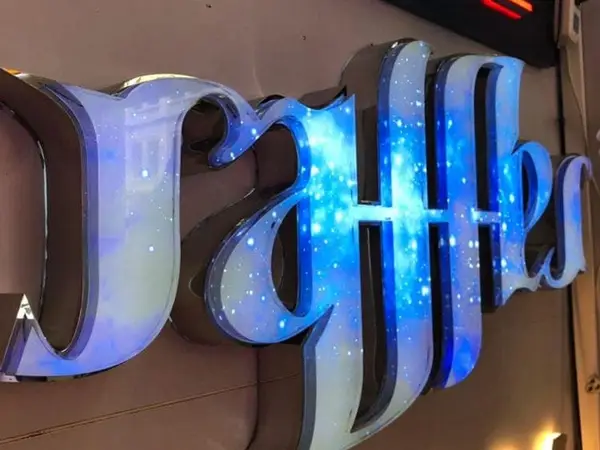
Real photo from our production floor — every sign we ship is made here.
See pricing, specs, and get a free quote for the sign type you need. Built in our factory, shipped worldwide.