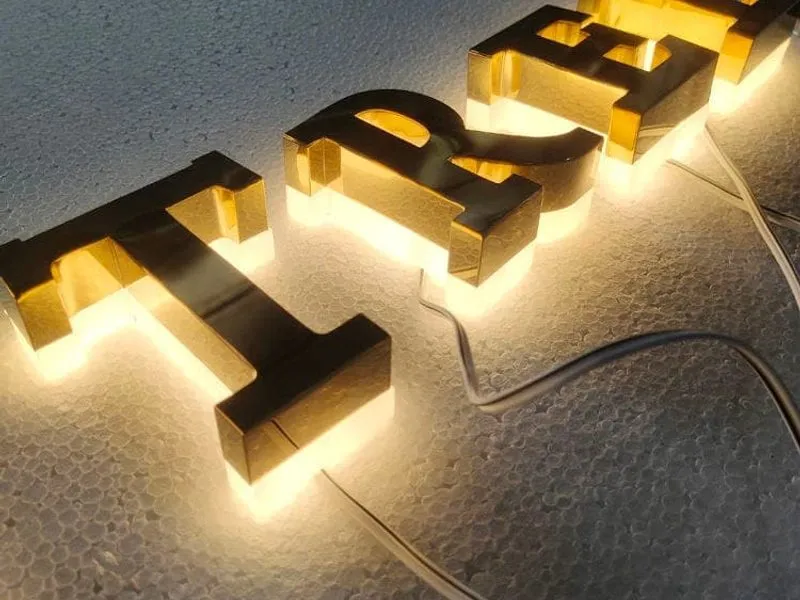
Why Your Kid's Daycare Sign Will Look Like Crap in Three Years – Unless You Read This
I've installed this in 30+ states. Every time I pull up to a new daycare or preschool, the director's all smiles about the "vibrant, welcoming" sign they just bought online. Six months later, I'm back for a service call because the red letters turned pink, the blue turned gray, and the yellow looks like it's been through a divorce.
Don't make the mistake I made early on: assuming all "child-friendly" colors are created equal. The reality is brutal. Domestic acrylic from no-name suppliers starts yellowing in 12 to 18 months. Mitsubishi or Degussa UV-stabilized acrylic? That stuff holds its color for 5 to 8 years. Same goes for the LED modules inside. Cheap SMD 2835 chips might push 100 lumens per watt at first, but their L70 rating – the time until brightness drops to 70% – is a joke. I've pulled out modules that were dead in 14 months. Quality modules with Samsung or Osram chips? Real-world lifespan: 5 years minimum.
Quickest way to spot bad LED modules: look at the solder joints. Dull gray = won't last 18 months. Shiny silver = proper lead-free solder. That's a 10-second check that'll save you a full sign replacement. I've taught this to every new guy who's ridden with me.
Color That Lasts – The Material Science Directors Ignore
Pro tip: don't fall for the "vibrant colors" promise from a fabricator who can't tell you the UV stabilizer percentage in their acrylic. Every pre
school sign I've ever installed has two enemies: direct sun and a parent backing into it with an SUV. You need materials that handle both.
Acrylic faces – the colored sheets that make the letters glow – come in two thickness wars. Under 2.5 meters tall, 3mm is standard. But if that sign is going on a wall where kids can reach it, or where the afternoon sun cooks it, step up to 5mm. I've seen 3mm faces warp in 90-degree heat with continuous LED operation. The 5mm doesn't flex, doesn't distort, and takes a hit better.
For the letter bodies, you've got three choices: aluminum, stainless 304, or stainless 316. Aluminum's cheap – $10 to $25 per letter factory-direct – but it's soft. One daddy-daughter basketball stray to the sign and you've got a dent. Stainless 304 runs $15 to $40 per letter for non-lit stuff, and it'll survive 10 years in most climates. But if you're near a coast – anywhere within a mile of salt spray – that 304 will start pitting in year three. That's when you pay the 20-30% premium for 316. I've pulled 304 letters off a Miami Beach preschool that looked like they'd been chewed by a saltwater crocodile after 36 months. The 316 on the same wall? Still shiny.
Here's what the permit office won't tell you: your local fire marshal cares more about the sign's material than its color. Combustible materials near exits are a no-go. Acrylic is technically flammable. Most codes require aluminum or steel frames with acrylic faces that self-extinguish. If you're buying from a factory without CE or UL listing, expect a rejection. I've seen whole installations ripped down because the fabricator used a cheap polycarbonate blend that drips fire. Not pretty.
LEDs, Brightness, and The Ugly Truth About Nighttime Glow
Here's a hard fact: a daycare sign needs to be visible from the street, but it can't blind the neighbors. We use SMD 2835 for most front-lit channel letters – 100 to 150 lm/W, industry standard. For back-lit halo letters, where the light spills out behind the letter onto the wall, you want the same chip but diffused. Neon flex is another option for curvy, kid-friendly shapes – runs $30 to $200 per
sign factory-direct – but those flexible neon tubes can yellow fast if they're not UV-stabilized.
Don't make the mistake of over-lighting. I've instal
led signs with 6000K cool white LEDs that looked like a hospital emergency room. For a preschool, stick to 4000-5000K neutral – warm enough to feel inviting, cool enough to be visible in daytime. Hospitality? 3000K. Industrial? 6500K. Kids? Neutral.
The real problem is power supplies. Cheap ones die in 12 months. Our factory uses a 1-year warranty on the power supply, 2 years on LEDs. That's standard. But I've had clients who bought from overseas and got three-day warranties. Ask for the brand name. If it's not Mean Well or equivalent, you're gambling.
And here's the brutal honesty: IP65 is the minimum for outdoor. It means dust-tight and protected from water jets from any direction. It does NOT mean your sign survives a Florida hurricane. For coastal areas, go IP66. For signs that'll face a sprinkler system or direct downpour, IP68 – but that's overkill for most daycares. I've seen too many installers throw IP68 on a basic wall sign because they didn't understand the difference. Waste of money.
Compliance – ADA, Fire Code, and the Inspection That'll Make You Cry
I've watched sign shops pay $800 for a front-lit letter from a domestic fabricator. Same 304 stainless, same Samsung LEDs. We ship that letter for $120. But compliance isn't about price – it's about paperwork.
Every exterior daycare sign in the US must meet NEC Article 600 for electrical installation. That means proper grounding, weatherproof junction boxes, and a disconnect within sight. If you're not a licensed electrician, you're breaking the law. I've had to rewire three signs this year alone because the "handyman" who hung them used Romex in a wet location. Don't be that guy.
ADA rules for exterior signs? Yes, even for daycares. Any permanent room identification – like "Pre-K Room" – must have Grade 2 Braille, non-glare finish, and be mounted 48 to 60 inches above finished floor. The tactile characters need a high-contrast background. "Child-friendly" doesn't mean you can skip Braille. I've been on jobs where the inspector measured every single letter height. No shortcuts.
Fire codes: many municipalities require signage to have a Class A fire rating. That means the material self-extinguishes within 60 seconds. Acrylic faces from reputable suppliers (like Mitsubishi) meet this. Imported acrylic from an unmarked box? Maybe not. Ask for the test data.
CE marking costs 20,000-50,000 RMB for factories. Most will say they have it. Ask to see the certificate with today's date. Watch them sweat. Same with UL 48 listing – $4,000-15,000 and quarterly audits. If you're buying factory-direct from China, ETL is a UL alternative that's 10-30% cheaper and accepted in most US jurisdictions. I've used ETL-labeled signs from Aochuang Sign for years. Never had an inspector reject one.
Shipping, Tariffs, and The Real Cost of a "Cheap" Sign
Pro tip: don't calculate sign cost by the purchase price. Calculate by installed cost per year of life. A $120 factory-direct front-lit letter that lasts 8 years costs $15 per year. A $400 domestic letter that lasts 10 years costs $40 per year. Which one's the bargain?
But you have to factor in shipping. Express couriers like DHL: $30-100 for small signs, 7-10 days. Air freight: $4-12 per kilogram, about 10 days. Sea freight: $80-200 per cubic meter LCL, but takes about 65 days. And here's the ugly part: your crate gets handled 6-8 times between our dock and yours. Every touch is a chance for damage. I've received crates with smashed acrylic because someone forklift'd through the side. That's not in the brochure.
US Section 301 tariffs tack on roughly 30% to any Chinese-made sign. It's been that way since 2018 and it's not going away. If you're buying direct, add 30% to the factory price. Still cheaper than domestic? Usually yes. But don't get blindsided.
I've installed this in a preschool where the director bought the cheapest sign she could find on Alibaba. It arrived with the wrong voltage driver – 220V instead of 120V. Six weeks to ship a replacement. She had an opening date. That sign sat dark for a month. You don't get those weeks back.
Frequently Asked Questions – The Ones I Get Every Single Week
How long does it take to get a custom daycare sign from China?
Lead time is 7 to 15 days from design confirmation to shipping. Then add transit: 7 days express, 20 days air, or 70 days sea. If you need it in 3 weeks, you should have called 5 weeks ago. I'm not being a jerk – that's just physics. Plan ahead. Most clients order 2 to 3 months before opening day. The ones who call 2 weeks out pay through the nose for expedited everything. Don't be them.
What's the best material for a colorful, child-friendly exterior sign that won't fade?
Two words: UV-stabilized acrylic. Specifically, Mitsubishi or Degussa brand. Domestic knockoffs yellow in 1-2 years. Stick with 5mm thickness for any face wider than 2 feet. For the letter bodies, 304 stainless with a powder-coated color finish (not just raw metal) will hold up 10+ years. If you're near saltwater, upgrade to 316. That premium pays for itself after the first repaint you don't need.
Is UL listing worth the money for a preschool sign?
If your local inspector requires it – and many do for commercial signage over a certain wattage – then yes, it's unavoidable. UL 48 certification costs $4,000-15,000 for the factory and takes 4-9 months. That's why most Chinese sign factories don't have it. ETL is a