Look, if you've ever quoted a dental office sign package without seeing the job, you know the pain. The client wants "clean and professional." The architect wants ADA compliance down to the sixteenth. The office manager wants it yesterday. And your competitor down the street is quoting acrylic letters that'll yellow in 18 months.
Dental offices aren't like retail stores. The sign isn't just decoration. That's patient flow, privacy, and infection control, all bolted to a wall.
I've built signs for dentists who think a cheap window decal is fine. Then the hygienist wipes it with disinfectant every morning and the vinyl curls like a potato chip. You don't want that phone call.
A dental practice isn't one sign. Think of it as a system. Exterior storefront, reception logo, room markers, directional arrows, window graphics, maybe a monument sign at the curb.
Placement matters more than design. The patient's eyes move from the parking lot to the front door, then to the check-in desk, then down a hallway to an operatory. Every pause is a sign opportunity.
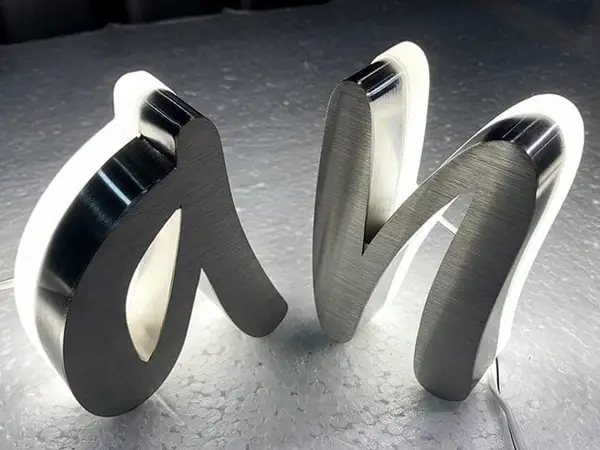
For the exterior, your workhorse is front-lit channel letters. Factory price runs $20-80 per letter. Installed retail in the U.S. is $200-700 per letter. That's the margin your competitor doesn't want you to know about.
Inside, the reception logo might be acrylic LED letters or back-lit halo. Operatory doors get tactile room signs. Hallways get directional arrows. Restrooms get ADA-compliant identification. Don't skip the restroom signs; inspectors love those.
Here's what nobody tells you: HIPAA doesn't require any specific sign. That's the client's paranoia, not a spec. But ADA? That's federal law and it's specific as hell.
Permanent room signs in dental offices—restrooms, X-ray, consultation, sterilization—need raised letters and Grade 2 Braille. You must mount tactile characters between 48 and 60 inches from the floor. Finish has to be non-glare. No mirror acrylic on a room sign. That's not style, that's the law.
I've seen this go wrong: a contractor mounted a beautiful laser-cut room sign at 66 inches because it "looked better." The inspector didn't care about aesthetics. The client paid twice—once for the sign, once for the re-fabrication.
State and local codes add extra layers. Some jurisdictions require exam room signs to be on the latch side of the door, not the hinge side. Check before you drill. If you're building a full wayfinding system, the ADA sign isn't the afterthought; it's the first thing the inspector checks.
The ugly truth is most sign shops don't think about chemicals. Dental offices are disinfected constantly. Cavicide, isopropyl alcohol, quaternary ammonium—these aren't gentle. Cheap materials don't survive.
304 stainless steel letters are the standard for a reason. 18% chromium, 8% nickel. Ten-plus years outdoors, which in a dental office means a decade of chemical wipes. If you're near the coast, go 316. That costs 20-30% more because it has molybdenum, but it'll last 15+ years in salt air.
Acrylic is trickier. Good UV-resistant sheet from Mitsubishi or Degussa lasts 5-8 years before yellowing. Domestic stuff? One to two years. In a dental office with daily cleaning, cheap acrylic fogs up fast. I've watched it happen in six months.
For interior door signs, use 2mm or 3mm acrylic with embedded tactile lettering. If you're doing a large fabrication over 2.5 meters, move up to 5mm acrylic or you'll get bowing.
Powder-coated aluminum is your budget option for wall signs. Weighs a third as much as steel, naturally rust-proof, and anodized finishes hold up to scratches. But it won't feel as premium as stainless. Some dental clients want that brushed #4 finish that hides fingerprints. Mirror #8 is beautiful for a week, then it's a smudge magnet.
A dental office with bad wayfinding is a maze of identical doors. Patient sits in the chair, anxious, staring at four closed doors: "X-Ray," "Consultation," "Staff Only," "Restroom." If they pick wrong, it's awkward for everyone.
Room signs need clear contrast between text and background. Non-glare finish, tactile lettering, Grade 2 Braille. Mount them on the latch side of the door. Not because I say so—because ADA says so. Check your local fire code too; some hallways require photoluminescent exit signs.
For directional arrows, don't hang them where the ceiling is cluttered with HVAC and sprinkler lines. I've installed signs in dental offices where a pipe blocked the arrow. Client called two weeks later: "Nobody can find the X-ray room." No kidding.
If the dental office has multiple floors, a lobby directory is worth the money. But don't let the architect talk you into a digital screen unless the client asks. Static directory panels are easier to update and don't need a software license.
Exterior signage is where the patient finds you from the road. If the tenant sign is too small, the dentist blames you. Even if the landlord limited the size.
For a storefront in a medical plaza, front-lit channel letters are the most common choice. They're legible day and night. Factory price per letter is $20-80. You sell them installed for $200-700. That margin covers your labor, UL-listed power supplies, and the inevitable service call.
Monument signs at the entrance are a different animal. Low-profile aluminum with routed faces, maybe stone columns. If the dental office is in a standalone building, the monument sign is the first impression. Don't put a cheap vinyl panel on a stone base. It looks like a yard sale sign.
Window signage is the cheapest exterior option, but it has a short life. Perforated vinyl is fine for a temporary promotion. For permanent branding, do not use window film as the only exterior sign. A dental office isn't a nail salon. Patients want to know you're not operating out of a strip mall storage unit.
If you're buying exterior signs, IP65 is the minimum for outdoor. That means water jets from any direction. Doesn't mean a Florida hurricane won't rip it off the wall.
Look, the numbers don't lie. Retail installed front-lit letters cost $200-700 per letter. Halo-lit run $400-1,000 per letter. Factory-direct product cost is 50-65% less. You're leaving money on the table if you're not sourcing strategically.
Here's what nobody tells you: your local fabricator is buying the same 304 stainless, the same Samsung LED modules, the same acrylic from the same factories in China. Then they mark it up 200% and call it "custom fabrication."
Factory lead time from a shop like ours is about 5-15 days. Shipping adds time: express about 5-15 days for small items, air freight about 10 days at $4-12/kg, sea freight about 65 days for full crates. If you're ordering a full monument sign, plan 3 months minimum.
Tariffs are real. Section 301 on Chinese signs is about 30%. Don't forget that when you quote. If your client needs it fast, air freight and the tariff both eat your margin.
Warranty matters. We give 2 years on LED modules and 1 year on power supplies. Cheap factories give you 6 months if you're lucky. I've seen cheap LED modules fail in 12-18 months. The solder joints go dull gray. Quality Samsung or Osram modules last 5+ years. In a dental office, a dead letter means a patient thinks the office is closed.
UL listing is another line item. UL 48 certification costs $4,000-15,000 and takes 4-9 months with quarterly audits. ETL is 10-30% cheaper and accepted in most jurisdictions. If the inspector asks for UL and you don't have it, you're not arguing your way out of that one.
Our shop is Aochuang Sign in Lu'an, Anhui. 3,000 square meters, 50+ workers, ISO 9001. MOQ is one piece. We're not a trading company. CE marking costs 20,000-50,000 RMB. Most factories say they have it. Ask to see the certificate with today's date. Watch them sweat.
Q: Do dental office signs need to be UL listed?
Look, NEC Article 600 covers electric signs, but not every local inspector asks for UL. If the job is in a jurisdiction that checks, use a shop with ETL or UL. The cert alone costs $4,000-15,000 and takes 4-9 months. Don't be the guy who finds out after the sign's built.
Q: Can I just use vinyl lettering for room signs?
Sure, if you want to redo them after the cleaning crew hits them with quaternary disinfectant for six months. Vinyl peels. Acrylic with embedded tactile lettering doesn't.
Q: How fast can I get dental office signs?
Factory lead time is about 5-15 days, but sea shipping is 50-70. Air freight is about 10 days at $4-12/kg. Express for small stuff is about 5-15 days at $30-100. Plan like an adult.
Q: Why are some stainless letters 20-30% more expensive?
316 stainless has molybdenum. It survives salt air and harsh cleaners. 304 is fine for most dental offices. If you're on the coast, pay the premium or shut up about the rust.

Real photo from our production floor — every sign we ship is made here.
Products mentioned or relevant to this topic — factory-direct, custom built.
From $24/letter · MOQ 1 piece · Flexible lead time · CE & UL certified · ships to 20+ countries
Custom sizes, colors, and finishes. Get a factory price in 24 hours.
Get a Free Quote Copy EmailWhatsApp +86 13865703472 · business@aochuangsign.cn