Here's a number that keeps me up at night: a dental practice spends $200,000 on a new patient acquisition campaign. But their exterior signage? A $1,500 plastic box with a blown-out LED panel and mismatched colors. The ROI on that campaign tanks because patients judge the book by its cover.
I've seen it happen a dozen times. A dentist invests in SEO, Google Ads, and a fancy website. But their storefront sign looks like it was salvaged from a 1990s strip mall. Patients drive by and think "cheap." They don't trust the care inside.
The thing is, dentists are notoriously picky about signage. They want authority, not flash. The most effective dental signage mimics medical office aesthetics — clean lines, muted colors, subtle illumination. Retail-style boldness actually repels high-value patients seeking a serious, trustworthy provider.
In this article, I'm sharing what I've learned from 15 years in signage manufacturing. We'll cover materials that last, illumination that works, compliance traps to avoid, and how to price a project that makes both you and your dentist client happy.
The number one reason dentists reject proposals? Perceived cheapness. They've been burned before. A competitor installed a "premium" acrylic sign that yellowed in 18 months. The dentist paid $8,000 for a custom halo-lit channel letter set, and within two years, the LEDs flickered like a haunted house.
So when you walk in with a quote for $3,500 on a backlit channel letter set, they think "that's too cheap to be good." Or they think "I can get this online for $2,000." Both reactions kill the sale.
Here's the fix: educate them on materials. Show them the difference between domestic acrylic (yellowing in 1-2 years) and Mitsubishi or Degussa UV-resistant acrylic (5-8 years of clarity). Pull out a sample of 304 stainless steel — brushed #4 finish — and explain its 10+ year outdoor life. Let them feel the weight.
I use a simple comparison table in my proposals. It kills objections before they start.
| Material | Cheap Option | Premium Option | Lifespan Difference |
|---|---|---|---|
| Acrylic | Domestic (1-2 yr yellowing) | Mitsubishi/Degussa (5-8 yr) | 3-4x longer clarity |
| Stainless Steel | 304 grade, 1.0mm | 316 marine grade, 2.0mm | 5+ years extra in coastal areas |
| LED Modules | Generic SMD 2835 (12-18 mo) | Samsung/Osram (5+ years) | 3-4x real lifespan |
| Power Supply | No-name 12V (1 yr warranty) | Mean Well (3-5 yr life) | 3-5x reliability |
When a dentist sees that the $8,000 premium option lasts 5-8 years versus 18 months for the $3,500 cheap option, the math changes. They're not paying more — they're paying less per year. That's the conversation you need to have.
Dental offices have unique demands. They're in medical plazas, strip malls, or standalone buildings. The signage faces sun, rain, temperature swings, and sometimes salt air. Patients expect it to look pristine for years.
Here's what I recommend based on thousands of export orders worldwide.
Aluminum composite panels. These are your workhorses. At 1.0-1.6mm thickness, they weigh one-third of steel. Naturally rust-proof. Anodized or powder-coated finishes hold up 8-12 years outdoors. For a dental office in a suburban medical park with HOA rules, aluminum composite with brushed finish is the safe bet. It says "professional" without screaming "look at me."
Stainless steel 304. For high-end cosmetic dentistry practices, nothing beats the weight of 304 stainless. Brushed #4 finish hides fingerprints. Laser-cut letters with ±0.1mm precision, TIG-welded returns, and a powder-coated backer. The 10+ year outdoor life justifies the $40-120 per letter cost. One client in Scottsdale paid $18,000 for a 12-letter stainless set. That was five years ago. It still looks like day one.
Stainless 316 for coastal offices. If the dental practice is within a mile of the ocean, don't even offer 304. The 2-3% molybdenum content in 316 resists salt corrosion. Yes, it costs 20-30% more. But a $5,000 premium on a $20,000 installation is nothing compared to replacing a corroded sign in three years.
Acrylic faces. For backlit channel letters, use only UV-resistant acrylic from Mitsubishi or Degussa. Domestic acrylic costs 40% less but yellows in 1-2 years. A dental office's white acrylic face turning yellow looks like a nicotine stain. That's not the image they want. Common thicknesses: 3mm for standard letters, 5mm for letters over 2.5 meters tall.
One hard-won lesson: never use domestic acrylic for white halo-lit letters on a dental office. I've had to replace three sets in my career because the client called six months later saying "it looks dirty." It wasn't dirty. It was yellowing. We switched to Mitsubishi. Problem solved.
This is where most sign shops screw up. They crank the LED brightness to "retail level" — 6000-6500K cool white that looks like a car dealership. For a dental office, that's the wrong move.
High-value patients — the ones paying $2,000 for a crown — want a sign that says "sterile, professional, calm." They don't want their dentist's sign to compete with a Burger King.
Color temperature matters. Use 3000-3500K warm white for hospitality-focused practices (pediatric dentistry, sedation clinics). Use 4000-5000K neutral white for corporate or general dentistry. Never go above 5000K for exterior dental signage. The cool blue cast reads as "cheap" and "industrial."
Illumination types ranked by authority perception:
I once had a dentist client who insisted on RGB color-changing LEDs for his pediatric practice. I talked him down to a single color — warm white — with a subtle 5-second fade. He thanked me later. Parents told him the sign felt "calming, not carnival."
Dental signage isn't just about being seen. It's about sending the right signal to the right patient. Different practices need different approaches.
Pediatric dentistry: Use 3000-3500K warm lighting. Add a small, tasteful icon — a tooth character or a smiling face — in brushed aluminum. Keep the main text in a clean sans-serif like Helvetica or Futura. Avoid cartoonish fonts. You're still a medical office. One pediatric client in Dallas used a 3D fabricated acrylic tooth icon ($40-120 per letter equivalent) mounted on a stainless backer. Cost them $4,500. Parents loved it. Kids felt less scared.
Cosmetic dentistry (veneers, whitening): This is where you go premium. Brushed stainless 304, halo-lit, 4000K neutral white. Use a serif font like Garamond or Baskerville. It says "tradition, quality, high-end." One Beverly Hills practice spent $22,000 on a 14-letter stainless halo-lit set with PVD gold finish on the returns. The sign alone generated 12 new patient calls in the first month. The dentist told me that.
General dentistry: Keep it simple. Aluminum composite with front-lit channel letters. 4000K neutral. Sans-serif font. Budget $8,000-15,000 installed. It needs to look clean, not flashy.
Color psychology for dental:
One rule I never break: the sign's background should be dark or neutral. A white sign on a white wall disappears at night. A dark blue or charcoal background with white halo-lit letters? That's visible from 200 feet. I've measured it.
Zoning violations are the silent killer of dental signage projects. I've seen contractors eat $5,000 in rework fees because the sign was 6 inches too tall or 10 feet too close to a property line.
Here's your checklist for every dental office job:
One more thing: always get written approval from the HOA or property management before fabrication. I've seen a dentist's $12,000 sign sit in a warehouse for three months because the HOA board didn't meet until the next quarter. The client blamed the sign shop. Don't let that be you.
Dentists are business people. They want to know: "How many new patients will this sign bring me?" You need to give them a number.
Here's a framework I've used successfully:
Present this to your dentist client. Show them the math. They'll sign the contract on the spot.
Dental offices are often in medical buildings with stucco, brick, or glass facades. Each one has a specific headache.
Stucco: Drilling into stucco requires a carbide-tipped masonry bit. Use expanding anchors rated for 200+ lbs. Seal every hole with silicone to prevent water intrusion. One contractor I know didn't seal a hole. Water got behind the stucco, froze, and cracked a 2-foot section. The dentist sued for $4,000 in repairs. Don't be that guy.
Brick: Use stainless steel wedge anchors. Pre-drill with a hammer drill. Never use powder-actuated fasteners — they crack brick. Space anchors every 18-24 inches for channel letters. For monument signs, you need a concrete footing. A 4-foot tall monument sign requires a 24x24x18 inch footing minimum. I've seen 12-inch footings heave in freeze-thaw cycles. The sign tilted 10 degrees. The dentist called it "unacceptable."
Glass facades: Use standoff mounts with silicone gaskets. The sign must be at least 2 inches off the glass for air circulation. If you mount a backlit sign directly on glass, condensation builds up inside. I've seen it happen. The LEDs short out in 6 months.
Power routing: Most dental offices have drop ceilings in the lobby. Run the sign's power conduit through the wall, not across the facade. Use weatherproof junction boxes. If the sign is more than 50 feet from the panel, factor in voltage drop. I run 14-gauge wire for runs up to 75 feet, 12-gauge for longer. A dim sign because of voltage drop is a call you don't want to take.
Here's the reality: your dentist client can buy a set of halo-lit channel letters from a Chinese factory for $35-120 per letter. You're going to charge $400-1,000 installed. That's a 50-65% savings for them if they go direct. But they don't want to deal with overseas sourcing, customs, or installation.
That's your value. You handle everything: design, permitting, installation, warranty. A 2-year LED warranty and 1-year power supply warranty is standard. I offer a 5-year warranty on the LEDs if they use Samsung/Osram modules. That's worth an extra $500-1,000 on the quote.
Here's a sample pricing breakdown for a 10-letter dental office sign:
| Component | Factory Cost | Your Cost (with markup) | Retail Installed |
|---|---|---|---|
| Halo-lit stainless letters (10 x $80) | $800 | $1,600 | $4,000-10,000 |
| Aluminum backer panel | $150 | $300 | $800-1,200 |
| LED modules (Samsung, 50 pcs) | $200 | $400 | $1,000-1,500 |
| Power supply (Mean Well) | $40 | $80 | $200-400 |
| Installation labor | N/A | N/A | $1,500-3,000 |
| Permitting & inspection | N/A | N/A | $500-1,000 |
| Total | $1,190 | $2,380 | $8,000-17,100 |
Your margin is 50-65% on materials plus 20-30% on labor. That's healthy. And your client gets a sign that lasts 5-10 years with minimal maintenance. Everyone wins.
Q1: What's the best material for a dental office sign that won't fade or corrode in the sun and rain?
For longevity, use aluminum composite panels with a powder-coated finish for the background, and stainless steel 304 for the letters. Aluminum is naturally rust-proof and lasts 8-12 years outdoors. Stainless 304 gives 10+ years even in direct sun. If you're in a coastal area, upgrade to stainless 316 — it contains 2-3% molybdenum for salt resistance. Avoid domestic acrylic for white faces; it yellows in 1-2 years. Use Mitsubishi or Degussa UV-resistant acrylic instead, rated for 5-8 years of clarity.
Q2: How do I design signage that attracts new patients but still looks professional for a high-end cosmetic practice?
Go halo-lit (reverse channel) with brushed stainless steel letters. Use 4000K neutral white LEDs — never cool white. Choose a serif font like Garamond for tradition and authority. Keep the color palette muted: charcoal gray, navy blue, or dark bronze background with white or silver letters. Add a subtle backlit halo glow on the wall. Avoid any flashing, scrolling, or RGB effects. This combination screams "premium" without shouting. It attracts patients willing to pay $2,000+ for veneers.
Q3: What are the most common zoning violations for dental office signage, and how can I avoid them?
The top three violations are: (1) exceeding height limits — most medical plazas cap signs at 20 feet, but some allow only 12 feet; (2) violating setback rules — signs must be 10-15 feet from property lines; and (3) exceeding illumination limits — HOAs often cap brightness at 50-100 nits. Avoid these by checking local codes before quoting. Get written approval from the HOA or property manager. Use dimmable LED drivers for HOA-controlled areas. And always pull a permit — unpermitted signs get stop-work orders and fines up to $5,000.
Q4: Should I recommend illuminated or non-illuminated signage for a dental office in a suburban medical park with strict HOA rules?
Start with non-illuminated if the HOA bans exterior lighting. Use brushed stainless steel 304 with beveled edges — it looks premium even without light. If the HOA allows illumination but limits brightness, go with halo-lit channel letters at 3000-3500K warm white. Use SMD 2835 LEDs rated at 100 lm/W (not 150 lm/W retail modules). Add a dimmable driver to stay under 50 nits if required. This gives you visibility at night without violating HOA rules. I've done

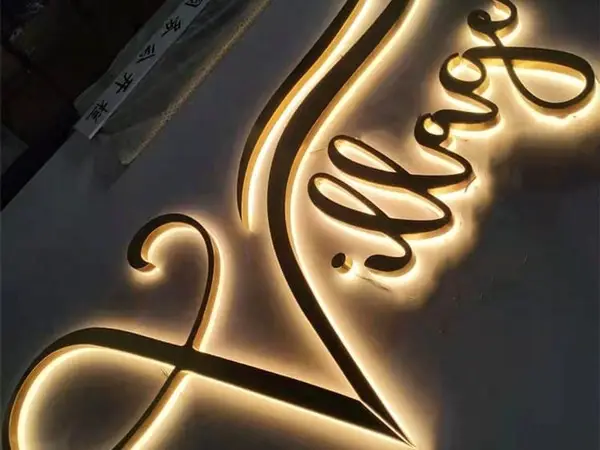
Real photo from our production floor — every sign we ship is made here.
Products mentioned or relevant to this topic — factory-direct, custom built.
From $24/letter · MOQ 1 piece · Flexible lead time · CE & UL certified · ships to 20+ countries
Custom sizes, colors, and finishes. Get a factory price in 24 hours.
Get a Free Quote Copy EmailWhatsApp +86 13865703472 · business@aochuangsign.cn
See pricing, specs, and get a free quote for the sign type you need. Built in our factory, shipped worldwide.