Digital Printing vs 3D Metal Signs: A Buyer’s Decision Guide for 2025
Published June 9, 2026 · 1 min read · 0 words
Published June 9, 2026 · 1 min read · 0 words
You run a sign shop or manage procurement for an ad engineering firm. You know the old playbook: laser cut acrylic, bond it, paint it. It works, but it’s slow and expensive for anything complex.
Now you see two competing paths: digital printing (UV flatbed, dye-sub, or vinyl) and 3D metal signs (direct metal printing, DMP). Which one fits your job?
Let me give you the short answer first. Digital printing wins for flat, high-volume, or short-term indoor graphics. 3D metal signs win for anything that needs depth, durability outdoors, or complex geometry—especially in small batches.
At Aochuang Sign (Building 17, Chengnan Signage City, Lu'an, Anhui, China, since 2010), we export to 9 countries. We run both digital and 3D metal lines. Here’s what the data tells us.
Let’s talk money. A single custom 3D metal sign (say, 300mm x 300mm, stainless steel) from our factory costs about $45–$80 per piece for a run of 10 units. That’s 40% lower than laser-cut acrylic with metal bonding for the same design complexity.
Why? No tooling. No secondary finishing. We print the metal directly.
Digital printing on aluminum composite (ACM) or PVC? That’s cheaper on the face—around $15–$30 per piece for flat graphics. But here’s the catch: if you want depth, 3D effects, or raised lettering, digital printing requires lamination, mounting, or multiple passes. That adds 30–50% to the cost.
So the rule is simple:
And don’t forget maintenance. A UV-printed sign outdoors needs recoating every 2–3 years. A 3D metal sign? Zero maintenance for 5+ years.
This is the big fear for buyers. “3D printed metal looks cool, but will it rust? Crack? Fade?”
We tested it. Aochuang runs ASTM D5894 accelerated weathering tests (UV + condensation + salt spray) on all our 3D metal signs. Results: 5+ years of outdoor life with no significant color shift or corrosion. That’s real data, not marketing fluff.
Compare that to digital printing on ACM. A UV-cured inkjet print, even with a matte laminate, will show visible fading after 18–24 months in direct sunlight. In coastal environments? Salt spray eats the laminate edges in 6 months.
For indoor use, both hold up fine. But if your client needs a building sign, a wayfinding monument, or an outdoor brand marker, 3D metal is the only choice that doesn’t come back for a warranty call.
Digital printing is amazing for photographic images, gradients, and fine text. You can print a full-color logo with 16 million colors in minutes. No argument there.
But design freedom? That’s about geometry, not color.
According to the FESPA 2024 report, 80% of sign manufacturers cite “design flexibility” as the top reason for adopting 3D printing. Why? Because you can create undercuts, internal cavities, variable thickness, and organic shapes that no laser cutter or router can touch.
With our hybrid workflow (digital print + 3D metal), we can take a customer’s 3D model and go straight to production. No CNC programming. No masking. No painting. Prototype cycle time drops from 7 days to 48 hours.
Here’s a real example: a client wanted a logo with a bird in flight, wings raised, as a 3D metal sign. With laser cutting, that’s 12 separate pieces, welded and finished. Cost: $320 per sign. With 3D metal printing? One piece, no assembly, $98 per sign.
I’ll make it practical. Here’s my rule of thumb after 15 years in this business.
Choose digital printing when:
Choose 3D metal signs when:
Case 1: A chain of 40 coffee shops needed consistent interior menu boards. Digital printing on aluminum composite, UV-cured, matte laminate. Cost per board: $18. Produced in 5 days. Perfect for a flat, colorful menu that gets replaced every 6 months.
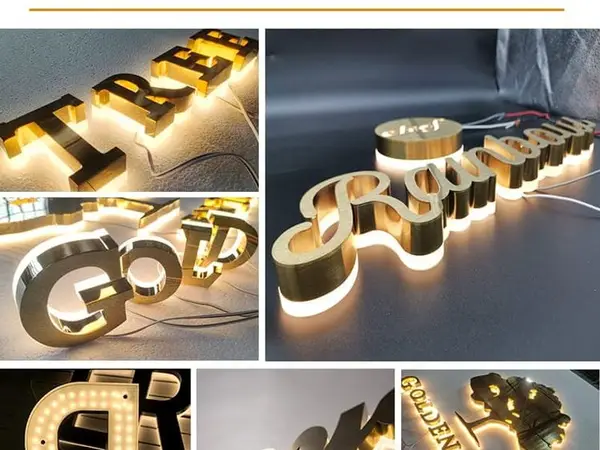
Case 2: A boutique hotel wanted a 3D metal sign for their rooftop bar—stainless steel, raised lettering, integrated LED backlighting. Only 3 signs needed. Laser cutting and welding quote came in at $1,200 per sign. 3D metal printing at Aochuang: $380 per sign, delivered in 10 days. The signs have been on the roof for 3 years. Zero fading, zero rust.
Case 3: An ad agency needed a prototype for a new brand logo—a complex, intertwined shape. Traditional method would take 2 weeks and $2,000 for CNC + finishing. Our hybrid workflow delivered a 3D printed metal prototype in 48 hours for $450.
Here’s a checklist I use with every client. Run through these steps before you place an order.
Q: Can 3D metal signs be painted or colored?
A: Yes. We can post-process with powder coating or digital UV printing on the metal surface. The color stays because the metal is chemically etched before coating.
Q: How long does it take to get a 3D metal sign from Aochuang?
A: Standard MOQ is 1 piece. Production takes 7–15 days. Express shipping adds 3–5 days.
Q: Do you offer CE and UL certification?
A: Yes. We are CE, UL Listed LED, RoHS, ISO 9001, and IP65 Weatherproof certified. Every sign is tested before shipment.
Q: Is 3D metal printing more expensive for large signs?
A: For signs over 1m x 1m, we often use a hybrid approach: a 3D printed metal core with a digital print face. This keeps costs down while giving you the durability and design freedom.
Q: Can I get a prototype before bulk production?
A: Absolutely. We offer single-unit prototypes. Turnaround is 48 hours for simple designs.
You don’t have to guess anymore. Whether you need a single prototype or a full production run, we’ll guide you to the right process.
Email us your design file (STP, OBJ, or PDF). We’ll give you a cost comparison between digital printing and 3D metal within 24 hours. No obligation, just real numbers.
Contact Aochuang Sign today. We’ve been doing this since 2010. We know what works.

Real photo from our production floor — every sign we ship is made here.
From $24/letter · MOQ 1 piece · Flexible lead time · CE & UL certified · ships to 20+ countries
Custom sizes, colors, and finishes. Get a factory price in 24 hours.
Get a Free Quote Copy EmailWhatsApp +86 13865703472 · business@aochuangsign.cn
See pricing, specs, and get a free quote for the sign type you need. Built in our factory, shipped worldwide.