Here's what nobody tells you: there's no universally "better" metal letter. There's only the right one for your budget, your building, and your client's expectations. I've spent 16 years in sign fabrication, and I'm here to cut through the catalog BS you've been fed.
The ugly truth is most comparison guides online are written by marketing interns who've never touched a blowtorch. So this one's coming from the factory floor, where we've built over 50,000 letters for shops across the world.
## Let's Kill the Confusion Right Out the Gate
Cast metal letters are made by pouring molten metal (typically aluminum, zinc, or bronze) into a mold. One design, one mold, repeat until you've got fifty identical letters.
Fabricated metal letters are cut from flat sheet metal, then bent, welded, and assembled piece by piece. Think stainless steel, aluminum, or brass — each letter hand-built by a craftsman.
Right out the gate: if you need 50 identical letters with intricate detail and a heavy, premium feel, casting wins. If you need large letters, custom shapes, or illuminated signage, fabrication wins.
**Cast metal letters** — because mold cost means you need volume. For a one-off sign, the mold alone will eat you alive.
**Fabricated letters** — because custom shapes and sizes are where we actually get to stretch.
## Cast Metal Letters: The Heavyweight Detail Kings
Let's talk about what casting actually delivers. We're looking at zinc, aluminum, and bronze options that come out of the mold with crisp edges and three-dimensional depth you can't replicate with sheet metal.
A cast letter will have 5-10mm thick walls. That's why it feels like it weighs twice what a fabricated letter does. When a developer runs their hand along that edge and it feels solid, that's the moment they decide the premium was worth it.
The weight isn't just for show. Cast letters handle wind load like a champ. I've seen cast aluminum letters take direct hits from debris in storms that would have dented a fabricated letter into scrap.
Here's the hard cost reality: cast letters run $40-120 per letter from any decent factory. US retail installed? You're looking at $400-1,000 per letter, and I've seen worse.
The mold itself costs $800-3,000 depending on complexity. That's your sunk cost before production even starts. If you need under 10 letters, casting is going to hurt unless the design is simple enough to reuse an existing mold or you're doing a massive volume.
Some of our best work in the cast category involves recreating historical signs for building restorations. When you need a 1920s-era letter that matches the original bronze exactly, casting isn't just an option — it's the only method that works.
For premium retail, hospitality, and corporate headquarters, we're talking about the kind of sign that becomes part of the architecture. Our
aluminum letters in particular give you that solid, permanent feel at a fraction of the bronze price.
## Fabricated Metal Letters: The Modern Workhorse
Look, if you're still reading because you thought maybe cast was the answer for everything, let me stop you right here. Fabrication is where 80% of commercial sign work actually lives.
Welcome to the real world: fabricated letters give you flexibility casting can't touch. Need a 36-inch letter? No problem — we scale the vector file and cut it. Need to change the font halfway through the project? We update the CNC file and we're cutting within the hour.
The magic of fabricated letters is what we can do with
stainless steel. We typically use 1.0-3.0mm sheets, and good 304 stainless will hold its looks for a decade outside without any help.
We cut with ±0.1mm precision on our CNC machine. Then our welders — who've each been at this for 15+ years — TIG weld the seams so clean you can't see the joint without a magnifier.
The finishes we can apply to fabricated letters would take a whole article to list. Brushed #4, mirror #8, PVD coating, powder coating, even a faux-bronze patina if you want the cast look without the weight.
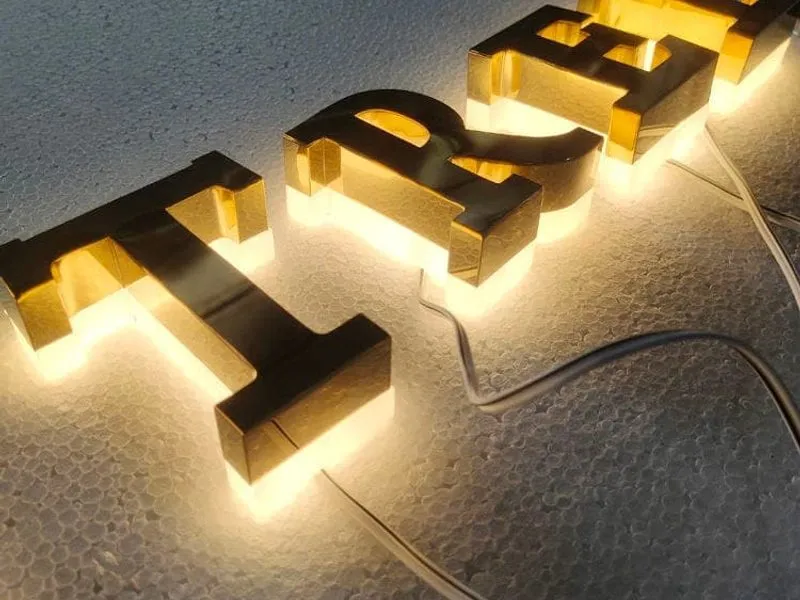
Here's what impresses clients: We can create letters with trimless faces, halo-lit backs, or dual-lit designs that switch from bright face to subtle glow depending on time of day. Check out what we can do with
rimless channel letters if you want a clean, modern look without the hardware showing.
Fabricated letter pricing scales beautifully. Front-lit
channel letters run $20-80 per letter from the factory. Halo-lit $35-120. Non-lit stainless $15-40. Your US retail price for the same job?
$200-700 per letter front-lit, $400-1,000 halo. That's why my phone keeps ringing.
## The Numbers That Actually Matter
Let me break this down with real numbers that should inform your decision, based on our actual production data.
Cast metal advantages:
- Wall thickness 5-10mm — they feel indestructible
- Fine detail reproduction from complex molds
- Zero seam lines (that's the clean aesthetic)
- Excellent for historic replication — age accelerates the patina
- Wind deflection? Not a concern
Cast metal disadvantages:
- Custom design = $800-3,000 mold investment
- Heavy — shipping kills you. We're talking $6-12 per kilogram by air.
- 3-6 weeks total timeline for cast (new molds need time)
- Finishes limited to what you can do to the raw casting
Fabricated metal advantages:
- No mold — any custom shape works on the first try
- Lighter, cheaper shipping. A set of 20 letters might weigh 60kg vs 180kg cast
- Any finish: PVD, powder coat, brushed, mirror, painted, plated
- Larger sizes — we do letters up to 2 meters easily
- Lead time: about 5-15 days. It's done before the cast even reaches final inspection
Fabricated metal disadvantages:
- Three-dimensional depth comes from fabrication design, not mold
- Thin walls (1-3mm) give it a lighter feel
- Visible seams if the fabricator is lazy (and they will be, at cheap shops)
- Can't replicate complex filigree like casting can
## The Ugly Truth About Quality Control
I've seen this go wrong too many times: someone buys fabricated letters from a cheap Chinese factory without checking their welding. Six months later, the seams are splitting and the finish is blistered.
The problem isn't fabrication. The problem is fabrication done wrong. Our welders average 15 years on TIG. Every letter goes through a 100% QC inspection before packaging. Every single one.
Ask for weld close-up photos before you commit to any supplier. If they hesitate, look elsewhere.
Another rookie mistake? Not checking what stainless grade you're actually getting. Cheap factories will substitute 201 stainless when you specify 304. It looks identical for six months, then starts rusting.
Our
stainless steel letters use verified 18-8 (304 grade) with material certification. For coastal installations, we'll recommend 316 with 2-3% molybdenum, and you'll pay 20-30% more — because it's worth every cent when the salt air starts chewing.
## When Cast Beats Fabricated: The Metal Sign Scenarios
Let's be specific about when you should push casting to the customer.
If they're building a bank, a courthouse, a historic theater, or a law firm trying to project centuries of stability, cast is the move. The visual weight translates to financial trust. Studies show customers rate businesses with dimensional signage as more credible.
Restaurants and hotels wanting that classic hospitality look? Cast letters with a warm finish say "we've been here forever." That's why you see them on those high-end boutique properties.
For signage taller than 2 meters, actually, fabrication wins. Cast letters that size would weigh so much you'd need structural engineers and a week just to rig them.
## When Fabricated Beats Cast: The Workhorse Scenarios
Strip malls, retail stores, corporate office parks, medical offices — anywhere you need clean, professional signage that doesn't break the bank.
The right price point gets you a sign you can install without special permits. You're not calling in a crane because 14 letters at 1-3mm stainless are manageable.
I had a customer last year buy fabricated letters for their office complex, thinking they were "getting a deal." When the first storm front rolled through, their neighbor's cast letters were fine too. But my customer paid 60% less for the same visual presence.
That's commerce. That's good business.
## Light Up Your Sign: LED Integration
Fabricated letters can be built with internal LED lighting. The
dual-lit channel letters we produce combine a illuminated face with a halo effect — you get visibility in daylight and that premium evening glow.
This is where fabrication completely outshines casting — you simply can't illuminate cast letters from within without loosing the structural integrity. If your client needs 24-hour visibility, you need fabricated.
For LED, you want SMD 2835 modules as the bare minimum. They run 100-150 lumens per watt, and quality modules from Samsung or Osram give you 50,000+ hours of life.
Don't let anyone sell you cheap LEDs. They'll last 12-18 months before failing, and your client will hold YOU responsible.
Cast letters are for presence. Fabricated illuminated letters are for marketing.
## The Shipping Reality
Look, nobody plans a sign install around a shipping container until they have to.
Fabricated letters ship flat — we nest them on steel pallets so you might fit 100 letters in the same space as 30 cast letters.
Air freight runs $4-12 per kilogram for fast delivery. Sea freight is $80-200/m³ LCL, but you're waiting about 65 days. That delay alone can kill a project timeline.
For anything under 100kg, express shipping in about 5-15 days at $30-100 becomes the most practical option. We make sure our packaging — foam, carton, plywood crate — protects even the most fragile surfaces.
## Certifications That Actually Matter (And Don't Cost You the Farm)
Don't let anyone scare you into paying $15,000 for a UL listing when you only need a basic sign for a coffee shop.
CE certification — the big one for exports — runs 20,000-50,000 RMB and takes 2-8 weeks. Look for factories that already have it. We do.
For US electrical connections, NEC Article 600 compliance matters most — that's a safety standard, not a performance certification. Any competent electrician will sign off on a sign built to those standards.
IP65 is the minimum outdoor rating — dust-tight and protected against water jets. IP66 for coastal or spray-prone areas. IP68 only if you're submerging half the sign or dealing with hurricane-grade rain.
## Here's What Nobody Tells You About Our Factory
We're not going to pretend to be something we're not. We're a mid-sized factory with 50+ skilled workers in 3,000m² of production space. We're not the biggest player, and that's exactly why you should work with us.
We've been exporting since 2010 and we take pride in what we do. Our founding team came from the sign industry — we don't just run machines, we understand what your business needs.
The factory-direct savings are real because we're cutting out the middleman. Sign shops that buy from us mark up 150-300% for their local installation work. They can do that because we're delivering the quality at factory-direct prices.
We export worldwide. CO2-neutral shipping options available.
## What We Can and Can't Do
Here's the honesty part they won't write in their brochures.
What we CAN do:
- Custom design and engineering for complex projects
- Fabricate any font, shape, or size you can give us as a vector file
- Produce high-quality
brass and copper letters with a gorgeous patina for premium clients
- Ship anywhere in the world with full export documentation
- Meet your deadline if you give us your real timeline upfront (not a miracle timeline after you've already cut it too close)
What we CAN'T do:
- Beat those $3-each import prices from factories using substandard materials — because we won't trade quality for a number
- Guarantee a 200-year lifespan. Our materials have honest ratings — 304 stainless for 10+ years, LED for 5+ years, acrylic at 90-92% transmittance that will yellow in 1-2 years if you buy domestic sheet or last 5-8 years if you spend the extra for UV-stable material
- Perform miracles on a 3-day turnaround. Our standard is about 5-15 days and that's what we promise
- Offer UL-listed products without charging you for UL-listed materials and processes — we'll happily do it because it's the right thing, but be ready for that cost
## The Bottom Line for Your Project
For indoor lobby signage or heritage designs — cast. For exterior storefronts, illuminated signs, or any project more than 10 letters — fabricated.
Ask your customer what matters more: the premium feel of cast metal against their fingers, or the affordability and flexibility of fabricated metal.
If budget is a constraint, fabrication wins. If the sign itself is a destination, casting delivers.
Don't be lured by the cheap overseas pricing pages claiming $5 per letter delivered. We've been in this game for decades — you get what you're willing to pay for.
## Questions to Ask Before You Commit to Any Factory
1. "Can you send me close-up photos of your weld seams?"
2. "Do you have material certificates for the stainless steel you use?"
3. "What's your exact lead time and shipping method for my project?"
4. "Can I see a sample of your LED modules and how they're sealed?" — This is critical for any illuminated sign, because moisture will kill an LED sign faster than anything else. We seal with neutral silicone and run an 8-12 hour aging test on every single sign that leaves our floor
5. "What experience do you have with signs in my climate?" — You need someone who knows 316 stainless for coastal areas and proper sealing for frost-prone regions
6. "Are your prices including freight and duties?" — Always confirm. Section 301 tariffs on Chinese goods into the US can add around 30% to your landed cost
## One Last Thing About Paying for Quality
I've watched sign shop owners lose their shirts on cheap imports. A container of rusting fabricated letters, a failed UL inspection, or a warranty nightmare that eats your entire margin.
Don't let that be you.
We're transparent about lead times, materials, and costs. We'll tell you when you're over-specifying, and we'll tell you when you're under-specifying. That's what 16 years on the factory floor gets you — judgment you can use before you commit.
The right fabrication partner makes you look good to your customer. The wrong one ruins your reputation one sign at a time.
## What's Your Project Looking Like?
If you want to talk through your specific project — whether it's 5 cast letters for a legal office, 50 fabricated letters for a retail chain, or an entire facade with LED — get in touch with a real person who'll give you straight answers.
We'll be honest about which process fits your job best, even if it means we make less on the deal. That's how you build a partnership that lasts, and that's how we've kept customers coming back since 2010.
Sometimes I get asked why a 52-year-old sign maker still cares about this stuff. The answer is simple: I've seen what a good sign does for a business. It's not decoration — it's a sales tool that works 24/7. Get it right, and your customer remembers.
Get it wrong, and you'll hear about it for years.
Ready to get it right? Send us your files. Let's build something that lasts.