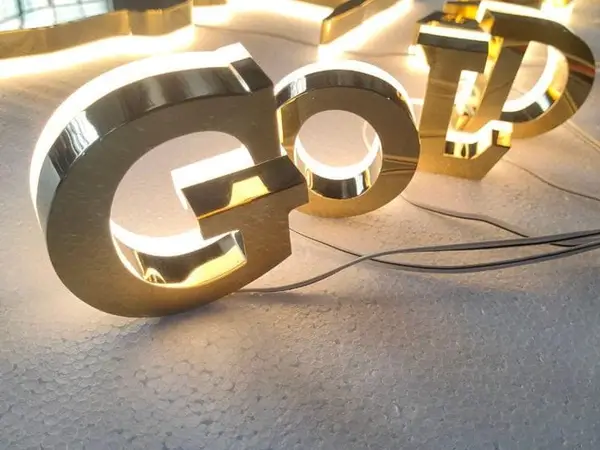
Look, I've been building signs since before some of you were born. I've seen it all. I've watched American contractors cry over a container of pitted stainless steel, and I've watched importers retire early because they found a factory that told them the truth. This guide is the truth.
Here's what nobody tells you: buying custom metal signs online factory direct isn't rocket science. It's just a minefield. You need to know where the bombs are buried.
---
The first thing you need to understand is the price gap. It's ridiculous. I've watched US retail shops charge $200–700 per letter for a front-lit channel letter. We ship the same letter—same 304 stainless, same Samsung LEDs—for $20–80. That's a 50–65% savings on the product itself.
The ugly truth is most of that US price is overhead, not materials. Rent in a strip mall, insurance, sales commissions, four trucks in the parking lot. You're not paying for better metal. You're paying for their lease.
---
Now, about the buzzwords.
Every factory claims "premium quality." Every factory claims "export grade." I've seen imports that looked like a raccoon chewed the edges, and I've seen domestic work that was worse. The difference isn't the label. It's the material spec and the guy holding the TIG torch.
Here's what I tell every contractor who calls me: get your material grades in writing. Not "stainless steel." Not "aluminum." Get the actual number.
What you need for outdoor metal signs, in plain English:
- 304 stainless: 10+ year outdoor life. 18% chromium, 8% nickel. This is your workhorse for most of America.
- 316 stainless: 15+ year marine grade. Contains 2–3% molybdenum. For coastal towns, industrial zones, anywhere with salt in the air. Costs 20–30% more than 304.
- Aluminum: Weighs a third of steel. Naturally rust-proof. 8–12 year outdoor life. Perfect for large letters where weight matters, or for that
aluminum letters look on a budget.
Don't let a factory sell you "stainless steel" without the number. If they can't tell you whether it's 304 or 316, they're buying whatever scrap fell off the truck.
---
I've seen this go wrong a thousand times: a client picks a design, signs the PO, and then gets a "surprise" about the acrylic.
For acrylic faces, you need to know what you're paying for. Domestic acrylic from Mitsubishi or Degussa has 90–92% light transmittance and UV resistance that lasts 5–8 years. Use that for any sign with thin letters or tight curves. The cheap domestic stuff will start yellowing in 1–2 years. You'll be getting warranty calls before the paint dries.
Common thicknesses are 2mm, 3mm, and 5mm. Here's the rule: anything over 2.5 meters wide, use 5mm or thicker. Thin acrylic flaps in the wind, flexes, cracks. I've watched sign shops try to save $30 on acrylic and lose $300 on a service call.
---
Let's talk about the LED modules, because this is where factories cheat the most.
The industry standard is SMD 2835, running 100–150 lumens per watt. That's fine for most jobs. For high-brightness applications like highway signs, you need SMD 5730 at 40–60 lumens per chip. That's the highest brightness you'll get. And for RGB color-changing work, you need SMD 5050.
Quality modules from Samsung, Osram, or Blueview will last 5+ years. The cheap no-name stuff lasts 12–18 months. That's the difference between a sign that pays for itself and a sign that gets you angry phone calls.
Every sign should be up to IP65 at minimum—that means dust-tight and protected against water jets. Don't let anyone sell you less for outdoor use. For coastal areas, spec IP66 or even IP68. The cost difference is small. The headache difference is huge.
---
Here's the part that makes contractors nervous: shipping and tariffs.
The US Section 301 tariff on Chinese goods is running about 30% right now. That's a fact. You need to factor that into your spreadsheets.
But even with the tariff, you're still ahead. Let's do the math. A stainless steel sign that costs $100 factory-direct gets hit with $30 in tariff. You're at $130. The US retail alternative is $400–1,000 per letter for halo-lit. You're still saving over 60%.
Shipping options break down like this:
- Express (DHL, FedEx): 7–15 days, $30–100 for small packages. Best for samples and prototype letters.
- Air freight: 10–20 days, $4–12 per kilogram. Good for mid-sized orders.
- Sea freight: 50–70 days, $80–200 per cubic meter for LCL (less than container load). A full container runs $1,200–3,000. This is where you get serious savings.
The ugly truth is every factory quotes "fast shipping." Most of them use air freight and pass the cost to you. Get the shipping cost in writing, in the quote, before you sign. Always.
---
Certifications. This is a minefield.
UL 48 certification (for USA) costs $4,000–15,000 and takes 4–9 months, with quarterly audits. It's expensive and slow. If a factory claims UL certification and they're a tiny operation with no audit trail, they're lying to you.
ETL is a legitimate alternative that's 10–30% cheaper. CE marking costs 20,000–50,000 RMB and takes 2–8 weeks. Most factories say they have CE. Ask to see the certificate with a date that isn't from 2018.
IP65 sounds impressive. It means water jets from any direction. It does NOT mean your sign survives a Florida hurricane. For that you need to spec IP66 or IP68, heavier gauge metal, and proper drainage holes. I've watched cheap signs fill with water and fry their LEDs in under a year.
---
For US jobs, remember NEC Article 600. That's the electrical code for signage. If your factory doesn't know what that is, they haven't done US work.
Also, if you're doing ADA-compliant signs for public buildings, you need tactile letters mounted 48–60 inches from the floor, non-glare finish, and Grade 2 Braille. The factory should know this cold. If you have to explain ADA to your manufacturer, find another manufacturer.
---
Now, the hard part. What we CAN'T do.
Here's what nobody tells you: we can't fix your bad design. We can laser cut, bend, weld, and polish with precision (tolerance of ±0.1mm), but if your file is garbage, your sign is garbage. I've seen logos so low-resolution they looked like they were drawn in MS Paint. I've seen files with missing fonts and corrupted paths.
We're a factory, not a miracle worker. Send us proper vector files (AI, PDF, CDR), or be prepared to pay for redrawing time.
---
The production process is straightforward. Ten steps, seven to fifteen days, from confirmation to crate.
Design confirmation takes 1 day. Laser cutting runs 1–2 days at ±0.1mm precision. Bending and welding (TIG welding, not that MIG garbage) takes 1–2 days. Grinding and polishing takes 1–2 days. The acrylic face gets CNC-cut in 1 day. LED assembly takes 1–2 days. Sealing with neutral silicone takes 1 day. Then there's an 8–12 hour aging test on every sign—that's where we power up the LEDs and make sure nothing burns out before it ships. 100% QC inspection. Then export packaging: foam, carton, plywood crate. No exceptions.
Total: 7–15 days, depending on complexity and how many letters you're ordering.
---
The MOQ is 1 piece. That's right. We'll build a single letter for you. You'll pay more per unit than a bulk order, but we won't turn you away.
Warranty: 2 years on LEDs, 1 year on the power supply.
---
Here's what I really want to emphasize, after 16 years in this business. The 316 stainless question. Everyone asks about it.
For a strip mall in Ohio? 304 stainless is fine. The air doesn't have salt. It'll outlast the tenant.
For Miami Beach? Pay for 316. The salt fog will eat 304 like acid. I've seen 304 letters pitted beyond repair in 18 months on Ocean Drive. You'll spend an extra 20–30% upfront, but you won't be replacing signs every two years.
The same logic applies to acrylic. If you're in Arizona or Texas, the UV will kill cheap acrylic in a year. Spec the Mitsubishi or Degussa material. It costs a little more. It lasts 5–8 years instead of 1–2.
---
Let me tell you a story about a contractor from Dallas.
He ordered 200 stainless letters from a factory that promised "premium quality" and "best price." The factory shipped them without the aging test. The LEDs started flickering after three months. The stainless was actually 201, not 304—it started rusting in the Texas humidity. He lost the entire job, plus his client.
Then he called us. We spec'd the proper materials, ran the full 10-step process, shipped the replacement in 12 days. He paid 15% more than the cheap factory. He saved his client relationship.
The moral: don't buy from the cheapest factory. Buy from the honest one.
---
If you're serious about buying custom metal signs online factory direct, you need to know what you're ordering. Let's break down the options:
-
Front-lit channel letters are the storefront standard. $20–80 per letter from the factory. Good for most businesses.
-
Back-lit halo letters cost $35–120 per letter. They're the premium architectural look—the light glows from behind, cutting a sharp silhouette. Great for banks, law offices, high-end stores.
-
Rimless channel letters have a clean, modern look. No visible trim cap.
-
Dual-lit channel letters are backlit and front-lit simultaneously. Perfect for businesses that need visibility day and night.
For metal letters, the choice is usually between our
stainless steel letters for maximum durability, or
aluminum letters when weight is a factor. For that old-money luxury look,
brass letters are unbeatable.
And if you're looking at sign boxes, we've got
acrylic light boxes priced at $80–250 per square meter. For the modern aesthetic,
neon flex signs run $30–200 per sign.
---
Two brutal truths before I wrap this up.
First: every factory promises "quality." Find me one that shows you its scrap rate. Ours is under 2%, and we'll tell you the number. If a factory can't explain its QC process in detail, it doesn't have one.
Second: the 100% QC inspection is a selling point because most factories skip it. We test every sign for 8–12 hours before it ships. That's why our warranty claims are under 1%. That's why repeat customers come back.
---
The bottom line is this: when you buy custom metal signs factory direct from a serious Chinese manufacturer, you can cut your costs by 50–65% without cutting quality. But only if you do your homework and buy from a factory that's honest about what they can and can't do.
Ask for material certs. Ask for the LED spec sheet. Ask for shipping costs in writing. Ask to see their QC process on video. A factory that's transparent about all of that is a factory you can trust.
I've spent 16 years in this industry. I've burned my hands on hot acrylic, argued with suppliers about LED bins, and watched good signs turn to rust because someone skimped on the material grade. Don't be that buyer. Spec it right, budget for the tariff, and buy from a partner who tells you the truth.
We do. Our doors are open, our scrap rate is on the record, and our factory has been exporting worldwide since 2010. If you're ready to order, we're ready to build.