
Look, I've been on the factory floor since 2010. I've wired more channel letters than I can count, and I've watched dimming go from a "maybe someday" to a spec-line requirement on half the RFQs we see. Most sign shops still treat "dimmable" like it's just flipping a switch. It isn't.
Dimmable LED channel letters are a system. You can't slap a wall dimmer on a 12V LED driver and call it done. That's the rookie mistake I see every month. Somebody orders a standard front-lit channel letter with a non-dimming driver, hooks it to a Lutron dimmer, and then calls me screaming about flicker and dead LEDs. It's not the LED's fault. It's your wiring plan.
The ugly truth is most cheap LED modules from no-name factories won't dim below 20% without strobing like a disco. If you're specifying a dimmable sign, you need to think about modules, drivers, and the control protocol together—not as a menu of separate parts. I've seen this go wrong: a contractor bought "dimmable" LED modules from one supplier and a driver from another. Neither talked to each other's spec sheets. The sign flickered at 30% brightness, then burned out the driver in four months. Now he's got an angry restaurant owner and a $1,200 replacement bill.
Energy codes are tightening. California Title 24, ASHRAE 90.1, and local ordinances all push for lighting controls. A sign that can dim at night isn't just a nice-to-have; it's often required to pass inspection. And it makes sense—why blast 100% brightness at 3 a.m. when nobody's on the street?
Here's what nobody tells you: dimming extends the life of your back-lit halo letters more than you think. LED modules are rated L70 ≥50,000 hours—that's how long before light output drops to 70% of original. But heat is the killer. Run a module at full tilt in a black acrylic face on a Texas afternoon, and that driver inside the letter cavity can hit 140°F. Dim it 30%, and you cut heat. The electrolytic capacitors in the driver don't cook as fast. The warranty on our drivers is 1 year, but a dimmed driver on a properly ventilated sign will often outlive that by a factor of three.
Customers ask for dimming because they want "ambiance." Hotels, restaurants, bars—they want the sign bright at happy hour, then soft after midnight. It's not about savings for them. It's about mood. But you should sell it as both.
Let's get specific. The module matters. SMD 2835 is the industry standard—100 to 150 lumens per watt. That's what we use in most front-lit channel letters. SMD 5050 is RGB-capable, so if you're doing color-changing signs you'll see those. SMD 5730 pushes the highest brightness—40-60 lumens per chip—but it runs hotter, so dimming becomes even more important to manage thermals.
Cheap modules are easy to spot. Look at the solder joints. Dull gray joints mean lead-free flux residue or worse—that module won't last 18 months. Shiny silver joints are proper lead-free solder, the kind you get from Samsung, Osram, or Blueview modules. Those are the 5+ year real lifespan modules. I won't touch a supplier that can't show me the reel.
The driver is where dimming actually happens. A driver either accepts a dimming signal or it doesn't. You can't make a non-dimming driver dim. Period. And not all "dimmable" drivers dim the same way. 0-10V is the workhorse in commercial signage. TRIAC/ELV works with existing wall dimmers in retrofit jobs. DALI is for large building automation. DMX is for animated signs. PWM is for color mixing. We'll break each down.
Minimum load is a real problem. Some drivers won't dim below 10% or 20% because the output becomes unstable. That's why you need to match the driver's minimum load spec to the total wattage of your modules. If you're running a 20W driver at 5W, it might not dim at all. That's not a defect—it's physics. Read the datasheet.
0-10V dimming is analog. You send a DC voltage between 0 and 10 volts to a control wire. 10V = full brightness. 1V = minimum. Simple, reliable, and works with almost any commercial lighting control system. But it has a flaw: low-end trim. Cheap 0-10V drivers will flicker or drop out below 10% brightness. Quality drivers—like the ones we pair with our back-lit halo letters—can go down to 1% smoothly. You get what you pay for.
TRIAC (also called leading-edge or forward-phase) is what's inside most residential wall dimmers. It's fine for retrofit jobs where the sign replaces an old neon or incandescent sign and the customer already has a dimmer on the wall. But TRIAC dimming was designed for resistive loads, not capacitive LED drivers. Mismatch causes buzzing, flickering, and early driver death. If you're using TRIAC, you need a driver specifically listed for ELV (electronic low voltage) dimming. Not all are.
DALI is digital. Each driver gets an address. A central controller can dim individual signs or groups. Overkill for a single storefront sign. But if you're doing a multi-tenant retail center with 40 signs, DALI is the only way to manage load shedding and schedules without running miles of control wire. Expect to pay more. It's worth it.
DMX is for show. If you want letters that chase colors, pulse, or do a light show, you need DMX. Our IoT smart signs can be app-controlled for simple dimming, but real DMX gives you frame-by-frame animation control.
PWM is the underlying method for color mixing—it rapidly pulses the LED on and off faster than the eye can see, varying the duty cycle. If you're doing RGB or tunable white, you'll deal with PWM dimming. The trick is avoiding visible flicker on camera. Cheap PWM drivers pulse at 200Hz and show banding on video. Quality drivers run at 1kHz or higher. Nobody wants their sign to look like a strobe on Instagram.
Here's the matrix nobody puts in a brochure: for a standard single-color sign with a basic dimming schedule, use 0-10V. For a retrofit with an existing wall dimmer, use TRIAC/ELV. For a large building with a BAS system, use DALI. For animated color signs, use DMX. If you're doing a stainless steel letter with a single dimming scene, stop overcomplicating it. 0-10V works fine.
Let's do some factory-floor math. A typical front-lit channel letter with a 24-inch face might pull 20-30 watts. Dim it to 50% from midnight to 6 a.m., and you save maybe 0.15 kilowatt-hours per night per letter. That's pennies per day. The real savings isn't electricity. It's driver replacement and service calls.
I've watched sign shops pay $800 for a front-lit letter from a domestic fabricator. Same 304 stainless, same Samsung LEDs. We ship that letter for $120. The math is brutal. Add dimming to a factory-direct order and the cost per letter goes up maybe $15-25 for a dimmable driver and control wiring. Over a 50-letter program, that's a thousand bucks. One service call to fix a burned-out driver on a non-dimming sign costs more than that. Twice.
Most sign failures aren't the LED. They're the driver. Drivers fail because of heat, moisture, or voltage spikes. Dimming cuts heat. Proper sealing with neutral silicone—not that cheap caulk some shops use—cuts moisture. A quality driver with surge protection handles spikes. I see drivers last 8 years in dimmed, well-sealed letters. I see the same driver die in 2 years when it's run full-bore in a poorly vented sign. That's not marketing. That's repair tickets.
Here's what nobody tells you about installation: remote driver placement matters more than the dimming protocol. If your driver is 30 feet from the LED modules, you've got voltage drop on the secondary wire. 12V DC loses about 5% over 20 feet of 18-gauge wire. That means your 100% brightness is actually 95%, and your 10% dim setting might not even light the LEDs because the forward voltage drops below threshold.
Run larger gauge wire for long secondary runs. 14-gauge or 12-gauge isn't overkill—it's cheap insurance.
Drivers generate heat. Don't bury them inside a sealed letter cavity with no airflow. Mount them in a junction box below the sign, or in a raceway with ventilation. If you're installing back-lit halo letters, the driver often sits behind the wall or in the ceiling. That's fine, but leave access. A driver will fail eventually, and if the sign shop has to tear open drywall to replace it, you've lost money.
Waterproofing is non-negotiable. IP65 means dust-tight and protected against water jets from any direction. That's the minimum for outdoor channel letters. IP66 handles powerful jets—coastal areas with wind-driven salt spray need that. IP68 is submersible, which you don't need unless your sign is going in a fountain. But IP65 doesn't mean hurricane-proof. I've seen signs ripped off buildings in 120 mph winds and the LED modules still worked—because the driver was in a sealed stainless enclosure and the wiring was marine-grade. The letters themselves bent like tin cans. That's a different problem.
Use neutrally-curing silicone for sealing acrylic faces. Acid-cure silicone can fog the inside of the acrylic and eat the LED solder joints over time. I've seen this go wrong: a shop used bathroom caulk on a white acrylic face, and six months later the face looked like it had cataracts. Nobody tells you that in the YouTube tutorials.
If you're selling into the US, you need UL 48 listing for electric signs. That costs $4,000 to $15,000 and takes 4 to 9 months, with quarterly audits after. If your factory doesn't have it, your sign might pass a field inspection with ETL listing—which is functionally equivalent and 10 to 30% cheaper. But don't lie about it. Some shops print "UL Listed" on their quote and then ship unlisted signs. That's a fast way to get a red tag and a lawsuit.
CE marking costs 20,000 to 50,000 RMB. Most factories will say they have it. Ask to see the certificate with today's date. Watch them sweat. A certificate from 2019 that expired is worthless. Same with RoHS and ISO 9001. A factory that's been running since 2010 should have current documentation. Ours does. Ask for the file. If they can't produce it in 24 hours, walk away.
NEC Article 600 covers electric signs and outline lighting in the US. It requires disconnects, proper wiring methods, and listing. Dimming adds a layer: the dimming control must be listed for the load type. A wall dimmer listed for incandescent only will not pass inspection on an LED sign. The inspector will look. I've watched a sign get red-tagged because the contractor used a $9 rotary dimmer from the hardware store. That $9 part cost the shop $400 in reinspection fees and a weekend rewiring.
For tactile signs—like room identification signs with Braille—ADA has its own rules. Mounting height 48 to 60 inches, non-glare finish, Grade 2 Braille. Dimming doesn't apply to those because they often aren't illuminated. But if you're doing a wayfinding system with dimmable LED modules, the drivers still need to be UL listed, and the wiring must be accessible.
I'm going to be blunt. Buying dimmable LED channel letters from a domestic fabricator is fine if you need them in three days and cost doesn't matter. But if you're doing a multi-location rollout—10, 20, 50 signs—factory-direct is the only way to stay profitable. Our factory in Lu'an, Anhui, China has 3,000 square meters of production space and 50+ skilled workers. We've been doing this since 2010. Minimum order is one piece. Lead time is about 5-15 days. Warranty is 2 years on LEDs, 1 year on power supplies.
Factory pricing per letter: front-lit channel letters $20-80, back-lit halo $35-120, stainless steel non-lit $15-40, 3D fabricated $40-120, aluminum $10-25. That's product only. Compare that to US retail installed: $200-700 per letter for front-lit, $400-1,000 for halo. The factory-direct savings on product is 50 to 65 percent. Add a dimmable driver and wiring, and you're still under $150 per letter. The shipping cost—express about 5-15 days, air about 10 days, sea about 65 days—is a fraction of the markup you're avoiding.
Now, the catch. Sea freight LCL means your crate gets handled 6-8 times between our dock and yours. Every touch is a chance for damage. That's not in the brochure. We pack every order with foam, carton, then plywood crate. But if the forklift driver at the warehouse drops it, that's not on us. Pay for insurance on LCL shipments. It's cheap. And factor the US Section 301 tariff—about 30% on many sign products—into your landed cost. Don't get surprised.
If you're specifying a dimmable program, work directly with the factory on driver compatibility. We use Mean Well or equivalent dimmable drivers with our LED modules. We can match 0-10V, TRIAC/ELV, DALI, or DMX. We test every sign on an 8-12 hour aging test before it ships. That means the sign runs at full brightness, then cycles through dimming profiles, then back to full. If it flickers on the bench, it doesn't leave the factory. That's a 100% QC inspection. Ask any domestic shop if they do that. They'll laugh.
One more thing. Ask for a sample letter before you commit to 50. Pay the $60 for express shipping. Hook it up to your own dimmer. Test the low-end trim. If it flickers at 5%, send it back and tell them to fix the driver. A good factory will do it without arguing. A bad one will send you a PDF of a datasheet and tell you it's "within spec." That's how you know who you're dealing with.
Can I use a regular wall dimmer on a dimmable LED channel letter?
Only if it's a TRIAC/ELV dimmer and the driver is listed for ELV dimming. A standard incandescent dimmer will cause flicker, buzzing, and eventually destroy the driver. Don't be lazy. Check the spec sheet.
What's the difference between 0-10V and TRIAC dimming?
0-10V uses a separate low-voltage control wire and gives you smooth, predictable dimming down to 1% with a quality driver. TRIAC chops the AC waveform and works with existing wall dimmers, but it's finicky with LED loads and often has poor low-end performance. For commercial signage, use 0-10V unless you're retrofitting a residential-style wall box.
Why does my dimmable sign flicker at low brightness?
Because the driver can't maintain stable output below its minimum load spec, or you have voltage drop on the secondary wire, or your dimmer's low-end trim is set too low. Fix in this order: check wire gauge, increase minimum dim level to 10%, replace the driver with one that has a lower minimum load rating. And stop buying $4 drivers from unknown sellers.
How much extra does dimming add to a channel letter?
Factory-direct, maybe $15-25 per letter for a dimmable driver and control wiring. That's it. If a shop quotes you $200 extra per letter for "dimmable option," they're padding. The hardware difference is negligible. The labor difference is zero—same wiring harness, just an extra control wire pair. Don't get ripped off.
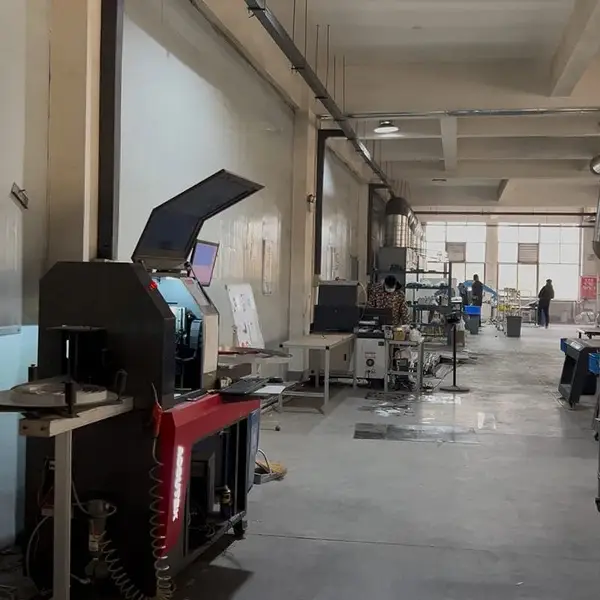
Real photo from our production floor — every sign we ship is made here.
Products mentioned or relevant to this topic — factory-direct, custom built.
From $24/letter · MOQ 1 piece · Flexible lead time · CE & UL certified · ships to 20+ countries
Custom sizes, colors, and finishes. Get a factory price in 24 hours.
Get a Free Quote Copy EmailWhatsApp +86 13865703472 · business@aochuangsign.cn