Directory signs are the unglamorous workhorses of a building. Nobody takes a selfie in front of one. But the second a courier can't find Receiving or an electrician walks into the wrong switch room, that cheap sign you accepted becomes a $5,000 problem.
I've watched facility managers torch a whole year's signage budget on pretty directory boards you can't update without a crowbar. We build this stuff in Lu'an, Anhui on a 3,000m² factory floor. 50 workers. Two shifts in summer.
Ugly truth: most directory signage fails because somebody picked a finish, not a system. A wall-mounted tenant list with slide-in acrylic strips beats a $4,000 digitally printed panel every time if you actually need to change names. You don't need more design awards. You need a sign that still works in 2028 when half your tenants have churned.
A directory sign isn't decoration. In a 12-story commercial tower or a 200,000-square-foot industrial park, the sign is the difference between a visitor finding the spec suite in three minutes or wandering past a high-voltage room because the sign fell off the wall last March. Function first.
Here's what nobody tells you: the cost of a bad directory sign is never the sign itself. You're paying for lost labor. Maintenance guys stopping to give directions. Front desk staff printing a new map every week. Contractors billing you $90 an hour to walk in circles. I've run the math. A proper modular directory pays for itself inside six months in a busy multi-tenant building.
Look, I'm not saying every directory needs to be a stainless steel monument. But if your building has more than three tenants, you need a real system, not something from the big-box sign aisle.
Industrial sites are even less forgiving. A directory sign outside an electrical room or warehouse bay gets vibration, dust, forklift exhaust, and the occasional pallet clip. The finish has to survive that. A pretty sign that looks like a hotel lobby and dies in a year is worse than no sign, because now you've taught everyone not to trust the signage.
Wall-mounted directory signs handle 80% of commercial jobs. They sit at a building entrance, main elevator bank, or corridor intersection. The good ones use removable aluminum or acrylic slats so a tenant change takes five minutes with your thumbs. The bad ones get a label maker or a sticker over the old name, which looks like exactly what it is: a repair, not a solution.
Floor-standing directory signs work best in lobbies with no usable wall space or where you need visibility from across a 40-foot atrium. They're heavier, need a flat floor, and a mail cart will knock into them at least once a year. Build them with a 3mm stainless steel base or you'll be re-welding a wobbly post by next spring. Not a guess. I've replaced 14 floor-standing directories for a single office complex because the original fabricator used 1.0mm zinc-plated sheet.
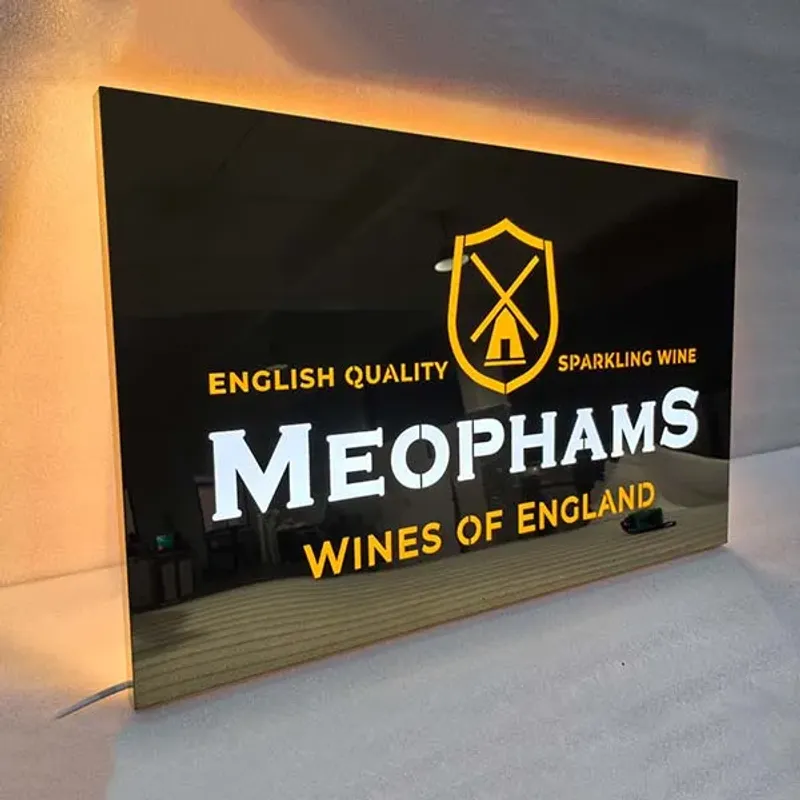
Illuminated directory signs are the premium option. You're looking at SMD 2835 LED modules rated L70 ≥50,000 hours — that's five-plus years of real use if you buy Samsung, Osram, or Blueview modules. Cheap no-name LEDs will die in 12 to 18 months and you'll be blamed. For a recessed, flush-mounted approach, an embedded lightbox doesn't stick out into the hallway and gives you an even face for tenant names. If you want individual letters instead of a lightbox, acrylic LED letters can be mounted onto a fixed panel and swapped individually.
Digital directories are seductive. They also need software, a CMS, a data connection, and someone who remembers the login. In a Class A tower, fine. In a 20-unit industrial strip, a static modular board will outlive three rounds of software updates and two IT managers.
Aluminum is the default for directory sign cabinets and frames. It weighs a third of steel, won't rust, and with a powder-coat finish it'll last 8 to 12 years outdoors. The catch is thickness. A lot of import boards use 0.040" (1.0mm) aluminum. That's fine for a wall-mounted interior sign. But a floor-standing directory that a hand truck hits? Not fine. For those, spec 1.6mm (0.063") minimum.
Acrylic is your window material and name-strip workhorse. Imported UV-resistant acrylic from Mitsubishi or Degussa holds up 5 to 8 years before yellowing. Domestic acrylic — the cheap stuff — starts to yellow in 1 to 2 years under direct sun. You won't see it from a conference room, but your tenant will. A 3mm face blocks about 8% of light. A 2mm face blocks 10%. You won't notice the 2% difference, but you'll notice the 40% cost bump when someone specs needlessly thick material.
For metal accents and durable lettering on directories, stainless steel letters are worth the money. 304 stainless is 18% chromium and 8% nickel — that's a 10-year outdoor life, minimum. If the building sits within two miles of salt water or in an industrial zone with acid rain, go 316. It has 2-3% molybdenum and costs 20-30% more, but it's the difference between replacing letters in 3 years or 15.
Laminates and painted MDF look great in a design render. I've seen this go wrong: a designer specs white oak laminate for a south-facing entrance directory, then the edges swell after two rain seasons and the landlord blames the sign company. Laminates are interior-only unless you're paying for marine-grade phenolic. If your directory touches weather, use aluminum, acrylic, or stainless. Period.
ADA is where everybody pretends to be an expert. Ugly truth: most 'ADA compliant' directory signs fail inspection. Not because of Braille quality. Because of mounting height, non-glare finish, or stroke width on secondary text. The rule is simple: tactile signs mount with the highest usable character at 60 inches and the lowest line of text no lower than 48 inches. Braille must be Grade 2, below the text, not floating around it like an afterthought. Glossy acrylic? That's a fail.
Look, I've had buyers tell me their local inspector doesn't care. Then a lawyer gets involved after a wheelchair user files a complaint and suddenly that $40 sign is a $40,000 settlement. Build to federal ADA guidelines even if your town uses the honor system. Your directory sign is the first thing a plaintiff attorney photographs.
For electrical safety on illuminated directories, if you're installing in the US, you need to know NEC Article 600. A CE mark doesn't mean squat for a US electrical inspector — CE is a European self-declaration that costs 20,000-50,000 RMB and takes 2-8 weeks. UL 48 runs $4,000-15,000 and takes 4-9 months. ETL is a cheaper alternative, about 10-30% less. Don't let a factory tell you 'CE is fine for the US.' Ask for the certificate with today's date. Watch them get quiet.
For outdoors, IP65 is the minimum. That means dust-tight and resistant to water jets. Storm-proof? No. If you're on a Florida coast or a Great Lakes pier, you need IP66 or IP68, and you need to be realistic about the enclosure, not just the label.
The first rule: if a directory sign doesn't update easily, it's a design failure. I've watched a property manager try to remove a tenant name from a laminated sign with a razor blade and Goo Gone. The whole panel looked like a crime scene. Modular systems — slide-in acrylic strips, magnetic backing, clip frames — cost 15-20% more upfront, but a name change drops from $150 to a five-minute in-house job.
Readability is not the same as pretty. For corporate and retail directories, use a 4000-5000K neutral white LED. Not 6000K blue-white, which makes a professional setting look like a gas station restroom. Warm 3000-3500K is for hospitality — hotels, restaurants, not a medical office building. Whatever you choose, keep the same color temperature across all panels. Mixing 3000K and 5000K in one hallway is how you get tenants asking if the sign is broken.
Here's what nobody tells you: your brand guidelines were likely designed for a website or a brochure, not a 4-inch tenant list at 20 feet away. Thin sans-serif fonts look great on a monitor. On an acrylic strip with backlighting, they bleed and disappear. If your typeface has stroke widths under 0.5mm, double it or choose a heavier weight. And for the love of all that is holy, don't put your logo at eye level if it pushes the actual directory text below ADA height.
Installation kills more directory signs than manufacturing ever will. A wall-mounted sign you anchor into drywall with plastic anchors will sag within a year. If the studs aren't where you need them, use a French cleat or a full-height 3mm aluminum backer plate that spans two studs. The sign itself might be 8 pounds; a person leaning on it while reading generates twice that. Account for it.
Maintenance is where factories and buyers lie to each other. LED modules carry an L70 ≥50,000-hour rating. That means after 50,000 hours, they're still emitting 70% of original light. That doesn't mean they last forever. Power supplies are usually the first thing to die. Factory warranties reflect this: we offer 2 years on LEDs, 1 year on power supplies. If a supplier offers a 10-year warranty on a $120 directory, ask where the extra $40 for the replacement fund is hiding.
Total cost of ownership is the only number that matters. A factory-direct directory sign costs roughly 50-65% less than what a US retail shop charges for the same product. But sea freight adds about 65 days and your crate changes hands 6 to 8 times between our dock in Shanghai and your loading bay in Ohio. Every touch is a chance for damage. If you need one sign, express shipping in about 5-15 days is worth the $30-100. If you're ordering a full wayfinding system across multiple buildings, consolidate into a sea shipment and buffer your schedule.
Here's what nobody tells you: factory-direct doesn't mean cheap junk if you know how to write a spec. We've built 3,000m² of production capacity in Lu'an with laser cutting at ±0.1mm, TIG welding, and an 8-12 hour aging test on every illuminated unit before it ships. MOQ? One piece. Lead time? about 5-15 days. You don't need to buy 500 units to get a real factory price.
When you ask a factory for a quote, don't just send a photo and say 'same but cheaper.' That's how you get 1.0mm aluminum when you needed 1.6mm, or domestic acrylic that yellows in 18 months. Specify: material, thickness, finish, LED module brand, IP rating, mounting method, and whether you need UL/ETL. Send a drawing or mark the critical dimensions. A good factory will ask you about stud spacing and power supply placement. A bad one will just say 'yes, we can do, friend.'
For a complete, code-compliant system rather than a one-off board, specify a wayfinding and directional system from a single manufacturer. Mixing a wall directory from one vendor, floor pylons from another, and room signs from a third means three different finishes, three different typefaces, and no single point of responsibility when the inspector asks questions. I've watched that blame game play out in hospital corridors. The designer's never the one who gets fired.
And ask for the certs up front. CE, RoHS, ISO 9001 are baseline for export. UL 48 or ETL is extra and you'll pay for it. The factory should be able to show you the certificate with a current date, not a scanned PDF from 2015. If they hesitate, walk.
Can I just paint over an old tenant name on an existing directory? You can, and then everyone will know you're cheap. Paint fades at a different rate than the facing material. Four months later you've got a ghost name glowing through. If the panel isn't modular, you either replace the whole face or you live with the ghost. That's not a maintenance plan, it's a shrug with extra steps.
Do I really need Grade 2 Braille on my directory sign? Yes, if it's a permanent room sign in an ADA-covered building. Grade 2 is the contracted form, not some optional premium. If your fabricator says Grade 1 is fine, find another fabricator. Same goes for non-glare finish. An inspector won't argue with you. They'll just fail you and walk out.
What's the difference between a $200 directory and a $900 one? The $200 one is probably 1.0mm aluminum, domestic acrylic, no-name LEDs, and a scanned JPEG of a CE certificate. The $900 one should be 1.6mm material, imported UV acrylic, branded LED modules, and a real warranty with someone who answers the phone. You'll replace the cheap one in 18 months. That's not value, that's a subscription to problems.
Can I order one directory sign from a factory overseas? Yes. MOQ? One piece. But don't expect one-piece pricing to beat your local shop on a single small board once shipping and tariffs are in. The 50-65% factory savings compounds when you're buying a building set or a multi-location program. If you need one sign fast, go local. If you need 30 signs over 12 months, call the factory and stop paying retail installed rates.

Real photo from our production floor — every sign we ship is made here.
Products mentioned or relevant to this topic — factory-direct, custom built.
From $24/letter · MOQ 1 piece · Flexible lead time · CE & UL certified · ships to 20+ countries
Custom sizes, colors, and finishes. Get a factory price in 24 hours.
Get a Free Quote Copy EmailWhatsApp +86 13865703472 · business@aochuangsign.cn