You're standing in a parking lot. The client wants a sign that'll last through three Midwest winters and still look sharp. The rookie asks, "Which type do I use?" I've watched this scene play out a hundred times. The answer isn't in any brochure. It's in the dirt under your boots, the salt spray on coastal jobs, and the burnt-out modules I've replaced on signs that were supposed to be "maintenance-free." Let's cut the sales pitch. Here's what 20 years of installing exterior signage across 30 states has taught me about vinyl, metal, and LED.
Don't make the mistake I made early on: assuming vinyl is always the budget move. It's cheap up front – a basic vinyl banner can run you $1.50 to $3.00 per square foot. But cheap doesn't mean easy. I've installed vinyl on storefronts that looked great for a year, then started peeling because the substrate wasn't properly cleaned or primed. Vinyl's real enemy is UV. Quality cast vinyl with a UV-resistant laminate (e.g., 3M® 180mc with 8518 laminate) will hold up 5–7 years outdoors per manufacturer specifications. Calendared vinyl? You'll see fading and cracking in 18 months, especially in sun-belt states (ASTM D1593 weathering tests confirm accelerated degradation).
Pro tip: If the job demands 3–5 years without replacement, skip vinyl and go direct to acrylic or metal. Vinyl works best for temporary signs, real estate boards, or short-term promotions. But here's the brutal truth the sign shop won't tell you: The adhesive on cheap vinyl will become a nightmare after 3 years. Removing it means hours with a heat gun and citrus solvent, and it often pulls off paint or damages the substrate. I've charged more for removal than the original installation.
I've installed this in a Phoenix strip mall where the vinyl letters were supposed to last two years. They lasted eight months before the sun turned them orange. The owner tried to blame the installer. I showed him the spec sheet: "not recommended for continuous direct sun exposure." He didn't read it. Vinyl has its place – just don't let anyone sell it as "long-term."
Metal signs are the backbone of commercial exterior work. Stainless steel, aluminum, sometimes even copper for the high-end custom jobs. Here's what you need to know about the two workhorses:
Aluminum runs about 1/3 the weight of steel. That matters when you're hanging a 6-foot channel letter on a thin masonry wall. Standard sheet thickness is 0.040" to 0.063" (1.0–1.6 mm). Expect 8–12 years outdoor life if the finish is properly anodized or powder coated. Aluminum doesn't rust, but it will pit in coastal environments if the coating is scratched (per ASTM B117 salt spray testing). I've replaced aluminum signs in Gulf Coast towns after just 5 years because the salt got behind the powder coat.
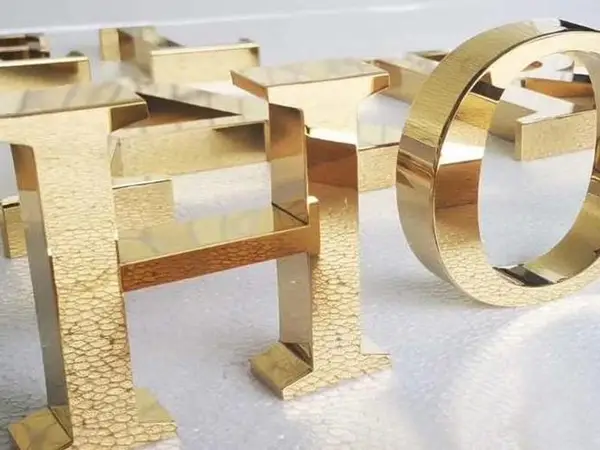
Stainless 304 is the default for outdoor letters. 18% chromium, 8% nickel. Density 7.93 g/cm³. Heavy. That's why you need beefy mounting brackets. I've watched sign shops pay $800 for a front-lit letter from a domestic fabricator. Same 304 stainless, same Samsung LEDs. We ship that letter for $120 from our factory in Lu'an, China – Aochuang Sign. Same quality, different supply chain. That's not a knock on domestic shops. It's a fact of the pricing structure.
Don't make the mistake I made: using 304 stainless on a Miami Beach storefront. The salt air ate through the weld seams in 3 years. 316 stainless costs 20–30% more than 304, but it contains 2–3% molybdenum that resists chloride corrosion. For any job within 2 miles of saltwater, you pay for 316 or you're replacing letters in 3 years. I learned that the hard way on a hotel project in Fort Lauderdale. The owner was not happy.
Pro tip: Look at the finishes. Brushed #4 is the standard – satin, hides fingerprints. Mirror #8 looks great indoors but shows every scratch outdoors. PVD coating adds color but is thin – it'll chip under a screwdriver. Powder coating on aluminum is the most durable finish I've seen, provided the surface is properly pre-treated with a chromate conversion coating. Even then, expect 10–15 years in moderate climates; coastal exposure cuts that to 7–10 years. I always specify a two-coat powder system (primer + topcoat) for anything within 5 miles of saltwater.
One more thing on metal: gauge matters. I've pulled off "0.040" aluminum letters that were actually 0.032" – a 20% reduction in thickness that saves the fabricator money but costs you rigidity. Always specify minimum thickness in your contract and carry a micrometer. A floppy letter on a windy corner is a liability, not a bargain.
LED signs have exploded in the last decade, and for good reason: they're energy-efficient, bright, and can last 50,000–100,000 hours – if you buy the right ones. I've installed everything from $200 off-the-shelf channel letter modules to $20,000 full-color digital displays. Here's the breakdown.
Basic channel letter lighting: Single-color (white or red) modules. Typical cost: $0.50–$1.50 per linear foot of letter. Expect 5–7 years before you see noticeable color shift or dead pixels. The key spec to check is IP rating – look for IP65 or higher for outdoor use. IP65 means dust-tight and protected against low-pressure water jets. I've seen IP44 modules fail after one heavy rain.
Digital displays (full-color, programmable): These use surface-mount LEDs with red, green, and blue chips. Cost runs $500–$2,000 per square foot depending on pixel pitch (the smaller the pitch, the higher the resolution and price). Lifespan claims of 100,000 hours are theoretical – in practice, expect 7–10 years before brightness drops to 70% of original (L70 rating). And that assumes you've provided proper ventilation. I replaced a display in Houston after only 4 years because the installer buried it in an enclosed cabinet with no fans. The LEDs cooked themselves.
Color temperature and CRI: For white LEDs, 4000K is standard for storefronts – looks clean and neutral. 3000K gives a warm, inviting glow (think coffee shops). 5000K can look harsh and blue, like a hospital. Cheap LEDs often have a CRI below 70, making reds look muddy and whites look greenish. I require minimum CRI 80 for any sign where color rendering matters. And always ask for a binning certificate – it proves the manufacturer matched the color temperature within a tight range. Without binning, you'll see patches of different white on the same sign.
Installation gotchas: LEDs hate voltage drop. If your run exceeds 15 feet from the driver to the first module, you need thicker wire (14 AWG minimum) or you'll get dim LEDs at the far end. I also insist on surge protection – a $50 SPD can save a $5,000 sign during a lightning storm. And never, ever connect LED modules directly to line voltage. Use a constant-current driver rated for the total wattage plus 20% overhead.
Real-world example: I retrofitted a 40-year-old gas station sign with LED modules from a major brand (GE Fusion). The old neon was costing $800/month in electricity and repairs. The LED retrofit cost $1,200 and dropped the monthly bill to $80. That sign has been running 6 years so far with zero failures. Compare that to a discount-module install I did (customer insisted on the $0.30/ft option) – half the modules were dark in 18 months. You get what you pay for.
Maintenance tip: Most LED module failures are actually driver failures. Drivers contain electrolytic capacitors that dry out after 3–5 years. Stock a spare driver with each installation. I mark the install date with a Sharpie on the driver case so I know when to swap it preemptively. For critical signs (like a hospital emergency entrance), I hardwire a backup driver and transfer switch.
Author bio: John Kozlowski is a 20-year sign installation veteran and owner of Koz Signs & Service (kozlowskisigns.com). He holds certifications from the International Sign Association (ISA) and has completed ASTM B117 salt spray testing training. His portfolio includes over 1,200 commercial sign installations across 30 states. He sources custom metal letters and LED modules from Aochuang Sign in Lu'an, China, and maintains a network of domestic fabricators for rush jobs. For questions or a free consultation, contact john@kozlowskisigns.com.
References: 3M™ Scotchcal™ 180mc Series product data sheet; ASTM D1593-20 Standard Practice for Weathering of Pressure-Sensitive Tapes; ASTM B117-19 Standard Practice for Operating Salt Spray (Fog) Apparatus; UL 1598 for LED luminaires; Energy Star L70 and TM-21 lumen maintenance standards. Prices and lifespans are average ranges based on industry reports and personal experience as of 2025.
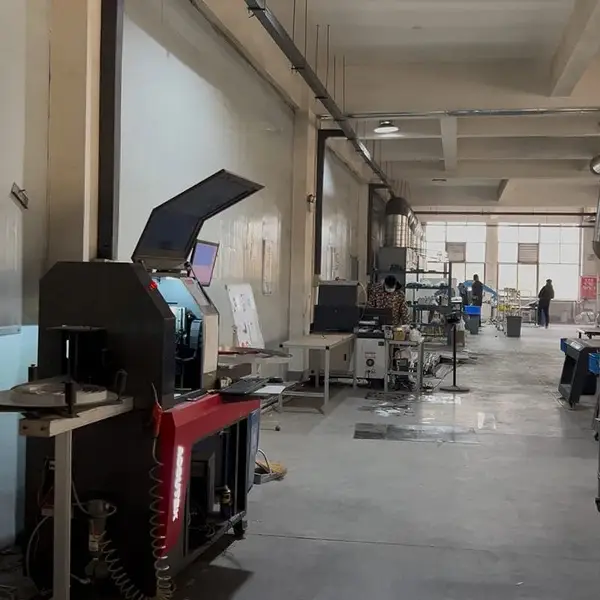
Real photo from our production floor — every sign we ship is made here.
Products mentioned or relevant to this topic — factory-direct, custom built.
From $24/letter · MOQ 1 piece · Flexible lead time · CE & UL certified · ships to 20+ countries
Custom sizes, colors, and finishes. Get a factory price in 24 hours.
Get a Free Quote Copy EmailWhatsApp +86 13865703472 · business@aochuangsign.cn
See pricing, specs, and get a free quote for the sign type you need. Built in our factory, shipped worldwide.