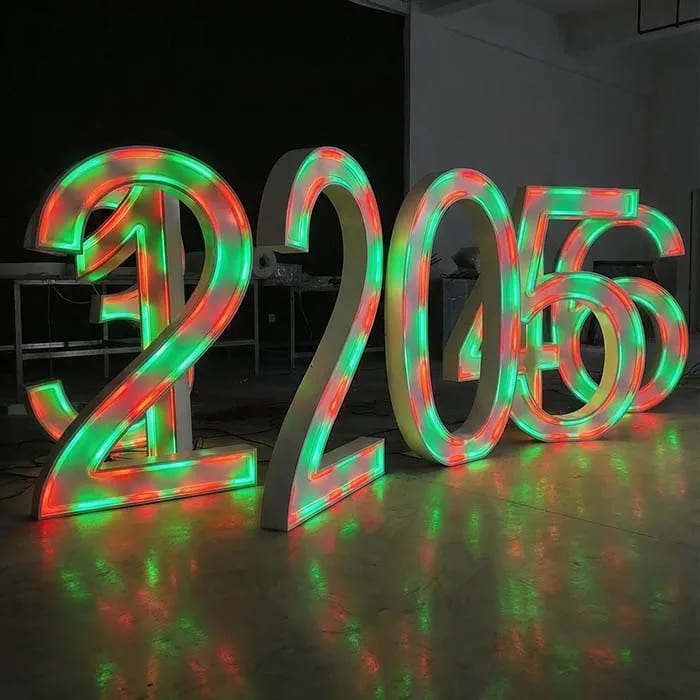
Face lit letters — most shops call them front-lit channel letters — are exactly what they sound like. You light the face from inside. Light passes through an acrylic face, the returns block light, and the back mounts to the wall or a raceway. So simple. Until someone skips a step.
Aochuang Sign makes them every day on a 3,000 m² floor with 50+ workers who've done this since 2010. A proper face lit letter has an aluminum or stainless steel return, a UV-rated acrylic face, an LED module strip, a trim cap, and a sealed back. The acrylic face transmits 90–92% of the light, depending on thickness. That's the whole magic.
And here's the part nobody warns you about: the trim cap isn't decoration. That thing's the seal. If you don't snap it tight or you use the wrong silicone, water creeps inside. Then you're redoing a client's storefront in 18 months.
If you're ordering front-lit channel letters for a storefront, spec the face thickness off the letter height. Over 2.5 meters, use 5mm acrylic, not 2mm. A big letter with a thin face bows. Once it bows, the silicone tears.
Look, reverse lit and halo-lit are the same damn thing, depending on which fabricator you're talking to. One shop says "reverse channel." Another says "halo." Both mean the face is opaque and the light spills out the back, creating a glow on the wall. Don't let anyone charge you a design fee for renaming it.
Face lit is the workhorse. A front-lit channel letter punches white or colored light straight through the acrylic. That's why it wins for roadside visibility and storefronts in a strip mall.
Factory price runs $20–80 per letter. A back-lit halo letter runs $35–120 per letter from the same factory line. On the installed side, US retail typically lands at $200–700 per front-lit letter and $400–1,000 per halo lit letter.
Halo-lit letters look expensive, but they don't read as bright at night. If your client's parking lot is 300 feet from the road, halo looks like a soft architectural accent. Face lit looks like a sign.
That doesn't make halo bad. It makes it the wrong tool for some jobs, and plenty of architects don't want to hear that. I've sold both. I've also had to explain to a restaurant owner why their $12,000 halo-lit façade is invisible from the highway.
My rule: hospitality and corporate lobbies lean halo. Retail, highway, grocery, auto shops — face lit. If they want both, look at back-lit halo letters with a separate front-lit option on alternating letters, or just dual-lit.
The word "aluminum" covers a lot of sins. A quality aluminum return is 1.0–1.6mm thick. It weighs one-third of steel and gives you 8–12 years outside without rusting. Cheap returns are thinner, dent easier, and wobble in a breeze.
For coastal or industrial jobs, step up to 304 stainless steel letters. That's 18% chromium and 8% nickel. It'll last 10+ years outdoors. If the site sits within a few miles of salt water, 316 stainless is the call. The molybdenum content buys you 15+ years marine-grade life, but it costs 20–30% more than 304.
For a strip mall in Ohio, 304 is fine. For Miami Beach, pay for 316 or you're replacing letters in three years. That's not an upsell. That's physics.
Acrylic is where rookies go cheap. UV-resistant acrylic from Mitsubishi or Degussa lasts 5–8 years before yellowing. Domestic no-name acrylic can start to yellow in 1–2 years. You won't see it in the sample photo. You'll see it on the wall after two summers.
Common face thicknesses are 2mm, 3mm, and 5mm. A 3mm acrylic face cuts 92% light output. A 2mm face cuts 90%. Your customer won't notice the 2%, but they will notice the 40% cost bump if you over-spec thickness. Over 2.5m letters, though, 5mm minimum. No exceptions.
For interior jobs or lightweight fascias, acrylic LED letters with an aluminum backing plate can save money and still look sharp. But don't hang them outside unless the acrylic is UV-rated and the LEDs are potted or sealed.
The ugly truth: most sign shops don't inspect the LED modules until they fail. Quickest way to spot bad LED modules? Look at the solder joints. Dull gray solder won't last 18 months. Shiny silver is proper lead-free solder. Quality modules from Samsung, Osram, or Blueview run 5+ years real lifespan. Cheap modules? 12–18 months, then the service calls start.
LED modules aren't all the same, and the lumen numbers on a spec sheet are usually optimistic. SMD 2835 is the industry standard, putting out 100–150 lumens per watt. SMD 5730 is the high-brightness option at 40–60 lumens per chip. SMD 5050 is what you use for RGB color-changing letter faces. If a supplier can't tell you the chip type, walk.
Color temperature matters more than most clients realize. 3000–3500K warm white suits hospitality and restaurants. 4000–5000K neutral works for corporate and retail. 6000–6500K cool white is for industrial, highway, and anywhere you need maximum punch. I've seen a hotel spec cool white because the architect liked "clean white." It looked like a hospital. We tore it out.
Lifespan claims are based on L70: the LEDs still hit 70% output at 50,000 hours. That's five and a half years of continuous burn. But that's the chip. The power supply is another story. Most channel letter power supplies carry a 1-year warranty because heat and water kill them faster than the LEDs. We give 2 years on LED modules and 1 year on power supplies. That's honest.
Heat kills. If the letter can't vent, the power supply cooks. If the LED strips are packed tight to boost brightness without thermal management, the solder weakens. Every letter we build runs an 8–12 hour aging test before it leaves the floor. That catches the early failures so you don't have to.
IP ratings get thrown around like candy. IP65 means dust-tight and protected against water jets from any direction. It does not mean your sign survives a Florida hurricane. IP66 is for powerful jets and coastal conditions. IP68 is submersible, overkill for 99% of storefronts. For most outdoor face lit letters, IP65 is the minimum. For Miami or Galveston, IP66.
If you can't read it from across the parking lot, it's a wall decoration, not a sign. Face lit letters fail at legibility when the stroke is too thin for the LED module, the face color filters the light too hard, or someone shrinks the letter height to fit a landlord's sign band that was never meant for a proper sign.
Bigger letters aren't just for looks. A 2.5-meter letter needs 5mm acrylic or it'll bow. A smaller letter can use 2mm or 3mm depending on exposure. But don't put five rows of text on a 3-meter wall and expect anyone to read it at 40 miles an hour. I've watched clients do this, then call back two months later asking why the sign "doesn't work." The sign works. The layout doesn't.
Face color and LED color interact. A white acrylic face with 6000K LEDs gives you the brightest output. A dark red or navy acrylic face filters a lot of light, so you'll need more LED density or brighter modules to keep the same punch. Warm white 3000K behind a red face looks like a mouthful of embers if you do it wrong.
Stroke width matters more than overall letter height. If the face stroke is narrower than your LED module, you'll get hot spots and shadows. Don't overthink a formula. Print the layout, tape it to the wall at full size, and stand across the street. If you have to squint, the client will too.
I've seen this go wrong: a shop ordered a beautiful set of face lit letters, installed them with an unlisted power supply, and the inspector failed the whole façade over UL. In the US, NEC Article 600 governs electric signs. That's not optional.
UL 48 certification costs $4,000–15,000 and takes 4–9 months with quarterly audits. ETL is an accepted alternative and runs 10–30% cheaper. CE is a European marking, not a US pass.
CE marking costs 20,000–50,000 RMB in China. Most factories will say they have it. Ask to see the certificate with today's date. Watch them sweat. At Aochuang Sign, we have CE, RoHS, and ISO 9001. We'll send the paperwork before you send a deposit.
Mounting matters. If you're installing on brick, use a backer panel or raceway so the letters don't trap water against the wall. Seal every penetration with neutral silicone. If the letters sit on a ledge, make sure the bottom isn't sealed tight — water needs a way out. I've seen letters fill up like fish tanks because someone sealed all four sides and the back had no weep hole.
IP ratings aren't the only electrical consideration. Outdoor face lit letters should be IP65 minimum, IP66 for coastal or high-pressure washdown. But a high IP rating won't fix a bad install. If the power supply box is mounted where the sprinklers hit it, you'll be back in six months. Mount power supplies inside a ventilated enclosure, away from direct water, and use waterproof connectors. That's not in the architect's spec. It's in the service call history.
Here's the math. Factory price for a front-lit channel letter at Aochuang Sign is $20–80 per letter, depending on size and finish. US retail, installed, runs $200–700 per letter. That's 50–65% savings on product if you import directly.
But once you add express or air freight, the Section 301 tariff of about 30%, and your own labor for final assembly and install, your total project savings usually land around 20–35%. That's real money on a $20,000 façade.
We're not a middleman. The factory runs 3,000 m² of production space in Lu'an, Anhui, China with 50+ workers. MOQ is one piece. Lead time is 7–15 days after design approval. Warranty is 2 years on LED modules, 1 year on power supply. If a factory wants a 100-piece minimum, they're not a factory. They're a trading company with a warehouse.
Shipping isn't magic. Express is 7–15 days for $30–100 on small orders. Air freight is 10–20 days at $4–12 per kilogram. Sea freight is 50–70 days, at $80–200 per cubic meter for LCL or $1,200–3,000 for a full container. LCL sea freight gets handled 6–8 times between our dock and yours. Every touch is a chance for damage. That's not in the brochure, but you need to plan crating for it.
The cheapest quote often isn't the cheapest after it arrives. If the letters show up with cracked acrylic because the crate was juice-box cardboard, your 50% savings evaporates in reorder time and client anger. We pack with foam, then carton, then plywood crate. We also run a 100% QC inspection before packaging. You don't see that in a line-item quote, but you'll feel it at install.
If you're quoting a client next week, pull a factory price and add freight, tariff, a 20% buffer for customs, and your install labor. That'll keep you under domestic wholesale and still ahead when the project closes. If you need a quick sanity check on whether to go factory-direct, we do a design confirmation in 1 day, laser cutting at ±0.1mm, TIG welding, 100% QC, and ship in 7–15 days. Then you'll understand why so many shops stop fabbing in-house and start importing.
Q: Why don't you just quote me a price without asking forty questions?
A: Because a 12-inch flat-cut acrylic letter and a 5-foot stainless return with RGB modules aren't the same product. If you don't know the size, face thickness, LED color temp, and mounting method, the number I give you is a guess. I don't do guesses.
Q: Can I get a free sample?
A: No. We'll fabricate a single letter at the same factory price and ship it express. That sample costs you maybe $250 total, and it'll tell you more than a photo. If you can't trust certifications and a video tour of the floor, importing probably isn't for you.
Q: Is CE enough for a US install?
A: No. CE is Europe. The US has NEC Article 600, and inspectors want UL 48 or ETL. I've answered this one too many times. Don't find out at final inspection.
Q: How fast can I get 40 face lit letters for a grand opening?
A: If you approve the drawing today, our lead time is 7–15 days in production, then express freight is another 7–15 days. Sea freight is 50–70 days. Plan backwards from install day and don't call me a week before the ribbon cutting.

Real photo from our production floor — every sign we ship is made here.
Products mentioned or relevant to this topic — factory-direct, custom built.
From $24/letter · MOQ 1 piece · Flexible lead time · CE & UL certified · ships to 20+ countries
Custom sizes, colors, and finishes. Get a factory price in 24 hours.
Get a Free Quote Copy EmailWhatsApp +86 13865703472 · business@aochuangsign.cn