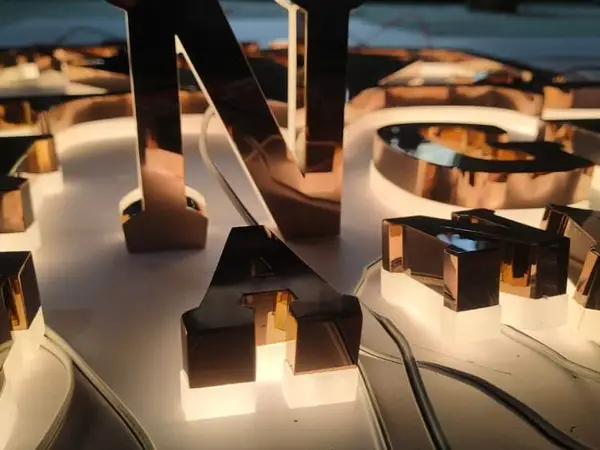
11 p.m. I just finished packing a crate of 40 front-lit channel letters headed to a strip mall in Dallas. The acrylic still smells faintly of laser cutting and neutral silicone. I've been on this factory floor since 2010, and I've seen every way a sign order can go sideways. If you're hunting for a "sign maker" because you need commercial work—not a Pinterest project—you need to know what separates a real fabricator from a guy with a vinyl cutter and a dream.
Look, a full-service sign maker isn't a print shop that happens to sell signs. They need to handle design files, laser cutting, metal bending, welding, LED assembly, silicone sealing, aging tests, and export-grade packaging. Our factory in Lu'an, Anhui runs a 10-step process from design confirmation to a packed crate in 7 to 15 days. If a vendor can't walk you through every one of those steps, they're outsourcing it.
If you're ordering front-lit channel letters for a storefront, you want the shop that actually bends the returns and welds the corners, not the one that emails a file to another province. That's the difference between a manufacturer and a middleman.
A real sign maker also knows LED modules by name, not just "bright white." We use SMD 2835 diodes at 100–150 lumens per watt as the standard. Cheap modules last 12–18 months. Good ones from Samsung, Osram, or Blueview run 5+ years real lifespan. Ask which one is in your quote before you sign anything.
Here's what nobody tells you: most "sign makers" in the US aren't fabricating anything. They're graphic designers who take your deposit and forward your artwork to a factory in China, then tack on 60 to 70 percent.
I've watched sign shops pay $800 for one front-lit letter from a domestic fabricator. Same 304 stainless. Same Samsung LEDs. We ship that letter for $120. Factory-direct pricing on front-lit channel letters runs $20 to $80 per letter. US retail installed runs $200 to $700. That's 50–65% savings on product before you even talk installation.
But factory-direct isn't for everyone. If you need one sign installed next Tuesday and you're not a contractor, a local shop earns their markup through permits and labor. If you're a sign shop or an importer placing volume orders, cutting out the middleman is how you survive margin pressure.
The ugly truth: material spec matters more than the render. For acrylic LED letters, the face is everything. Good cast acrylic transmits 90–92% of light. UV-resistant stock from Mitsubishi or Degussa lasts 5–8 years outdoors. Domestic acrylic starts yellowing in 1–2 years. That's not aging. That's cheap resin. If the face is over 2.5 meters, go 5mm thick or it'll bow like wet cardboard.
For metal, 304/316 stainless steel letters are the workhorse. 304 has 18% chromium and 8% nickel—good for 10+ years outdoors. 316 adds 2–3% molybdenum for coastal and industrial air. That costs 20–30% more. Strip mall in Ohio? 304 is fine. Miami Beach? Pay for 316 or you're replacing letters in 3 years.
Aluminum weighs a third of steel and rust-proofs itself, giving 8–12 outdoor years at 1.0–1.6mm thickness. But if you want that architectural halo glow, back-lit halo letters with a 2mm acrylic face cut light output to 90%. A 3mm face cuts 92%. Your customer won't notice the 2% difference, but they'll notice the 40% cost bump from over-spec'ing.
LEDs: SMD 2835 is the standard at 100–150 lm/W. SMD 5730 pushes 40–60 lumens per chip for high brightness. SMD 5050 handles RGB. L70 rating of 50,000 hours means the LED is still at 70% brightness after that long—if you buy real modules. Quickest way to spot bad LED modules: look at the solder joints. Dull gray means the module won't last 18 months. Shiny silver is proper lead-free solder.
The ugly truth: most quotes are worthless if they don't list material thickness, LED module brand, and power supply spec. I've seen a $90-per-letter quote turn into $190 after they added silicone sealing, IP65 power supplies, and export packing.
US Section 301 tariffs add roughly 30% to Chinese sign imports. Sea freight LCL runs $80–200 per cubic meter. Dock crews handle your crate 6–8 times between our dock and yours. Every touch is a chance for damage. Forklift drivers don't read "fragile." Express shipping for small orders runs $30–100 and takes 7–15 days. Air freight is $4–12 per kilogram. Sea freight takes 50–70 days.
Ask for a line-item quote: metal gauge, acrylic brand and thickness, LED module model, power supply brand—Mean Well, not no-name—silicone type, packaging spec (foam plus carton plus plywood crate), and Incoterm. If they won't break it down, they're hiding something.
UL 48 certification costs $4,000 to $15,000, takes 4–9 months, and requires quarterly audits. ETL is a legitimate alternative at 10–30% cheaper. CE marking costs 20,000–50,000 RMB and takes 2–8 weeks. Most factories will claim they have it. Ask to see the certificate with today's date. Watch them sweat.
IP65 is the minimum outdoor rating—dust-tight and protected from water jets in any direction. IP66 handles powerful jets. IP68 is submersible. But IP65 doesn't mean your sign survives a Florida hurricane. That's wind load and mounting engineering, not an LED module rating.
For US electrical work, NEC Article 600 covers signs. For ADA tactile signs, mounting height is 48–60 inches with non-glare finish and Grade 2 Braille. If your sign maker doesn't know those numbers? Walk away. A real factory also has ISO 9001 and RoHS compliance, not a PDF from a template.
I've seen this go wrong: a client sent a JPEG logo instead of vector art. We laser-cut from that pixelated mess, built 15 letters, then the client said the font wasn't right. Rework cost twice the original order. Vector files, outlined fonts, and a signed digital proof before cutting—not bureaucracy, survival.
Our process is 10 steps: design confirmation (1 day), laser cutting at ±0.1mm (1–2 days), TIG welding and bending (1–2 days), grinding and polishing (1–2 days), CNC acrylic face (1 day), LED assembly (1–2 days), sealing with neutral silicone (1 day), 8–12 hour aging test, 100% QC inspection, export packaging with foam, carton, and plywood crate. Total 7–15 days.
Factory-direct reduces rework because one team owns every step. When design, fabrication, and QC are under one roof, a measurement error on Tuesday gets caught before Friday's crating. When you outsource, it becomes a blame game.
Ask for factory floor photos or a live video call. If they won't show the laser cutter and bending brake, they don't have them.
Ask: what LED module brand are you quoting? What's the warranty? Mine is 2 years on LED, 1 year on power supply. What's your MOQ? Mine is one piece—we're a factory, not a set-up shop. Can you provide UL or CE certificates with current dates? What's your true lead time, not counting weekends and Chinese holidays? What's your packaging spec for sea freight?
And don't ask "Can you match Pantone?" Every shop with a powder coat line can. Ask what happens when the crate arrives with fork truck damage. That's when you find out who's a partner and who's a vendor.
And since you're still reading, here are the FAQ questions I'm tired of answering:
"What's your minimum order?" One piece. We don't charge setup fees like a print shop. You order one letter, we build one letter.
"Can you make a sign for my food truck?" Yes, but don't use cheap domestic acrylic. Pay for UV-resistant stock or you'll be replacing faded, yellowed faces in 18 months.
"Why is sea freight so slow and risky?" Because dock crews handle LCL crates 6–8 times between docks. That's why we pack with foam, carton, and plywood crate. You want fast? Express takes 7–15 days and costs $30–100 for small orders.
"Should I hire a local sign maker or import direct?" If you're a sign shop, import direct and mark up. If you're the end user and don't know a screwdriver from a driver bit, hire a local installer for permits and mounting. The product doesn't install itself.

Real photo from our production floor — every sign we ship is made here.
Products mentioned or relevant to this topic — factory-direct, custom built.
From $24/letter · MOQ 1 piece · Flexible lead time · CE & UL certified · ships to 20+ countries
Custom sizes, colors, and finishes. Get a factory price in 24 hours.
Get a Free Quote Copy EmailWhatsApp +86 13865703472 · business@aochuangsign.cn