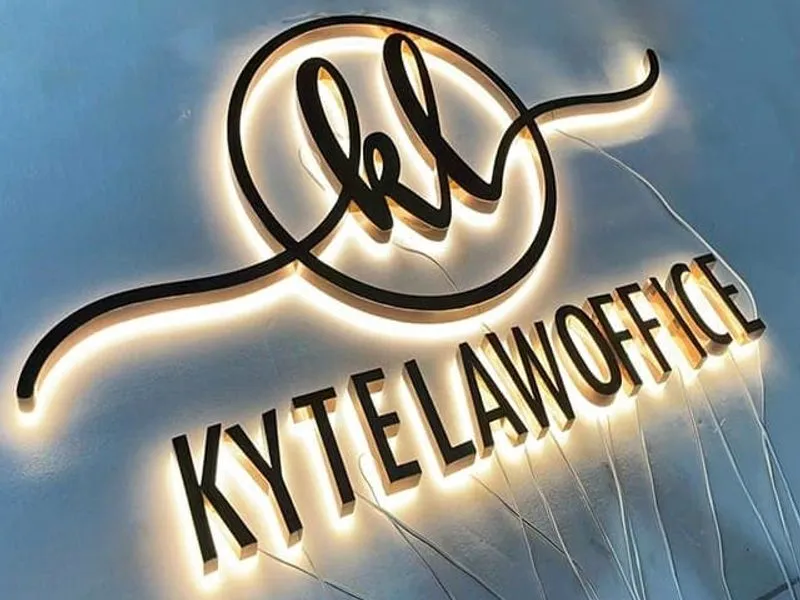
Here's what nobody tells you: front-lit channel letters aren't just a metal can with a light bulb inside. They're a system. Get the face thickness wrong, space the LEDs like Christmas lights, or undersize the power supply, and you'll have a customer calling you at 9pm about a dead letter. I've built these in a 3,000m² facility in Lu'an since 2010, and I still see the same mistakes every week.
The ugly truth? Most failures aren't the LEDs. They're the guy who specced a 2mm domestic acrylic face for a 4-meter sign in direct sun.
If you're ordering front-lit channel letters for a storefront, you need to understand five things: anatomy, face material, LED layout, fabrication method, and compliance. Skip one and you're buying a problem.
Anatomy's simple: a metal return, an acrylic face, internal LED modules on a rail, and a trim cap or welded flange. That's it. Anyone selling you a 'proprietary weatherproof system' is selling you a can with a face.
Returns are usually stainless steel or aluminum. 304 stainless gives you a 10+ year outdoor life. Aluminum weighs a third of steel and doesn't rust, with an 8-12 year life. I use 304 for high-end retail, aluminum for big letters where weight matters.
Depth matters because light needs room to bounce.
A shallow can creates hot spots you can see from across the parking lot. I've had to re-fabricate letters because a client insisted on 50mm depth and then complained about 'dots.' Don't spec less than 80mm for a front-lit letter with standard stroke width.
You can bend the return from sheet or extrude it. Extruded is cheaper but limits your stroke width. Sheet metal returns give you custom shapes. We cut on a laser at ±0.1mm. That matters when the letter has sharp serifs.
Acrylic is the default face material because it transmits 90-92% of the light. Polycarbonate is tougher, but I don't spec it for front-lit faces unless code requires impact resistance. It scratches more and costs more.
Thing is, not all acrylic is the same. UV-resistant sheet from Mitsubishi or Degussa lasts 5-8 years outdoors. Domestic sheet yellows in 1-2 years. I don't care what the supplier's spec sheet says. I've pulled yellow faces off signs after 18 months.
Thickness is simple. Use 2mm or 3mm for most channel letters. If the letter is over 2.5 meters tall, use 5mm or the face will bow in the wind. A 2mm face transmits about 90% of the LED output. A 3mm face transmits about 92%. No one notices the 2% difference from the sidewalk, but they'll notice the cost bump if you overspec.
If you're ordering acrylic LED letters, write the exact face material on the PO. Don't just write 'acrylic.'
Look, I've seen this go wrong: a client bought 1,200 cheap modules from some online marketplace. The solder joints were dull gray. Good modules have shiny silver joints. Those cheap modules died in 14 months. Cheap LED modules last 12-18 months. Samsung, Osram, or Blueview modules last 5+ years real-world.
I spec SMD 2835 modules for most front-lit channel letters. They run 100-150 lumens per watt. That's plenty for a storefront. SMD 5730 is brighter at 40-60 lumens per chip, but unless the sign faces a highway, it's overkill. RGB needs SMD 5050.
Spacing depends on depth and stroke width. For a 100mm deep letter with a 100mm stroke, I don't go over 100mm between modules. If the stroke is narrow, I'll cut that in half. Hot spots are the #1 complaint on front-lit letters.
Driver sizing isn't optional math. Run the power supply at 80% of its rated load. A power supply running at 100% is a heat engine. We warranty our LEDs for 2 years and power supplies for 1 year. Undersize the driver and you'll be replacing it before the warranty expires.
The ugly truth is drivers fail before LEDs. That's why we warranty the power supply for 1 year and the LEDs for 2.
Trim cap is the fastest method. You bend the return, weld the corners, and snap a plastic trim cap over the edge to hold the acrylic face. Cheap, yes. But it's a plastic edge that can warp in afternoon sun.
Truth is, a cheap trim cap will warp if the sign sits in direct sun. I've seen shops sell trim cap as 'premium seamless.' No, it's a plastic lip.
Cleat or flange returns give a cleaner face, no visible plastic rim. Welded returns hold the acrylic with a welded aluminum or stainless flange. More labor, but the most weather-tight. Our welders TIG-weld returns all day, and the laser cutter holds ±0.1mm, so the corners meet.
If the letter sits within reach or on a monument sign, welded returns are worth the money.
The ugly truth is people think welded returns and trim caps look the same from 20 feet. They do. Up close, the plastic edge yellows and cracks. If the customer's brand is luxury, don't let them cheap out.
UL 48 is the US standard for electric signs. Certification costs $4,000 to $15,000 and takes 4 to 9 months, plus quarterly audits. ETL is an alternative and runs 10-30% cheaper. If a factory claims they're UL listed, ask for the file number. Then call the lab. I've watched factories sweat over that.
Here's the catch: IP65 sounds impressive. It means dust-tight and water jets from any direction. That doesn't mean your sign survives a Florida hurricane. For coastal installs, go IP66 at minimum and use 316 stainless returns. 316 has 2-3% molybdenum and a 15+ year marine-grade life. It costs 20-30% more than 304. Pay it if you're within five miles of salt water.
NEC Article 600 covers electric signs in the US. Your electrician should know it. If he doesn't, fire him.
CE marking costs 20,000 to 50,000 RMB and takes 2 to 8 weeks. Most factories will say they have it. Ask to see the certificate with today's date. Watch them sweat.
We seal every front-lit letter with neutral silicone and run an 8-12 hour aging test before it ships. I don't care if the customer is in a hurry. I'm not skipping that test.
IP68 means submersible. If someone sells you IP68 for a strip mall sign, you're paying for a submarine you don't need.
Look, factory-direct pricing isn't magic. For front-lit channel letters, a factory like ours charges $20 to $80 per letter depending on size, finish, and LED spec. US retail installed runs $200 to $700 per letter. You do the math.
I've watched sign shops pay $800 for a front-lit letter from a domestic fabricator—same 304 stainless, same Samsung LEDs—and we ship that letter for $120. That's not a typo.
The savings are 50-65% on product, but you have to factor shipping and the US Section 301 tariff, which is about 30%. Express shipping gets a small sign to your dock in about 5-15 days for $30 to $100. Air freight takes about 10 days at $4 to $12 per kilo. Sea freight takes about 65 days, but LCL costs $80 to $200 per cubic meter. Every method has a trade-off.
I've seen this go wrong: a buyer picks sea freight to save $300, then the crate gets handled six to eight times between our dock and theirs. Every touch is a chance for damage. If you need the sign for a grand opening, don't gamble with sea freight.
Lead time is about 5-15 days, not 4 weeks. That includes laser cutting, bending, TIG welding, grinding, CNC acrylic face, LED assembly, sealing, aging test, QC, and export packaging with foam, carton, and plywood crate. MOQ is 1 piece. We're not forcing you to buy a container.
Full container load sea freight runs $1,200 to $3,000. If you're doing a whole plaza, that's the play.
If you're looking at back-lit halo letters, the price jumps to $35 to $120 per letter. That's a different product with different light dynamics. Don't buy front-lit if you want a halo effect.
Depends where they're going. UL 48 or ETL for the US. CE for Europe, and that costs 20,000 to 50,000 RMB and takes 2 to 8 weeks. Ask the factory for the certificate with today's date. Watch them sweat.
About 20-30% cost and 2-3% molybdenum. 304 lasts 10+ years inland. 316 lasts 15+ years in marine environments. If you're on the coast, buy 316. If you're in Ohio, don't waste the money.
No. Domestic acrylic yellows in 1-2 years. UV-resistant acrylic from Mitsubishi or Degussa lasts 5-8 years. Write the brand on the PO. If the factory won't tell you, walk.
Shiny solder joints. Dull gray means lead-free solder that'll fail in 12-18 months. Quality modules from Samsung, Osram, or Blueview last 5+ years. A 2-year LED warranty is the floor. If someone offers 5 years for cheap modules, they're lying.

Real photo from our production floor — every sign we ship is made here.
Products mentioned or relevant to this topic — factory-direct, custom built.
From $24/letter · MOQ 1 piece · Flexible lead time · CE & UL certified · ships to 20+ countries
Custom sizes, colors, and finishes. Get a factory price in 24 hours.
Get a Free Quote Copy EmailWhatsApp +86 13865703472 · business@aochuangsign.cn