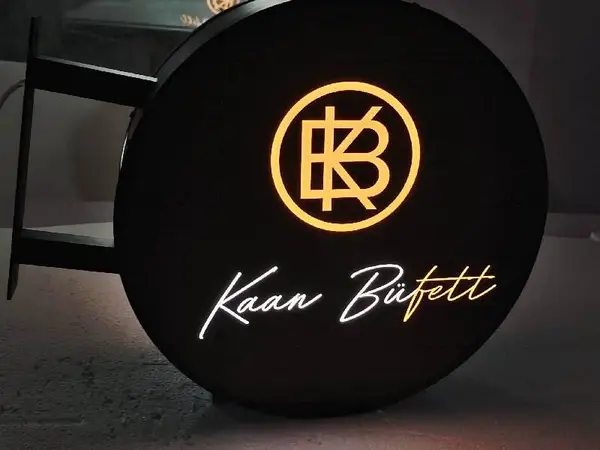
Halo lit letters are the closest thing this trade has to a magic trick.
You hang a metal letter off a wall, kill the front face, and the wall itself starts glowing. Architects love them because they photograph like a million bucks. Installers hate them because every mounting surface is different. Buyers order one and then call me asking why it doesn't look like the render.
I've spent 14 years on the factory floor watching halo letters go from custom showpieces to something you can source factory-direct without getting burned. I'd tell you this stuff over a beer, not a sales call.
Halo lit letters wear a few names: back-lit halo letters, reverse channel letters, rear-lit letters. Same animal. You get a solid metal front face, usually 304 stainless or aluminum. The returns are metal. The back is clear acrylic or polycarbonate. Inside, LED modules face the wall, not the street.
Standoffs hold the letter off the mounting surface. Light spills out the back, bounces off the wall, and creates that soft halo. The face stays dark. That's the opposite of a front-lit letter with an acrylic face glowing right at you.
Here's what nobody tells you: the wall does half the work. A smooth white stucco wall gives you a clean, even halo. A rough brick wall scatters the light and muddies the effect. You're not just designing letters—you're designing light hitting a wall.
Front-lit letters are your bread-and-butter storefront sign. A front-lit channel letter has an acrylic face, internal LEDs, and you can read it from across the parking lot day and night. Halo lit letters are more architectural. At night, the letters stay dark and the wall glows. During the day, they look like brushed metal or powder-coated letters.
Backlit and halo lit are the same thing. If someone tries to sell you a "backlit letter" as a separate premium tier, they're either confused or hoping you are.
Cost follows complexity. Front-lit letters run about $20-$80 per letter from a factory. Halo lit letters run $35-$120 per letter because the back has to be sealed, the standoffs are structural, and the LED mounting is less forgiving. A US shop will charge $200-$700 per letter for front-lit installed. Halo lit letters? $400-$1,000 per letter installed. That gap is why factory-direct sourcing matters.
Material choice isn't just about looks—it's about how many winters the sign survives before a service call.
304 stainless steel is the default. That's 18% chromium, 8% nickel, and it'll live outdoors for 10+ years. If you're in a coastal or industrial area, pay the 20-30% premium for 316 marine-grade stainless. It has 2-3% molybdenum, which resists salt pitting. I've seen 304 letters on Miami Beach start showing rust in 3 years. Don't be that buyer.
Aluminum is another option. It weighs a third of steel and lasts 8-12 years outdoors. For large letters on a wall that can't take much dead load, aluminum returns will save your installer's back and your mounting anchors. If you're set on stainless, check the 304/316 stainless steel letters specs before you order.
Now the LEDs. Rookies get gutted right here. Cheap modules die in 12-18 months. Quality modules from Samsung, Osram, or Blueview run 5+ years in the real world. The L70 spec is ≥50,000 hours, meaning they'll still be at 70% brightness at that point. SMD 2835 modules are the industry standard at 100-150 lumens per watt. If a factory can't tell you the chip brand, walk away.
Quickest way to spot bad LED modules without a datasheet: look at the solder joints. Dull gray means it won't last 18 months. Shiny silver is proper lead-free solder.
Color temperature matters. 3000-3500K warm white for hospitality. 4000-5000K neutral for corporate and retail. 6000-6500K cool white for industrial and highway. Wrong color temp makes a premium sign look like a gas station bathroom.
Factory pricing for halo lit letters runs $35-$120 per letter. That's the product, not the install. A halo letter with a 304 stainless face and Samsung modules might leave our floor at $90. That same letter installed by a US fabricator? $500 easy. Factory-direct saves you 50-65% on product, and that's before you factor in volume.
What drives the price? Size, material thickness, finish. Mirror #8 polishing costs more than brushed #4. PVD gold or powder coating costs more than unfinished. Material thickness for stainless runs 1.0-3.0mm. Most halo letters use 1.5mm returns and a 2mm face. Go thicker only if you're in a high-wind zone or want a heavier look.
If you need UL listing, budget for it. UL 48 runs $4,000-$15,000 and takes 4-9 months with quarterly audits. ETL is 10-30% cheaper and accepted in most US jurisdictions. CE marking costs 20,000-50,000 RMB, but here's the ugly truth: most factories will say they have CE. Ask to see the certificate with today's date. Watch them sweat.
Shipping is the silent line item. Express is about 5-15 days for $30-$100 on small signs. Air freight runs about 10 days at $4-$12 per kg. Sea freight is about 65 days at $80-$200 per cubic meter LCL. Then add the roughly 30% Section 301 tariff for US imports. That $90 letter doesn't look so cheap after freight, tariff, and handling.
Look, the halo effect isn't free. You need clean wall clearance, correct standoff depth, and a power supply that isn't drowning in condensation.
IP65 sounds impressive. It doesn't mean your sign survives a Florida hurricane. For most outdoor signs, IP65 is the minimum. Coastal zones should step up to IP66. IP68 is for submersion—if you're asking for IP68 on a wall sign, you're paying for a spec you don't need.
Direct mount versus raceway is the next fight. Raceway mounting hides the wiring and lets you run one penetration through the wall. Direct mount means individual penetrations per letter and exposed wiring behind each letter, which some architects love and every electrician hates. NEC Article 600 covers the electrical side in the US. Get that wrong and the inspector won't care how pretty the halo looks.
Water ingress kills power supplies faster than time does. Seal every seam with neutral silicone, run an 8-12 hour aging test, and inspect the driver compartment before it leaves the factory. If a sign shop skips the aging test, you'll find the failure on your wall, not their bench.
Here's what nobody tells you: the difference between a $90 halo letter and a $500 halo letter isn't always quality. The gap is layers of margin. Domestic fabricators are paying rent, paying installers, and paying for a showroom. A factory like ours in Lu'an, Anhui has 3,000 square meters, 50+ workers, and an MOQ of 1 piece. We ship in about 5-15 days, not 6 weeks.
But you have to ask the right questions. If a factory can't answer these, don't send a deposit.
First, what LED modules are they using? Ask for the chip brand—Samsung, Osram, Blueview. Not "high quality LED," not "top brand." The actual name. Second, what's the warranty? Ours is 2 years on LEDs, 1 year on the power supply. That's honest. Anyone offering 10 years on a power supply is selling you a fantasy.
Third, what certifications do they actually hold? ISO 9001, CE, RoHS—ask to see the certificates with current dates. Fourth, what's the packaging? Foam, carton, then plywood crate. If your letters show up in a cardboard box wrapped in tape, you're about to unbox dents.
I've seen this go wrong: a client ordered halo letters from a factory that sent photos of another company's work. They saved a few hundred dollars and spent more fixing bad wiring on site. Factory-direct works when the factory is real. Ask for a video call on the production floor. If they won't show you the laser cutter and the aging rack, they might not have one.
Plan for the power supply to die before the LEDs do. The LED modules are rated for 50,000+ hours to L70, which is over 11 years at 12 hours a day. The power supply is usually the first thing to go. Warranty on it is 1 year.
Keep a spare driver on the shelf for every sign. When one goes, you swap it in 20 minutes instead of waiting for a replacement from China. If the sign is 30 feet up on a pylon, that shelf spare is the difference between a same-day fix and an angry tenant.
Cleaning matters. Dust and grime on the back acrylic cuts light output. Dirt on the wall behind the letters kills the halo contrast. A soft wipe twice a year keeps the effect crisp. If you used domestic acrylic instead of UV-resistant acrylic from Mitsubishi or Degussa, expect yellowing in 1-2 years, not 5-8. That's not a cleaning problem—that's a material choice mistake.
Q: What's the difference between halo lit and backlit?
Same thing. Halo lit, back-lit, reverse channel—different names for the same build. Stop overthinking it.
Q: Can I get halo letters for $50 installed?
Not happening. Factory price per letter starts around $35-$120. A US install runs $400-$1,000 per letter. If someone quotes $50 installed, check if they're using cardboard and Christmas lights.
Q: Do I need IP68 for outdoor halo letters?
No, unless your sign is going underwater. IP65 is the minimum for outdoor. IP66 for coastal or high-pressure washing. IP68 is for submersion. Stop asking for IP68 on a pylon sign.
Q: Do you offer UL listed halo letters?
We can arrange it, but UL 48 costs $4,000-$15,000 and takes 4-9 months. If you need it, say so before production. If you don't, you're paying for a sticker.

Real photo from our production floor — every sign we ship is made here.
Products mentioned or relevant to this topic — factory-direct, custom built.
From $24/letter · MOQ 1 piece · Flexible lead time · CE & UL certified · ships to 20+ countries
Custom sizes, colors, and finishes. Get a factory price in 24 hours.
Get a Free Quote Copy EmailWhatsApp +86 13865703472 · business@aochuangsign.cn