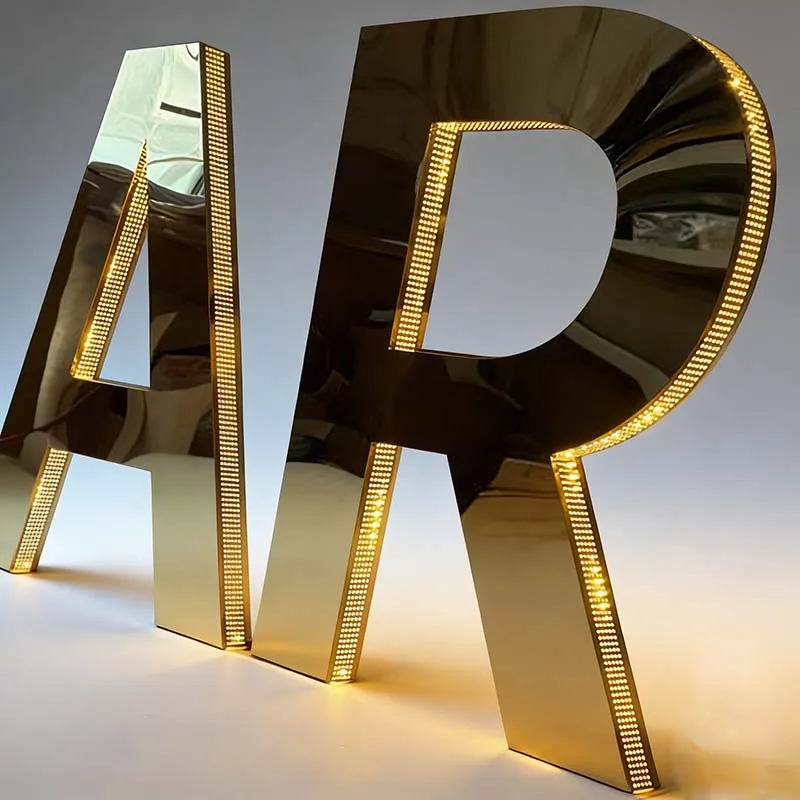
I just pulled a 14-hour shift and I'm still wiping acrylic dust off my phone. Want to know the real difference between halo lit and front lit channel letters? Sit down.
A front-lit channel letter is 3 things: a metal return, an acrylic face, and LED modules pointed at the sidewalk.
Look, after 14 years on the factory floor, front-lit still outsells everything because it does one job: maximum punch from 100 feet away. If you're ordering front-lit channel letters for a storefront, you're buying the workhorse, not a show pony. You take a 3mm acrylic face with 90-92% light transmittance, wrap it in an aluminum or 304 stainless return, and pack SMD 2835 modules inside at 100-150 lumens per watt. The light bounces off the inside walls, passes through the face, and your customer's logo reads like a billboard.
I've watched sign shops pay $800 for a front-lit letter from a domestic fabricator. Same 304 stainless, same Samsung LEDs. We ship that letter for $120.
Here's what nobody tells you: the acrylic face is the first thing to fail on a front-lit sign if you cheap out.
Domestic acrylic from who-knows-where starts yellowing in 12-24 months. UV-resistant acrylic LED letters faces from Mitsubishi or Degussa hold 5-8 years. Over a 2.5m-wide storefront, use 5mm thickness minimum. Under that, 2mm or 3mm is fine. And if a shop says 3mm is always better, walk away — a 3mm face lets through 92% of light, a 2mm face lets through 90%, and your customer won't notice the 2% but will notice the 40% cost bump.
Halo lit is the same can, but you flip the light around.
When a client asks for back-lit halo letters, they're usually chasing that architectural, luxury look. The LEDs mount inside the letter, but the face is solid metal — typically 316 stainless or aluminum — and the light spills out the back, off the wall, creating a soft glow around each letter. You're not reading the light. You're reading the shadow and the halo.
The ugly truth is most sign shops will happily sell you 304 stainless for a coastal job because it's 20-30% cheaper than 316. Three years later the pitting starts and they're not answering the phone.
No acrylic face means you skip the 8-10% light transmission loss. You can run a 2835 at 100-150 lumens per watt instead of a 5730 at 40-60 lumens per chip. Plus the glow reads intentional, not bright.
Front-lit wins for raw readability from a moving car. Halo wins for upscale brand perception.
At 45 mph on a main road, a front-lit sign with 6000-6500K cool white punches through. Halo's soft 3000-3500K warm glow looks elegant from 20 feet, but it disappears from 200. That's why you see front-lit channel letters on retail storefronts and halo on boutique hotels and law offices.
Look, if your client's logo is lit at 6000K, it'll look sterile but visible. Drop it to 4000K and it reads corporate. Go 3000K and it reads hospitality. Nobody tells the client that color temperature is the cheapest brand decision they'll make.
I had a dental office reject a sign because it was too blue. We swapped to 4000K and saved the job.
Front-lit letters cost less to make because the face is acrylic and the installation is simpler.
Factory prices per letter run $20-80 for front-lit channel letters and $35-120 for back-lit halo letters. Once a US shop installs them, that front-lit letter runs $200-700 and the halo runs $400-1,000. That's not materials. That's labor, permitting, and markup.
Buying factory-direct knocks 50-65% off the product cost. But don't kid yourself — sea freight from China takes about 65 days and Section 301 tariffs add about 30%. Air freight gets it here in about 10 days at $4-12/kg. Express in about 5-15 days for small jobs.
For materials, 304 stainless is your 10-year outdoor workhorse at 18% chromium and 8% nickel. 316 adds 2-3% molybdenum and 15+ years marine life. Aluminum weighs a third of steel and lasts 8-12 years, naturally rust-proof. I've seen this go wrong: a strip mall in Ohio spec'd 316 for all letters. He spent 25% more than he needed to because nobody explained coastal means within a few miles of saltwater, not "my customer drives a boat."
Here's what nobody tells you: the LED module isn't your long-term cost. The power supply is. Power supplies die on a Tuesday. Always.
Quality LED modules from Samsung, Osram, or Blueview run 5+ years real lifespan. Cheap modules die in 12-18 months, and you can spot them by dull gray solder joints — shiny silver means proper lead-free solder. But the driver? Most suppliers warranty the LED for 2 years and the power supply for only 1. That's not an accident.
A front-lit sign using 5730 modules at 40-60 lumens per chip will pull more power than a halo sign running 2835 modules at 100-150 lumens per watt. Over 7 years, that difference is real money, plus you'll replace the front-lit acrylic face when domestic material yellows in year 2. Halo has no face to yellow, but the wall behind the halos collects dust and insect carcasses, so you'll be pressure washing that backing plate annually.
IP65 means dust-tight and protected from water jets from any direction. It does not mean your sign survives a Florida hurricane. I've replaced enough letters after a Cat 3 to promise you that.
Use front-lit for retail, franchises, gas stations, anything with drive-by traffic or a code officer who cares about luminance.
Use halo for building-mounted corporate IDs, medical offices, law firms, hotels. Halo generally reads as lower light trespass because the light reflects off the wall instead of blasting forward. But check NEC Article 600 for US electrical requirements and the local sign code before you promise a client anything.
If you're doing a coastal job, 316 stainless back-lit halo letters with an IP66 rating survive powerful jets and salt spray. If you're doing a roadside pylon, front-lit with 6500K cool white and 5mm acrylic over 2.5m spans.
If a US client asks for UL, tell them UL 48 certification runs $4,000-15,000 and 4-9 months with quarterly audits. That's why most direct factory orders ship without it and you use the ETL alternative for 10-30% less.
Don't take a supplier's CE claim at face value. CE marking costs 20,000-50,000 RMB and 2-8 weeks. Ask to see the certificate with today's date. Watch them sweat.
Spec the letter the way you'd spec a tool: what's the job, what's the environment, what's the maintenance budget.
If the client wants maximum bang for the buck and the sign is above a storefront on a 45 mph road, spec front-lit channel letters. Factory price $20-80 per letter, 7-15 day production, MOQ 1 piece. If they want to justify a premium brand and they're willing to spend $400-1,000 per letter installed, spec halo. It's that simple.
Don't order 316 unless you're within a few miles of saltwater. Don't order 5mm acrylic under 2.5m. Don't skip the 8-12 hour aging test and 100% QC inspection, because the factory that skips it ships a sign that fails at the worst time.
And because I still get these calls at midnight:
Q: Can I use front-lit for a high-end restaurant?
You can, but you shouldn't. Halo at 3000K says $40 entree. Front-lit at 6500K says drive-thru.
Q: Which is cheaper to maintain?
Halo usually. No acrylic face to yellow, fewer LEDs. But you'll clean the wall behind it more.
Q: Is IP65 enough outdoors?
For most places, yes. It's dust-tight and water-jet proof. For coastal or hurricane zones, go IP66.
Q: Why is there a $400-per-letter difference between front and halo installed?
Because labor, mounting, and code compliance don't care that the factory price only differs by $15.

Real photo from our production floor — every sign we ship is made here.
Products mentioned or relevant to this topic — factory-direct, custom built.
From $24/letter · MOQ 1 piece · Flexible lead time · Project-specific compliance documents · ships to 20+ countries
Custom sizes, colors, and finishes. Get a factory price in 24 hours.
Get a Free Quote Copy EmailWhatsApp +86 13865703472 · business@aochuangsign.cn