Nobody calls a sign shop because they're excited about signage. They call because a Joint Commission surveyor wrote them up, or because patients keep wandering into the kitchen looking for Radiology. Hospital signage isn't a design problem. It's a liability problem that happens to look nice when you do it right.
I've been building signs since 2010. I've shipped wayfinding packages to hospitals in Texas, Dubai, and a 60-bed clinic in rural Germany. Healthcare jobs are the ones that keep you up at night, because there's no "close enough."
Look, here's the number that matters. ADA requires tactile signs mounted 48 to 60 inches from the floor, measured to the baseline of the character. Not 45. Not 62. Non-glare finish. Grade 2 Braille. Get that wrong and you're not "almost compliant" — you're non-compliant, and the facility eats the cost of remaking every room sign on the floor.
A 300-bed hospital runs somewhere between 800 and 1,500 individual signs once you count patient rooms, exam rooms, restrooms, stairwells, elevators, and utility closets. Multiply that by a surveyor's phone call and you understand why healthcare buyers don't shop on price alone.
Patients don't read signs. They read the first thing that looks like it might be a sign, and if that's wrong, they're lost. Anxiety makes people worse at navigation, and a disoriented 78-year-old in a corridor at 2am isn't a wayfinding annoyance. That's a fall risk.
Here's what nobody tells you: most hospitals don't have a signage problem. They have a maintenance problem. The signs were fine in 2014. Then three departments got renamed, two floors got renumbered, and now the lobby directory is a museum piece.
Good hospital wayfinding runs on four levels and they only work in sequence. Campus gets them to the right building. Building gets them to the right zone. Floor gets them off the elevator. Room gets them to the door.
Break one link and the whole chain collapses — you're back to staff giving verbal directions, which is the most expensive wayfinding system ever invented, because you're paying a nurse $40 an hour to be a human map.
The mistake I see on almost every bid: designers spec gorgeous campus monuments and then cheap out on floor directories. Patients spend most of their navigation time at the floor level. That's where the money goes. That's where you use a modular wayfinding and directional system with swappable inserts, so when Oncology moves to 4 West you replace a panel instead of rebuilding the whole sign.
Modularity isn't a buzzword here. It's the difference between a $400 service call and a $4,000 rebuild.
The ugly truth: ADA is the floor, not the ceiling. You've also got NFPA 101 for egress marking, FGI Guidelines for healthcare construction, state health codes that vary wildly, and NEC Article 600 if anything on that wall is electrified.
Three things get missed constantly. Egress signage has its own photoluminescent and illumination requirements and it's not decorative. Powered signs in the US typically need UL 48 or an accepted equivalent — that's $4,000 to $15,000 and 4 to 9 months, with quarterly factory audits after. ETL hits the same standard for 10-30% less. And outdoor signage needs IP65 minimum: dust-tight plus protection from water jets. Coastal facilities want IP66. Nobody needs IP68 unless you're signing a submarine.
IP65 sounds impressive in a spec sheet. It doesn't mean your sign survives a Florida hurricane.
I've seen this go wrong: a contractor bought "CE certified" signage from a trading company, installed it in a surgical wing, and got asked for the certificate during inspection. The cert was for a different product line. Two months of finger-pointing later, they ate the replacement.
CE marking costs 20,000 to 50,000 RMB and takes 2 to 8 weeks. Any factory that claims it in 24 hours is selling you a PDF, not a certification. Ask to see the certificate with today's date on the scope page. Watch them sweat.
Clinical spaces are hostile to signs. They get wiped with quaternary ammonium, bleach, and whatever infection control bought this quarter. They get UV. They get rammed by beds and carts.
Acrylic is the workhorse for interior faces. Real UV-resistant cast acrylic — Mitsubishi or Degussa stock — holds 5 to 8 years outdoors. Domestic generic acrylic yellows in 1 to 2 years. Same look at install. Completely different product at year three.
Thickness matters more than people think. Standard is 2mm, 3mm, and 5mm. Anything over 2.5m in span needs 5mm minimum or it bows. Here's a detail nobody mentions: a 3mm acrylic face cuts about 92% of your light output. A 2mm face cuts 90%. Your customer won't notice the 2%, but they'll absolutely notice the cost bump.
For anything exterior or high-touch, I default to stainless steel letters. 304 gives you 10+ years outdoors — 18% chromium, 8% nickel, density 7.93 g/cm³. Right call for a strip mall in Ohio. For a Miami Beach hospital or an industrial campus, pay the 20-30% premium for 316 with its 2-3% molybdenum, or you're replacing letters in three years.
Infection control is where sign design gets real. Every crevice is a cleaning problem. Flush-mounted, sealed, non-porous surfaces beat decorative layered signage every single time in patient care areas. That's why recessed units like an embedded lightbox make so much sense in corridors — no ledges, no dust traps, nothing for a wipe-down to snag on. And seal with neutral-cure silicone. Acid-cure corrodes electronics and eats metal finishes.
Quickest way to spot bad LED modules? The solder joints. Dull gray means it won't last 18 months. Shiny silver means proper lead-free solder. Quality modules from Samsung, Osram, or Blueview run 5+ years real-world with an L70 rating of 50,000 hours. Cheap modules flat die at 12-18 months, which is right after your warranty expires.
You don't need a screen at every corner. You need a screen where the information actually changes.
Digital directories at main entrances, elevator lobbies, and cafeteria junctions earn their keep. Screens in a 30-foot corridor between two patient rooms are just another surface to clean.
Where it pays: department names change, doctors rotate, event schedules shift, languages multiply. A hospital in a diverse metro might need four languages on the lobby directory, and static signage can't do that without a full rebuild.
Color temperature matters here too. Run 4000-5000K neutral in clinical and wayfinding contexts. 3000-3500K warm for waiting rooms. 6000-6500K cool only for industrial or exterior use.
Somewhere in the middle of every hospital project, someone from marketing shows up with a brand guideline PDF and a 400-page donor list.
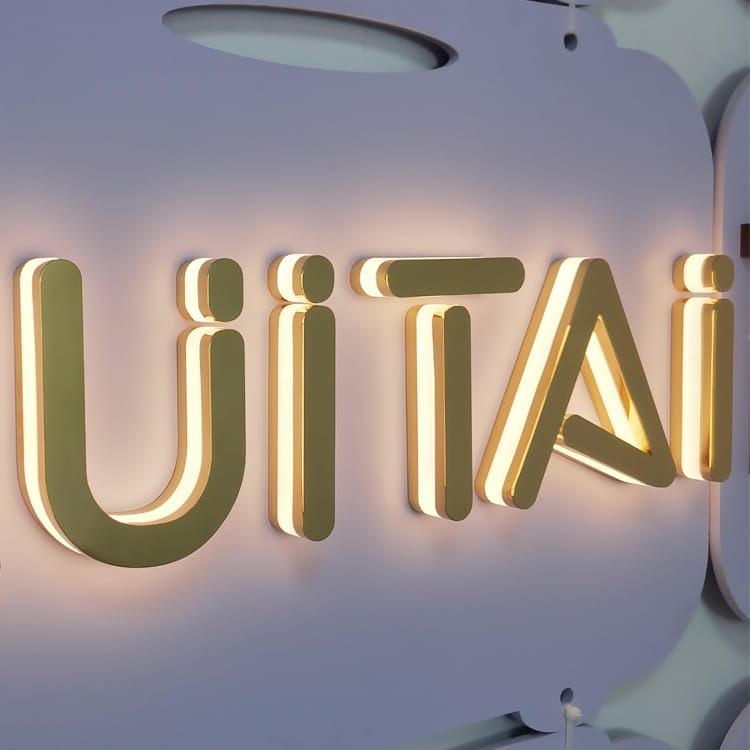
Brand consistency in a hospital isn't vanity. It's trust. Donor recognition is a different animal — it has to feel permanent because it is. Factory pricing on back-lit halo letters runs $35 to $120 per letter. Installed in the US, that same letter is $400 to $1,000. Do that math before you quote a donor wall.
Use warm light — 3000-3500K — in waiting and recovery areas. Clinical corridors stay neutral. And keep CRI high in lobbies or the wood veneer looks like cardboard.
I've watched sign shops pay $800 for a front-lit letter from a domestic fabricator. Same 304 stainless, same Samsung LEDs. We ship that letter for $120.
Front-lit channel letters run $20 to $80 per letter at factory. Domestic installed price is $200 to $700. Halo-lit runs $35 to $120 at factory and $400 to $1,000 installed. Factory-direct buyers save 50-65% on product. That's not a sales pitch, that's the gap.
But price is the small number. The lifecycle number is bigger. Spec every hospital package modular so replacement parts are orderable five years later. Ask any factory what happens when a hospital calls in year six needing 14 matching room signs. If the answer is "new tooling," you bought the wrong system.
Look at service revenue. A well-built wayfinding package turns into a maintenance contract — insert swaps, LED module replacement, pre-survey compliance audits. Steady money. That's why smart shops chase healthcare work in the first place.
Then the boring logistics. Express is about 5-15 days at $30-100 for small orders. Air is about 10 days at $4-12/kg. Sea freight runs about 65 days — $80-200 per cubic meter LCL, $1,200-3,000 for a full container. LCL means your crate passes through 6-8 sets of hands between the factory dock and yours. Every touch is a chance for damage. That's not in the brochure. MOQ is 1 piece, lead time is about 5-15 days, and a real factory gives you 2 years on LEDs and 1 year on the power supply. Anything less and you're buying from a trader.
Oh, and don't forget the US Section 301 tariff, roughly 30%. Build it into the bid or eat it later.
Do hospital signs really need to be ADA compliant, or is that just for bathrooms?
I can't believe I still have to explain this. ADA covers permanent room identification — patient rooms, exam rooms, restrooms, exits, stairwells. Mounting height 48-60 inches, non-glare, Grade 2 Braille, raised characters. If it identifies a room where people need to be found, it's covered. Full stop.
Can I really import hospital signage and install it myself?
Yes, if you know NEC Article 600, local amendments, and how to bond and ground. If you don't, hire an electrician who does. The sign isn't the risk. The sign that fails inspection is.
How long does hospital signage actually last?
Depends on materials. 304 stainless outdoors: 10+ years. 316 marine-grade: 15+. Acrylic faces: 5-8 years with quality UV-stable stock, 1-2 years with cheap domestic. LED modules: 5+ years from Samsung or Osram, 12-18 months from no-name suppliers.
How do I win a hospital contract without a UL listing?
You usually can't — not for anything powered. UL 48 takes 4-9 months and $4,000-15,000. ETL gets you to the same standard 10-30% cheaper. Ask the AHJ before you bid, not after.

Real photo from our production floor — every sign we ship is made here.
Products mentioned or relevant to this topic — factory-direct, custom built.
From $24/letter · MOQ 1 piece · Flexible lead time · CE & UL certified · ships to 20+ countries
Custom sizes, colors, and finishes. Get a factory price in 24 hours.
Get a Free Quote Copy EmailWhatsApp +86 13865703472 · business@aochuangsign.cn