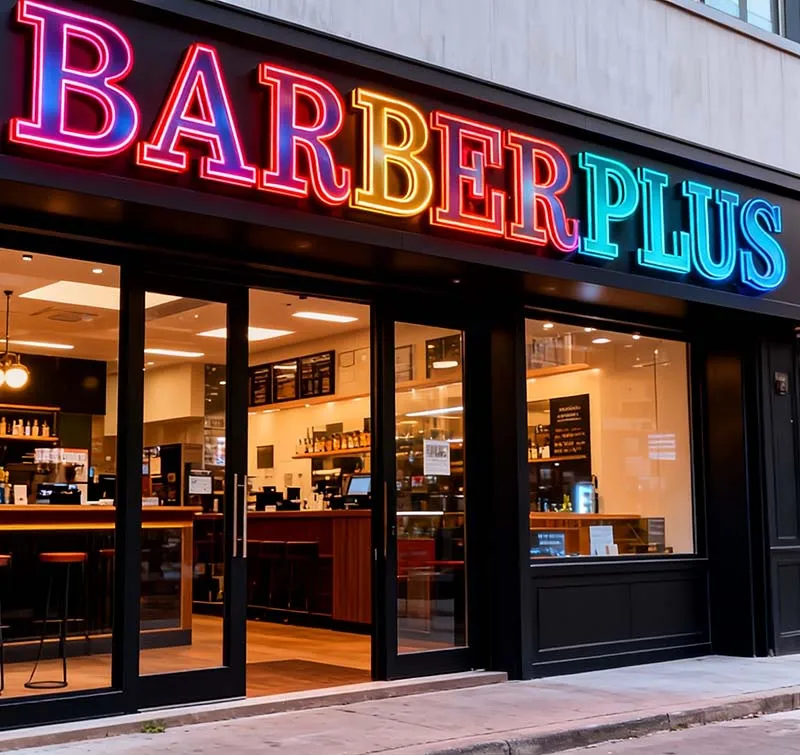
I've installed commercial signs for 20 years across 30+ states. The worst ones? Veterinary clinics. Not because the owners are difficult—they're usually passionate and care deeply—but because the environment is brutal. Cleaning chemicals strong enough to kill parvovirus will eat cheap acrylic. Anxious dog owners will scratch the finish while waiting. And if your sign has a glossy surface that reflects glare into a nervous cat's eyes? You've just made the exam room harder.
You need signage that says "trust and care" but also survives bleach wipes, urine spray, and a 140-pound Great Dane rubbing against it twice a day. The manual doesn't cover that. Here's what does.
Don't make the mistake I did on my first vet clinic job: using standard domestic acrylic with a glossy white face. Within six months, the "Pet Hospital" lettering had yellowed where the vet tech wiped it down with quaternary ammonium cleaner. I had to replace the whole face—out of my pocket.
Here's the real data. Mitsubishi or Degussa acrylic offers 90–92% light transmittance and is UV-resistant for 5–8 years. Domestic acrylic? 1–2 years before yellowing. For a veterinary clinic that gets disinfected daily, you want the good stuff. Thickness matters too: letters over 2.5 meters tall need minimum 5mm acrylic. I've seen 3mm faces buckle under their own weight in a heated lobby.
Pro tip: stainless steel 304 is the go-to for outdoor channel letters on a vet clinic. 10+ year outdoor life, 18% chromium, 8% nickel. But if that clinic is within a mile of the coast—say, a beach town pet hospital—you need 316 stainless. It contains 2–3% molybdenum, and it costs 20–30% more. For a strip mall in Ohio, 304 is fine. For Miami Beach, pay for 316 or you're replacing letters in 3 years. I've watched sign shops send out 316 quotes at $800 per letter. Factory direct from Aochuang, we can ship that same 316 letter for $120. That's a true story.
Aluminum backs are lighter—about one-third the weight of steel—and offer 8–12 years outdoor life. For interior directional signs like "Exam Room 2" or "X-Ray," aluminum with powder coating is perfect. Naturally rust-proof, easy to clean. Just don't use brushed aluminum near the kennel area; it holds onto odors even after wiping. Learned that one the hard way.
Color temperature matters more for veterinary clinics than any other commercial sign I've installed. I've installed this in a cat-only hospital where the owner insisted on 6500K cool white LEDs. The cats hid under the benches. Their pupils dilated, heart rates spiked. Within three months she asked me to swap to 4000K neutral white. That's for retail and corporate spaces—fine for a doggy daycare, but still too harsh for anxious animals.
The real win is 3000–3500K warm white for the main clinic sign. It's the color of sunset, of rest. It signals safety. For the emergency entrance, use 4000K—still neutral but bright enough to read by. Never use 6000K+ near a treatment area where animals are already stressed. I'm not a vet, but 20 years of watching pet owners' faces tells me the light matters.
LED modules: don't cheap out. I've seen signs with SMD 2835 modules that achieve 100–150 lumens per watt—industry standard. But the real test is the solder joints. Quickest way to spot bad LED modules: look at the solder joints. Dull gray = won't last 18 months. Shiny silver = proper lead-free solder. Quality modules from Samsung or Osram last 5+ years real-world. Cheap modules from no-name brands? 12–18 months, then you're on a ladder in the rain.
IP rating time. IP65 means dust-tight and protected against water jets from any direction. That's the minimum for outdoor signs. But it does NOT mean your sign survives a Florida hurricane. For coastal areas or any clinic that gets pressure-washed weekly, you want IP66 (powerful jets) or even IP68 (submersible). I had a client in Houston whose "Pet ER" sign got hit by a tropical storm. IP65 modules survived but the wiring junction box wasn't sealed—corroded within a month. Now I always specify IP66 for the whole system on veterinary exteriors.
Don't make the mistake I made: mounting a wall sign directly onto stucco at mouth-level of a large breed dog. One excited Bernese Mountain Dog scratched the lower corner to bare metal. Solution? Mount the sign at least 48 inches above grade, or use a brushed stainless mounting plate that's easily replaceable.
For interior signs, ADA compliance is non-negotiable. Tactile signage mounted 48–60 inches above the floor, non-glare finish, Grade 2 Braille. Veterinary clinics often forget this for exam rooms. The local code inspector will fail you—speaking from experience. Also, any sign in a cage area or kennel must be able to withstand disinfectant spray. I recommend aluminum with a matte powder coat. Glossy finishes show every smear and scratch.
Here's what the permit office won't tell you: NEC Article 600 requires electrical disconnects within sight of the sign. For a facility with a front desk and a back treatment room, that means you need a disconnect at each location if the sign is fed from multiple circuits. I've seen electricians run a single circuit for the outdoor sign and then put the disconnect behind a locked door. That fails inspection every time. Plan your sign circuits before the concrete is poured.
Wayfinding for anxious pets: use directional arrows with rounded corners. Sharp angles stress animals already scanning for threats. Color psychology? Blue and green tones calm most pets. Red and orange increase heart rates. I've installed this in a clinic that used soft sage green for "Exams" and pale blue for "Surgery." The techs said fewer animals needed sedation.
Brutal honesty: the sign industry markup is insane. I've watched sign shops pay $800 for a front-lit letter from a domestic fabricator. Same 304 stainless, same Samsung LEDs. We ship that letter for $120 from Aochuang. That's including a 2-year LED warranty and 1-year power supply warranty. The factory has been operating since 2010 in a 3,000m² facility with 50+ workers and exports worldwide. CE, RoHS, ISO 9001 certified. MOQ is 1 piece—you can order a single letter if that's all you need.
But shipping realities: LCL sea freight takes about 65 days and your crate gets handled 6–8 times between our dock and yours. Every touch is a chance for damage. That's not in the brochure. For urgent clinic openings, use air freight (about 10 days at $4–12/kg) or express (7-10 days for small packages). And remember the US Section 301 tariff: approximately 30% on imports from China. Factor that into your budget. Even with that tariff, you're still saving 50–65% over domestic fabrication.
CE marking? Another brutal truth. Most factories will say they have it. Ask to see the certificate with today's date. Watch them sweat. CE certification costs 20,000–50,000 RMB and takes 2–8 weeks. Aochuang has it—but I've walked into Chinese factories that claim CE for every product when only one model is certified. If you're importing signs for a veterinary chain with corporate liability concerns, demand UL or ETL certification. ETL is 10–30% cheaper than UL and accepted by most US authorities having jurisdiction. UL 48 takes 4–9 months and costs $4,000–$15,000, with quarterly audits. ETL is a faster path for the same safety.
Here's a pricing breakdown I've used for vet clinic budgets: front-lit channel letters $20–80 per letter factory. Back-lit halo $35–120. Stainless steel non-lit $15–40. Aluminum $10–25. Light boxes $80–250 per square meter. Neon flex signs $30–200. For a typical 8-letter "PET HOSPITAL" in front-lit 304 stainless with 3mm acrylic faces and Samsung LEDs, factory cost around $600–$640. Add 30% tariff = $780–$832, plus shipping. Compare to US retail installed: $1,600–$5,600 for the same sign. The math works.
I've visited Aochuang's factory twice. Their process is 10 steps, 7–15 days total. Design confirmation in 1 day, then laser cutting (±0.1mm precision), welding with TIG, grinding and polishing, CNC routing the acrylic faces, LED assembly, sealing with neutral silicone (not the cheap acid-cure stuff that corrodes electronics), 8–12 hour aging test on every sign, 100% QC inspection, then export packaging with foam, carton, and plywood crate.
That aging test is critical for a veterinary clinic sign that's expected to run 24/7. I've seen signs from other factories fail after 3 days because they skipped the burn-in. The LED modules might work for a week, then flicker. Aochuang's aging test catches bad modules before they ship. They also use neutral silicone sealant—acid-cure silicone outgasses acetic acid that can eat LED solder joints. Another thing the factory brochures don't tell you.
Warranty: 2 years on LEDs, 1 year on power supply. But real-world lifespan on quality modules is 5+ years. Cheap modules fail in 12–18 months. The difference is in the chip brand and the heat sinking. Samsung modules have aluminum PCBs that dissipate heat. Cheap ones use fiberglass—they cook themselves to death. If your vet clinic sign uses SMD 5730 chips (40–60 lumens per chip, highest brightness), make sure the module has a metal core PCB. I always specify that in my orders.
Q: How long does a custom sign take from order

Real photo from our production floor — every sign we ship is made here.
Products mentioned or relevant to this topic — factory-direct, custom built.
From $24/letter · MOQ 1 piece · Flexible lead time · CE & UL certified · ships to 20+ countries
Custom sizes, colors, and finishes. Get a factory price in 24 hours.
Get a Free Quote Copy EmailWhatsApp +86 13865703472 · business@aochuangsign.cn
See pricing, specs, and get a free quote for the sign type you need. Built in our factory, shipped worldwide.