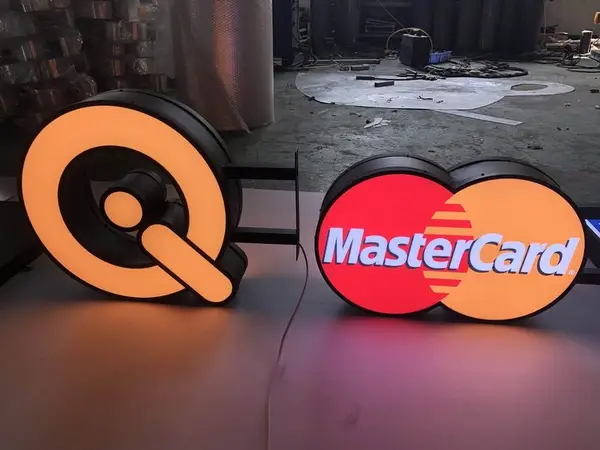
A storefront 60 feet from the curb needs 6-inch channel letters. A 20-foot-wide facade under a 60% coverage code gives you roughly 144 square feet of sign area. Don't use all of it. I'll show you the math.
The rule is simple: one inch of letter height for every 10 feet of viewing distance. 30 feet away? 3-inch letters. 80 feet? 8 inches.
That's the minimum for legibility, not a target. Sidewalk 20 feet away? 4-inch letters feel fine. Car on a 35 mph road 80 feet back? You need at least 8 inches, probably 10. I've seen a 4-inch acrylic sign on a 45 mph road get zero glances. That's not a sign, it's wall texture.
Here's what nobody tells you: the 10-to-1 rule assumes a clean sans-serif font mounted at eye level. Put a script font on there, or mount it 15 feet up, and you need to add 20–30% to letter height just to break even.
Look, if your sign goes above a sun awning or a second-floor window, add 2 inches for every 10 feet of mounting height above 8 feet. That's not from a code book. That's from watching people squint.
Before you calculate anything, grab a tape measure. Write down the storefront width in feet, the sign band height, and the distance from the sign face to where people will actually see it. Don't guess.
I've watched a tenant swear they had a 20-foot facade, and then the actual face between the columns came in at 16 feet. That changed the whole layout and cost them two extra design rounds.
Setback matters more than you think. A 10-foot sidewalk puts your sign about 12 feet from a pedestrian's eyes. A parking lot that pushes you back 60 feet means your 6-inch letters just became too small. Measure from the curb or the nearest driving lane, not from your front door.
Facade area is width times available sign band height. A 20-foot storefront with a 3-foot sign band gives you 60 square feet of physical space. That doesn't mean you can fill all 60 square feet. Code caps you lower.
Most sign shop websites won't tell you this: your city's zoning code, not your taste, controls your maximum sign size. I've seen a city allow a 20-foot storefront only 20 square feet of signage because it's in a historic district. You can't argue with that.
Look, if you skip this step and order a 40-square-foot cabinet, you'll take it down at your own expense. The city denies the permit. Your landlord fines you. That happens every month.
The usual formula is sign area per linear foot of storefront frontage. Most US cities allow between 1 and 2 square feet per linear foot. A 25-foot storefront at 1.5 sq ft per foot gets 37.5 square feet max. That includes wall signs, window graphics, and sometimes projecting signs—read the definitions.
Also check height restrictions, setback requirements, and electrical certification. For outdoor illuminated signs in the US, UL 48 listing runs $4,000–$15,000 and takes 4–9 months. If a sign company says "UL certified" without a file number, check it. CE marking costs 20,000–50,000 RMB. Most factories will say they have it. Ask to see the certificate with today's date. Watch them sweat.
The ugly truth: IP65 sounds impressive. It means water jets from any direction. It doesn't mean your sign survives a Florida hurricane. If you're on the coast, you need IP66 and 316 stainless—2–3% molybdenum keeps the pitting away. Otherwise you're replacing letters in 3 years.
Here's the formula nobody writes down: frontage (in feet) × local sign area factor = maximum square footage for a wall sign. Your city allows 1.5 sq ft per foot and you have 20 feet of frontage? You're capped at 30 square feet. That's a 10-foot by 3-foot sign, or a 20-foot by 1.5-foot sign.
Don't confuse this with the 60% coverage rule. Some older codes limit sign area to a percentage of the facade area—often 40%, 50%, or 60%. A 20-foot-wide facade with a 12-foot sign band has 240 square feet of facade, so 60% gives you 144 square feet of sign area. Generous? Sure. Most strip malls won't let you get close to that.
If you're ordering front-lit channel letters for a storefront, the sign area doesn't mean the letters themselves have to fill that whole square. Letters usually take up 30–50% of the sign box or band because negative space helps readability. If your code gives you 30 square feet, a 20-inch-tall channel letter set across 20 feet will use about 10–15 square feet. That's plenty.
Need both sides visible? A double-sided sign counts differently in some codes, but most places measure one face only. Don't assume—call the permit office.
Here's what nobody tells you: letter height is only half the battle. Use a thin script font and even 10-inch letters disappear. Block sans-serif, bold, or slab fonts punch from a distance. Keep stroke width at least 15–20% of letter height, or you're fighting physics.
Contrast is a hard number. Black letters on white give you the best legibility. Dark bronze on beige? You just spent $3,000 to be invisible. I've seen a dentist's office do exactly that, then blame the sign company.
Illumination changes the game. Standard LED modules, SMD 2835, run at 100–150 lumens per watt. We use Bluesky and Rishang modules because cheap ones die in 12–18 months, while ours are still running 5 years later. If you're backlighting, back-lit halo letters give a premium architectural look, but they need more letter spacing, not less.
Don't overpay for acrylic thickness. I've watched people pay 40% more for 3mm acrylic because they thought thicker was better. A 3mm face has 92% light transmittance. A 2mm face has 90%. Your customer won't notice the 2%, but they'll notice the cost bump. Use 5mm only for large or high-traffic faces where impact resistance matters.
For outdoor signs, UV-resistant acrylic from Mitsubishi or Degussa lasts 5–8 years before yellowing. Domestic acrylic? 1–2 years and it's the color of a smoker's fingers. If you're building a sign that has to last, specify brand-name acrylic and 304 stainless steel returns—they'll outlast the lease.
Let's do an actual one. You have a 25-foot-wide storefront, 40 feet from the curb, and your city allows 1.5 square feet per linear foot. Code max: 37.5 square feet. Viewing distance: 40 feet, so 4-inch letters minimum. But traffic moves at 30 mph, so double it: 8-inch letters for drivers.
Your sign band is 24 inches tall. A single line of 10-inch letters across 20 feet leaves about 14 square feet of actual letter area. That's well under your 37.5 square foot cap. Answer: 10-inch front-lit channel letters, maybe with a 2-inch return, mounted on a raceway or directly to the facade. Done.
I've seen this go wrong. A coffee shop owner ordered 8-inch letters for a 15-foot-wide storefront 100 feet from the highway. She called back six months later asking why nobody could read it. I told her 10 inches minimum. That extra 2 inches cost maybe $3 per letter and fixed the problem.
If people need to read your sign at night from a moving car, consider acrylic LED letters with a 6000K cool white color temperature. That's what highway signs use, and it cuts through rain and windshield glare better than warm white.
Once you know your letter height and sign area, pricing is simple: per centimeter of letter height. A front-lit stainless trim acrylic letter runs $1.05–$1.35 per cm. A 12-inch (30.5 cm) letter costs about $32–$41. Eight letters: $256–$328. That's factory-direct, not a broker mark-up.
I've watched sign shops pay $800 for a front-lit letter from a domestic fabricator. Same 304 stainless, same Samsung LEDs. We ship that letter for $120. The difference isn't quality—it's overhead and a middleman.
We're in Lu'an, Anhui, China. 3,000 square meters, 50+ workers, CE and UL certified. Our MOQ is one piece. We'll ship a sample in about 5 days, production in 15 days depending on size and complexity. Warranty: 2 years on LEDs, 1 year on the power supply.
If you're pricing stainless steel backlit letters, electroplated versions run $1.50–$1.80 per cm. Baked paint backlit runs $1.20–$1.65. For a premium look, back-lit halo letters in electroplated stainless go $1.80–$2.25 per cm. It adds up fast.
Look, I'm not going to give you a sign size without seeing your storefront. But send me your facade width, setback, and local code allowance, and I'll give you an exact number and a factory quote in a day. Measure first. Then order once.
Do I really need a permit for a small storefront sign? Yes. Most cities require a permit for any exterior sign. I can't believe I still have to explain this. A $50 permit review is cheaper than a $1,500 fine.
Can I use 4-inch letters if the sidewalk is right there? 4 inches works at 40 feet. But if your sign is mounted 8 feet above the door, pedestrians are craning their necks and losing legibility. Go 6 inches minimum for storefronts.
How much bigger do letters need to be for street traffic? Double the minimum. If the 10-to-1 rule says 4 inches and traffic moves at 35 mph, use 8 inches. On a 50 mph road, 12 inches is safe.
What if my landlord limits the sign band to 2 feet? Then you're choosing between one line of 10-inch letters or two lines of 6-inch letters. One line always reads better. Skip the second line and make the first one larger.
Products mentioned or relevant to this topic — factory-direct, custom built.
From $24/letter · MOQ 1 piece · Flexible lead time · CE & UL certified · ships to 20+ countries
Custom sizes, colors, and finishes. Get a factory price in 24 hours.
Get a Free QuoteWhatsApp +86 13865703472 · cairuisheng@aochuangsign.cn