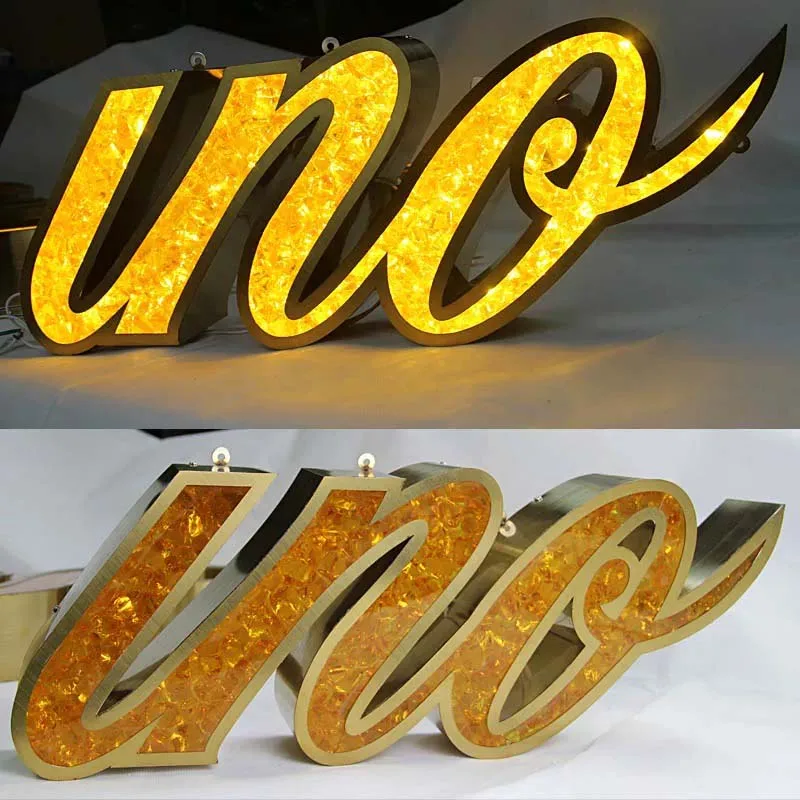
A real factory can quote you $0.90 per centimeter for stainless steel baked-paint letters and not flinch. The person quoting owns the laser cutter, the bending brake, and the TIG welder. A trading company can't think in those numbers.
They're translating somebody else's factory price and tacking on their own margin. That's 20% to 50% extra before your crate ever leaves China. And when a weld turns porous or an acrylic face shows up cracked, a trading company just forwards your angry email to the real factory. Then they wait. You'll wait longer.
Look, I've been on the Aochuang floor since 2010. 3,000 square meters, 50-plus workers, Lu'an, Anhui. I've watched this industry get flooded with middlemen who've never touched a CNC spindle or smelled hot acrylic. Here's how you separate the floor from the forwarding address.
When a shop owner orders front-lit channel letters, they're not just buying letters. They're buying the factory's process. A real factory controls the 10 steps: design confirmation, ±0.1mm laser cutting, TIG welding, grinding, acrylic CNC, LED assembly, silicone sealing, an 8–12 hour aging test, QC inspection, and export packaging.
That's what you're paying for. Factory control.
A trading company can't give you that. They don't know if the factory switched from 304 to 201 stainless on Tuesday because 201 is cheaper. They won't know the LED modules changed from Bluesky or Rishang to something with dull solder joints that won't make it 18 months. You'll find out when the letters are already mounted over a storefront.
Here's what nobody tells you: a trading company's biggest skill is making a brochure look like a factory. They'll send you a photo of a clean production line. They won't send you today's job ticket. That's the gap.
The ugly truth is that most factories will say they have every certification you ask for. Don't accept that. A CE mark isn't a sticker. It costs 20,000 to 50,000 RMB and takes two to eight weeks. Ask to see the certificate with today's date next to it. Watch them sweat.
If you're selling into the US, UL 48 is the big one. That's $4,000 to $15,000 and four to nine months, with quarterly audits. A trading company won't have a UL file. Ask for the UL file number, then check it on UL's public database. It takes two minutes.
Ask for the business license too. Not a logo, not a web page. The actual license. The business scope should say manufacturing. If it says "wholesale" or "trading," you've got your answer before lunch. While you're at it, ask for an export record. A bill of lading that names their company as the shipper, not the notify party.
I've seen this go wrong: a buyer told me he'd been buying from a "factory" for three years. Turned out the factory was a rented office in Shenzhen and the real production was two provinces away. He found out when his replacement order came in with different solder joints and thinner stainless.
Here's a little secret: a photo of a factory is a postcard. A live video call is a tour. Don't ask for a pre-recorded video. Ask for a live call and give them zero notice.
Here's your script. Tell them to point the camera at the raw material rack for stainless and aluminum. Then walk over to the laser cutter. Ask them to show you the cutting bed moving in real time, not a stopped frame. Then say, "Pan to the current production jobs." If they hesitate, that's your sign.
Ask to see the CNC cutting acrylic LED letter faces. Ask what acrylic they stock. A real factory can say "Mitsubishi or Degussa, 5mm, 90–92% light transmittance." A trading company will say "high-quality acrylic." That phrase is worthless.
Also ask them to walk outside and show the building entrance. A 3,000 square meter facility doesn't look like a co-working space. If the video cuts out every time you ask for something unscripted, that's not a bad connection. That's a middleman.
You want proof a factory is real? Ask a specific engineering question. Not "Can you do custom?" That's a yes for everyone. Ask: "I need 316 stainless for a coastal install in Miami. What's the molybdenum content and how much extra will that cost me?"
A factory will say 2–3% Mo and quote a 20–30% premium over 304 stainless steel letters. A trading company will go quiet for a day, then come back with a generic line about marine-grade material.
Ask about acrylic. "Will this face yellow in two years or five?" A factory knows domestic acrylic lasts 1–2 years before yellowing. UV-resistant Mitsubishi or Degussa goes 5–8. If they can't tell you which they're using, they're not making it.
Ask for any RAL color on baked paint letters. A real factory has a paint booth and a color chart. A trading company has an email to send to the actual factory.
Quickest way to spot bad LED modules: look at the solder joints. Dull gray means they won't last 18 months. Shiny silver means proper lead-free solder. If your supplier can't even tell you what solder looks like, you're not talking to a producer. You're talking to a passport for a box.
I've watched sign shops pay $800 for a front-lit letter from a domestic fabricator. Same 304 stainless, same LEDs. We ship that letter for $120 in the right size and finish. The difference isn't magic. It's layers.
If you're ordering front-lit channel letters for a storefront, the factory quote should read like a bill of materials, not a mystery. Stainless steel baked-paint letters run $0.90 to $1.05 per centimeter of letter height. Front-lit with stainless trim and acrylic runs $1.05 to $1.35 per centimeter for baked paint. When your quote is 40% above that with no explanation, you're paying a middleman.
MOQ is a tell. I can run one piece. Our MOQ is one piece because I have a laser cutter and a fabricator standing next to it. A trading company usually says MOQ 10 or 50 pieces because they need to combine orders to make their margin work. One piece doesn't pay their commission.
Lead time is another one. A sample should take about 5 days. Bulk production runs about 15 days, depending on size and complexity. A trading company quotes 30 to 45 days because they're buffering for the factory's schedule they don't control.
Also watch for "design fee" line items on a stock letter. That's nonsense. A factory wants your vector file and that's it. A design fee on standard letters is a middleman's toll.
If you're spending more than a few thousand dollars, get a third-party audit. SGS, Bureau Veritas, Intertek. They'll visit the site, check equipment, count workers, and verify the business license. An audit costs less than one failed shipment.
Ask for references in your country. Not WhatsApp screenshots. Real phone numbers or email addresses of importers who've received crates. Then call one and ask how the sign arrived, not how the salesperson sounded.
Here's a scorecard you can use. Real factory: business license says manufacturing, MOQ one piece, live video without notice, raw material racks visible, a sample in about five days, and a price per centimeter that matches the industry bracket. Trading company: MOQ 10+, prices 30–50% higher, they say video tours aren't possible today, and they describe certifications but never show them.
At Aochuang, we're CE and UL listed, and we'll walk a camera through on a Tuesday at 9pm. Not because we're show-offs. Because we're actually here, running the floor. If a supplier can't do that, ask yourself what they're hiding. They're probably not the ones making your signs.
No. A photo is a postcard from a trade show booth. Ask for a live video call where you direct the camera. If they make excuses for 48 hours, move on.
Then they're a trading company with extra steps. Some finishing work gets subbed everywhere—powder coating, PVD. But the core production, the metal cutting and welding and acrylic routing, should happen under the roof they claim to own. If they can't show that, they're a broker.
No. Sometimes it's a sign of 201 stainless sold as 304 or cheap LED modules rated L70 for 12–18 months instead of the 50,000 hours you need. Ask for material certs and a brand name on the LEDs. Cheaper isn't cheaper when letters rust in three years.
You need verification, not enthusiasm. A fast reply doesn't mean a real factory. It means someone has good Wi-Fi. Audit the supplier, check the license, and make them prove the floor exists. Otherwise you're gambling with a container of signs and a customer's storefront.
Products mentioned or relevant to this topic — factory-direct, custom built.
From $24/letter · MOQ 1 piece · Flexible lead time · CE & UL certified · ships to 20+ countries
Custom sizes, colors, and finishes. Get a factory price in 24 hours.
Get a Free QuoteWhatsApp +86 13865703472 · cairuisheng@aochuangsign.cn