Here's what nobody tells you about the custom sign business: most companies that call themselves manufacturers don't own a single laser cutter.
They're brokers. They take your deposit, email a drawing to a factory like ours, mark it up 40%, and hope the crate shows up. That's not evil — brokers do handle paperwork and design. But if you're a sign shop or contractor checking out a custom sign company, you'd better know which one you're actually dealing with.
We're Aochuang Sign. We've been at this since 2010. 3,000 square meters of production floor, 50+ workers, CE, RoHS, and ISO 9001 certified. I've burned my hands on hot acrylic and argued with LED suppliers about lumen depreciation.
Here's what I tell other trade pros when they ask how to pick a partner.
Look, a manufacturer owns the actual process. Laser cutting, bending, welding, painting, assembly, aging tests. A broker owns a website.
I can't count how many shops have sent me a quote from a "factory" that's really a trading company in Shenzhen. They'll sell you front-lit channel letters for $500 and pay the real factory $60. You're not saving money — you're paying a middleman.
Ask three questions up front. Where's the factory? Can I video call the production floor? Can you send me photos of the laser cutter and the aging test rack at 9pm your time? Watch how fast the silence gets loud.
The ugly truth? Most buyers don't ask because they're afraid of offending a supplier. Rookie mistake. It's your money and your client's brand. Offend them.
We publish wholesale ranges right here: front-lit channel letters run $20–80 per letter factory-direct. That same letter, installed by a US sign company, goes for $200–700. You're not paying for better materials. You're paying for local labor, permits, and a middleman or two.
Material choice isn't about looks. It's a lifespan calculation.
Acrylic faces come in 2mm, 3mm, and 5mm. UV-resistant acrylic from Mitsubishi or Degussa holds up 5–8 years before yellowing. Domestic acrylic? 1–2 years. That's a warranty claim waiting to happen. If your sign runs over 2.5 meters, use 5mm or thicker — not because it looks better, but because 2mm will bow in the wind.
Acrylic transmits 90–92% of light. A 2mm face lands around 90%, a 3mm face around 92%. Your customer won't notice that 2% difference, but they'll notice the cost bump if you over-spec. I've seen shops order 3mm acrylic for an interior lobby sign that'll never see weather. That's not engineering, that's superstition.
For metal, 304 stainless steel letters last 10+ years outdoors. 316 stainless adds 2–3% molybdenum and lasts 15+ years in coastal or industrial air. It costs 20–30% more. For a strip mall in Ohio, 304 does the job. For Miami Beach, pay for 316 — or you'll be replacing letters in 3 years. I've seen this go wrong: a hotel in Fort Lauderdale cheaped out on 304, and the pitting started before the first hurricane season ended.
Aluminum weighs a third of steel and naturally fights rust. It'll give you 8–12 years outdoors. If you're mounting large letters on a foam facade, weight matters more than corrosion. Use 1.0–1.6mm aluminum sheet with a powder coat or anodized finish.
LEDs are where sign companies lie the most. SMD 2835 modules run 100–150 lumens per watt and set the industry standard. SMD 5730 chips hit 40–60 lumens per chip for maximum brightness. Quality modules from Samsung, Osram, or Blueview last 5+ years real-world. Cheap no-name modules? 12–18 months. Quickest way to spot a bad LED module: look at the solder joints. Dull gray means they skipped lead-free solder. Shiny silver is what you want.
Color temperature matters. 3000–3500K warm for hospitality, 4000–5000K neutral for corporate and retail, 6000–6500K cool for industrial and highway. And an acrylic LED letter built with cheap domestic acrylic and no-name modules will fail twice as fast as one with UV-rated acrylic and Samsung modules. The savings? Maybe $8 per letter. You'll spend ten times that on a bucket lift to replace it.
If your custom sign company doesn't ask about permits, walk away.
UL 48 certification is the US standard for electric signs. It costs $4,000–15,000 and takes 4–9 months with quarterly audits. ETL is a legit alternative, 10–30% cheaper. If a factory claims "UL-compliant" without a certificate, they're lying. CE marking costs 20,000–50,000 RMB and takes 2–8 weeks. Most factories will say they have it. Ask to see the certificate with today's date. Watch them sweat.
Ingress protection matters. IP65 means dust-tight and protected from water jets from any direction — that's your minimum for outdoor signs. IP66 handles powerful jets near coastal spray. IP68 is submersible; you don't need it for a storefront, but you might for extreme weather.
Here's what nobody tells you: IP65 doesn't mean your sign survives a Florida hurricane. It just means the enclosure resists water jets during testing. Hurricane winds are a structural problem. That's on the mounting pattern and the wall anchors, not the LED seal.
US installs fall under NEC Article 600. You need a disconnect switch, proper bonding, and listed components. If your factory doesn't know what Article 600 is, you're doing their engineering for free.
ADA tactile signs are a different animal. Mounting height 48–60 inches from floor to centerline, non-glare finish, Grade 2 Braille. You can't fake Braille with a CNC router. It needs spherical bumps. If you're doing wayfinding, spec it before you cut — not after the inspector shows up.
I could walk you through our 10-step process, but let's talk about what actually matters.
Design confirmation takes one day. Laser cutting hits ±0.1mm — that's the difference between a letter face that fits and one that leaves a 1mm gap. TIG welding for stainless, not MIG. Grinding and polishing eat another day or two. Then CNC routing for acrylic faces, LED assembly, and sealing with neutral silicone. After that, every sign runs an 8–12 hour aging test. Not a five-minute power-on. Eight to twelve hours.
Then 100% QC inspection. Then export packaging: foam, carton, plywood crate. If a factory skips the aging test, they're shipping you a time bomb.
Here's a quality check you can run from your desk: ask for a photo of the aging test rack with your job number on it. If they can't produce it, their "QC" is a guy looking at the sign and saying "looks fine."
We manufacture back-lit halo letters, front-lit channel letters, stainless letters, acrylic letters, lightboxes, neon flex — all under one roof. If a company says they make everything but farms out the acrylic bending to another shop, your lead time just doubled and your QC went out the window.
MOQ is one piece. Lead time is 7–15 days. Not because we're slow — because silicone needs to cure and LEDs need to burn in. Rush it, and you'll get failures in month 14.
Pros compare factory pricing per letter, not per project.
Front-lit channel letters run $20–80. Back-lit halo letters $35–120. Stainless steel non-lit $15–40. 3D fabricated letters $40–120. Aluminum letters $10–25. Light boxes $80–250 per square meter. Neon flex $30–200 per sign. Those are factory-direct ranges. Locally installed, you'll pay $200–700 per front-lit letter and $400–1,000 per halo-lit letter.
Buying direct saves 50–65% on product. Not on installation, not on permits — product. If someone promises 80% savings, they're either lying about quality or quoting without UL/CE compliance.
Shipping is where budgets blow up. Express takes 7–15 days at $30–100 for small orders. Air freight 10–20 days at $4–12 per kg. Sea freight takes 50–70 days: LCL runs $80–200 per cubic meter, a full container $1,200–3,000. US Section 301 tariff adds roughly 30% to Chinese signs. It's not hidden — people just ignore it until the invoice arrives.
The ugly truth? Sea freight LCL changes hands 6–8 times between our dock and yours. Every touch is a chance for damage. That's not in the brochure. If your letters are delicate, pay for air or insist on a plywood crate, not just cartons.
You can buy a perfect sign and ruin it with bad installation.
Use stainless hardware. Use isolated mounting if you're mixing metals. Seal any wall penetrations with silicone. For channel letters, run a bead of neutral silicone along the top seam — not the bottom, so water can drain. That's old-timer stuff, but it saves signs.
Maintenance is mostly cleaning and checking connections. LED modules have an L70 rating of at least 50,000 hours. That means they're at 70% brightness at that point, not dead. If a module fails at 12 months, it was never L70 — it was cheap solder.
Warranty should be 2 years on LEDs and 1 year on power supplies. That's our standard. If a supplier offers a 10-year warranty on LEDs, ask what L70 rating and what brand. Then ask for the warranty in writing, with a real return address.
Here's what nobody tells you: power supplies fail more often than LEDs. The 1-year warranty on power supplies is standard because cheap drivers run hot. Spend an extra $3 on a Mean Well driver, and you'll replace it once — maybe never.
Can I get a sample before bulk?
Yes, MOQ is one piece. But don't expect a free sample with free express shipping. We'll make the sample; you pay for it and the freight. If you're serious, that won't bother you.
Why is your price half of what my local fabricator charges?
Because we run a 3,000m² factory in Lu'an, Anhui, not a strip mall. Our labor rates are different, and you buy direct. But watch the tariff and freight. That $50 letter becomes $70 landed. Still cheaper than $400 installed.
Do you provide CAD drawings and permit packages?
Yes, we can provide production drawings, but we're not licensed in your state. Permitting packages need local engineer stamps. You handle that; we'll provide the technical specs, materials certificates, and photometrics if you ask.
What's the real lead time after I approve the drawing?
7–15 days production, then shipping. Sea freight adds 50–70 days. If you need it next week, we can express it, but you'll pay for it. Don't call Monday and expect a 6-foot stainless logo Friday.

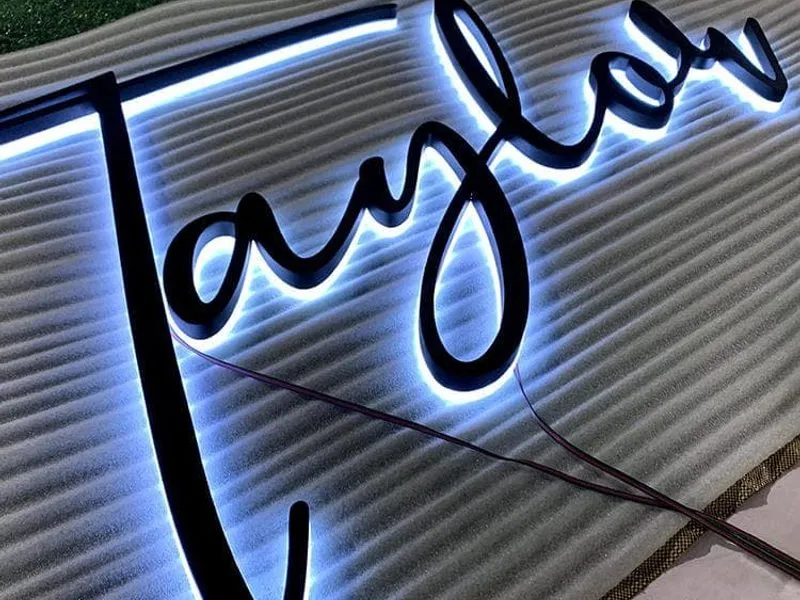
Real photo from our production floor — every sign we ship is made here.
Products mentioned or relevant to this topic — factory-direct, custom built.
From $24/letter · MOQ 1 piece · Flexible lead time · CE & UL certified · ships to 20+ countries
Custom sizes, colors, and finishes. Get a factory price in 24 hours.
Get a Free Quote Copy EmailWhatsApp +86 13865703472 · business@aochuangsign.cn