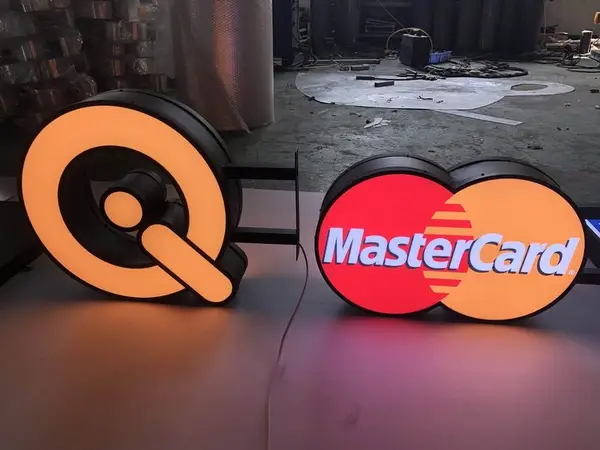
Quality LED channel letters last 5 to 10 years in the real world, not the 50,000-hour fairy tale on the spec sheet. The L70 rating on a decent module says 50,000 hours, but that's a lab number. Lumen depreciation, not failure. And that number doesn't cover the whole sign.
Five years if it's built right. Eighteen months if it's built cheap.
A channel letter is a system: steel can, acrylic face, LED modules, power supply, silicone seal. Any one of those fails and the letter looks dead. I've been on the shop floor since 2010, and the power supply usually goes first. That's why the power supply warranty is 1 year and the LED warranty is 2 years. That split tells you where the risk lives.
Look, I've sold and installed enough of these to know: if you buy front-lit channel letters with branded modules and a real driver, you should get 7 years before you're touching them. If you buy the cheapest thing on Alibaba, you'll be back in 18 months with a ladder and a bad attitude.
Here's what nobody tells you: the diode itself rarely dies. Something around it does. Moisture, heat, bad solder, a $12 driver that spiked. That's the real story.
The spec sheet says L70 ≥50,000 hours. Run that 12 hours a day and you get 11.4 years before the LED drops to 70% brightness. Sounds great. That's not the same as lasting 11 years.
Ugly truth: L70 gets measured in a controlled lab at 25°C with perfect current. Your sign bakes inside a sealed can in Phoenix at 65°C. Heat kills LEDs fast. Every 10°C above spec roughly cuts lifespan in half. So your 11.4 years becomes 5.7, then 2.8. You do the math.
Quality modules from Samsung, Osram, or Blueview will give you 5+ years of real outdoor life. Cheap modules: 12 to 18 months. I've seen it. The quickest way to spot bad LED modules is the solder joint. Dull gray solder means the LED won't last 18 months. Shiny silver means proper lead-free solder.
I've seen this go wrong: a shop in Houston bought cheap modules to save $3 per letter. Fourteen months later, half the letters looked like broken teeth. The labor to pull the old modules and reseal the letters cost more than the original sign. That's not a savings. That's a self-inflicted wound.
Also remember: SMD 2835 is the industry standard at 100-150 lumens per watt. If a factory can't tell you the chip brand, assume the worst.
Thermal management first. A sealed, non-vented letter in direct sun cooks LEDs. A vented or heat-dissipating can runs cooler. The enclosure matters more than the diode.
Ugly truth: most channel letter failures aren't the LEDs. They're the power supply. A cheap driver kills a $120 letter. We warranty the power supply for 1 year, the LED for 2. That tells you exactly what fails first.
Then there's water. IP65 is the minimum for outdoor signs. It means dust-tight and protected against water jets from any direction. It does NOT mean your sign survives a Florida hurricane. For coastal work, spec IP66. IP68 is for submersible or extreme weather. Don't let a salesman throw "IP65" at you like it's a force field.
The acrylic face matters too. UV-resistant Mitsubishi or Degussa sheet lasts 5-8 years before yellowing. Domestic acrylic can yellow in 1-2 years. And thickness: a 2mm face cuts 90% light output, a 3mm face cuts 92%. Your customer won't notice the 2% difference but they will notice the 40% cost bump. For faces over 2.5m, use 5mm or thicker or it'll sag like a wet napkin.
If the can is 304 stainless steel, you've got 10+ years of outdoor life. That alloy has 18% chromium and 8% nickel. For a strip mall in Ohio, that's fine. For Miami Beach, pay the 20-30% premium for 316 stainless. It has 2-3% molybdenum and holds up 15+ years in marine air. If you skip 316 near salt, you're replacing letters in 3 years.
And don't forget the face and return. Acrylic LED letters with domestic sheet can yellow fast. UV-resistant acrylic is the only choice if you don't want a piss-yellow sign at year two.
I've replaced more broken neon tubes than dead LEDs. Neon looks great until a baker's delivery truck taps it, or a hailstorm finds it. Glass breaks. Gas leaks. Then it's done.
Fluorescent? I stopped recommending those a decade ago. Ballasts die, tubes dim, and the cold-weather flicker makes a $10,000 storefront look like a haunted house. LED L70 of 50,000 hours beats any fluorescent ballast I've ever installed.
Maintenance is where LED really wins. A dead neon tube means a custom glass bender and a service call. A dead LED module usually means a 20-minute swap if you can get to the letter. But only if the sign was built right with accessible faces.
If you want the neon look without the glass, LED neon flex runs $30-200 per sign from the factory and doesn't shatter when the bar's bouncer leans on it. Not the same as glass neon, but it's still glowing a decade later.
If every letter on one circuit is dead or dimming, it's the power supply. If individual sections are out, it's the modules. If the acrylic is yellow, cracked, or water is pooling inside, the face or seal has failed.
Look, here's the rule I give my installers: once water has been inside a sealed letter, you don't fix it. You gut it. The silicone, the LED boards, the wiring—everything becomes a corrosion time bomb. Replace the whole module tray, not just the dead diode.
If the letter can is rusted through, it's done. If you have 304 stainless pitting in a coastal town, don't patch it. Order 316. If the power supply has failed twice in three years, stop buying that driver.
After about 7-8 years, if more than 30% of modules are failing, replace all the modules and drivers in one shot. That's cheaper than rolling a truck every month. Labor is the real cost, not the parts.
A new module costs a few bucks from the factory. The service call to replace it costs hundreds. Don't be penny wise and pound foolish.
Spec the LED chip brand. Samsung, Osram, or Blueview. Not "high quality white LED." That means nothing. Ask for a photo of the solder joints. Shiny silver or walk.
Spec the driver. Ask what brand and whether it's UL or ETL listed. A UL 48 certification costs $4,000-15,000 and takes 4-9 months. ETL is 10-30% cheaper. If a factory says they have CE, that's 20,000-50,000 RMB and 2-8 weeks. Ask to see the certificate with today's date. Watch them sweat.
Spec UV-resistant acrylic: Mitsubishi or Degussa. Not "acrylic." Spec thickness: 3mm minimum for small, 5mm for anything over 2.5m.
Spec the can material. 304 stainless for general, 316 for coastal. Don't use painted mild steel outside unless you love rust streaks.
And spec the IP rating. IP65 minimum. IP66 if you're near salt. IP68 only if it's going underwater, which your channel letters are not.
Look, if a factory can't tell you the LED chip brand, driver spec, and acrylic supplier in writing, you're buying a lottery ticket. Not a sign.
Factory pricing for front-lit channel letters runs $20-80 per letter. US retail installed runs $200-700 per letter. That's 50-65% savings on product. I've watched sign shops pay $800 for a front-lit letter from a domestic fabricator. Same 304 stainless, same Samsung LEDs. We ship that letter for $120.
Ugly truth: what you pay upfront isn't the real cost. The real cost is the 10pm phone call, half your sign dark, client wants it fixed before morning. Cheap letters create that call. Good letters don't.
If you import, factor in shipping and tariffs. Express is 7-15 days but $30-100 for small stuff. Air is 10-20 days at $4-12/kg. Sea freight is 50-70 days at $80-200 per cubic meter LCL. US Section 301 tariff is about 30%. And LCL means your crate gets handled 6-8 times between our dock and yours. Every touch is a chance for damage. That's not in the brochure.
Spend the extra 20-30% for 316 stainless in coastal areas. Spend the extra $2 per module for branded LEDs. That extra spend isn't an expense; it's the cheapest insurance in this business.
A sign that lasts 8 years costs half as much per year as one that lasts 3. Your client doesn't care what you paid. They care that it's still lit when they open the doors at year five.
Can't I just buy cheap LEDs and replace them later?
Sure. And you'll pay more in labor than you saved on parts. I've watched it happen too many times.
Does the 50,000-hour rating mean my sign lasts 50,000 hours?
No. That rating means the LED might still be at 70% brightness in a lab. It doesn't cover drivers, water, or the fact your sign faces Phoenix at 3pm.
Is IP65 enough for outdoor channel letters?
That's the minimum. If you're within a mile of salt water, go IP66. If you're in a hurricane zone, no rating saves you from a flying trash can.
What fails first, the LED or the power supply?
Power supply. Almost always. That's why it gets a 1-year warranty and the LED gets 2 years.
Products mentioned or relevant to this topic — factory-direct, custom built.
From $16/letter · MOQ 1 piece · 7–15 day production · CE & UL certified · ships to 20+ countries
Custom sizes, colors, and finishes. Get a factory price in 24 hours.
Get a Free QuoteWhatsApp +86 13865703472 · cairuisheng@aochuangsign.cn