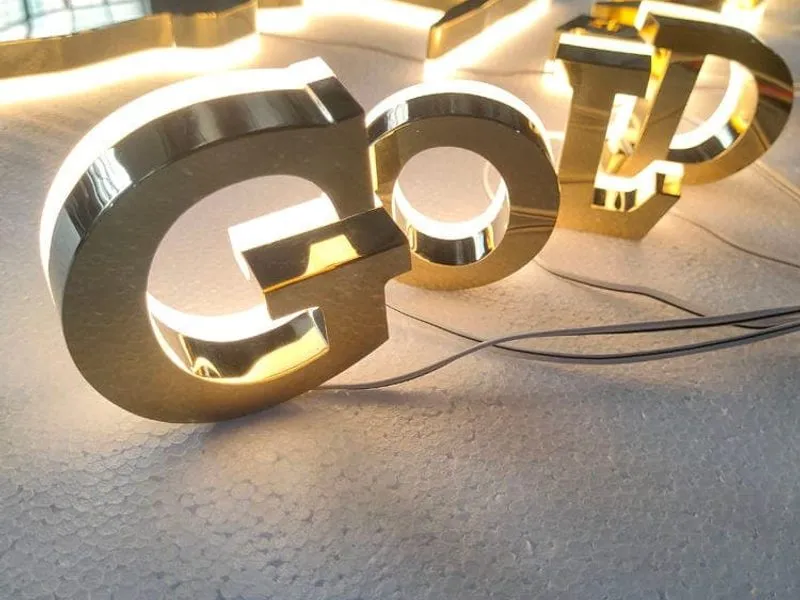
I've seen sign shop owners buy a custom business sign for $800 a letter and then sell it for $2,500 installed. Good for them. But the same letter out of my factory costs $120. That gap isn't magic. It's just what most people don't know about how sign pricing works.
Here's what nobody tells you: the cost of a custom business sign breaks down into about five buckets — material, production, LED/components, finishing, and overhead. If you're comparison shopping from China, you need to know what's in each bucket. Otherwise you'll just be comparing apples to oranges, and that's how you end up with a sign that falls apart in 14 months.
The ugly truth is that most quotes you get — even from Chinese factories — are padded with marketing and middlemen. You're paying for someone's sales team, their showroom, their broker's cut. I've watched sign shops pay $800 for a front-lit letter. Same 304 stainless, same Samsung LEDs. We ship that letter for $120. And we still make a profit.
So let me give you the real breakdown. Numbers you can take to the bank.
Start with the face, the returns, and the backing. For a standard indoor or outdoor sign, acrylic is the workhorse. We use 90-92% light transmittance acrylic from Mitsubishi or Degussa for UV resistance lasting 5-8 years. That's the good stuff. If you buy domestic Chinese acrylic, it'll yellow in 1-2 years. The price difference is maybe 15-20%. On a typical 3mm sheet, that adds up to $15-40 per square meter — but when your sign is still bright after six years, nobody questions the price.
For metal letters, stainless 304 is the standard for outdoor life of 10+ years. We use 18% chromium, 8% nickel, 1.0-3.0mm thick. The difference between 1.0mm and 2.0mm is about $3-7 per letter, but if a letter is taller than 2.5 meters, you better be using 5mm acrylic and at least 2mm steel because the wind will eat it. I've seen this go wrong: a guy ordered 1.0mm letters for a building top sign, and within a year the wind bent them down to where you couldn't read the name. That's not a material failure. That's a spec failure.
If you're near a coast, pay the 20-30% premium for 316 stainless. It has 2-3% molybdenum and resists salt corrosion for 15+ years. For a Miami Beach hotel, that's non-negotiable. For a strip mall in Ohio, 304 is fine. Don't let anyone upsell you on 316 for a desert climate.
Aluminum is another option — it's a third the weight of steel, rust-proof, and lasts 8-12 years outdoors. We use aluminum letters for insulated glass or drywall where you don't want heavy weight. The cost is $10-25 per letter. But you get what you pay for — aluminum bends easier than steel. If your sign is going to be fingered, punched, or hit by a snowplow, go 304 stainless.
Here's what nobody tells you: the LED modules are ~20-30% of your sign's cost, and it's the one place where cheaping out will destroy your reputation. We use SMD 2835 modules as the industry standard, 100-150 lm/W, with quality Samsung or Osram chips. Those have a real L70 lifespan of 50,000 hours, which is about 5+ years at 10 hours per day. Cheap modules last 12-18 months. I've seen them burn out in a Walmart parking lot in six months because the heat sink was fake.
For RGB or neon effects, SMD 5050 modules are standard. If you need serious brightness, SMD 5730 puts out 40-60 lm per chip, the highest output we use. But here's the kicker: the driver and power supply matter just as much. We warrant our LEDs for 2 years, power supply for 1 year. That's not a gimmick. That's the design life of the components. If a factory tells you they warranty everything for 5 years, ask them to put it in writing and name the brand of chips. They won't.
Let's get into the actual numbers. For a standard front-lit channel letter, you're looking at factory cost of $20-80 per letter depending on height and material. That includes the acrylic face, aluminum or steel returns, the LED modules, and wiring. When your customer is quoted $200-700 per letter installed by a US retail shop, you can see the margin there. It's not all profit — there's installation, permitting, and travel — but the product itself is a fraction of the retail price. We make front-lit channel letters that are the storefront standard for a reason.
If they want the premium look, back-lit halo letters run $35-120 per letter. That's for the reverse-lit effect where the light glows out behind the letter. It requires a thicker steel face and a diffuser, and the machining is more expensive. These are the back-lit halo letters architects spec for high-end retail, and they cost twice as much for a reason: they're gonna look good for twenty years.
For metal letters without lights, stainless steel letters come in at $15-40 per letter. Brushed #4 or mirror #8? The finish affects cost because mirror #8 takes twice the polishing time. For a luxury feel, brass or copper runs 50% more than stainless — those are the brass letters you see in old-school law offices.
Light boxes are priced per square meter, not per letter. An acrylic light box with internal LED mesh is $80-250 per square meter, factory-direct. That includes the aluminum frame, the acrylic face, and the light source. For a drive-thru menu board, you're looking at $300-800 total. Compare that to buying a retail enclosure for $1,500. We make acrylic light boxes for storefronts and food menu signs for restaurants, and they're the same box.
Neon flex, if you want that modern neon look without gas, runs $30-200 per sign depending on length and complexity. It's basically LED inside a flexible silicone tube. We sell neon flex signs for beer bars and coffee shops, and they're a hell of a conversation starter.
Stop. Before you order, ask about certifications. If you're in the US, you need UL 48 for electrical signs — that costs $4,000-15,000 and takes 4-9 months, with quarterly audits. ETL is a cheaper alternative, 10-30% less. CE marking is different: it costs 20,000-50,000 RMB and takes 2-8 weeks. Most Chinese factories say they have CE. Ask to see the certificate with today's date. The IP rating is another one: IP65 means dust-tight and water jets from any direction. It does NOT mean your sign survives a Florida hurricane. For coastal, we spec IP66 at minimum; IP68 is submersible, which you probably don't need.
Here's what nobody tells you about shipping: it's not the price per kilo that kills you, it's the air freight ransom. Express for small signs runs $30-100 and arrives in about 5-15 days. Air cargo is $4-12/kg and takes about 10 days. Sea freight is $80-200 per cubic meter LCL and takes about 65 days. A full container is $1,200-3,000. On a typical order of 20 letters, sea freight adds $150-400 to your cost. But if you're in a rush and want air, you might pay double the product price in freight. Plan ahead.
And then there's the US Section 301 tariff — about 30% on most sign products. That's a real cost, not a rumor. If you're importing, build that into your quote. Some factories will try to declare the goods as something else to avoid the tariff. Don't do it. We don't. Getting caught is a headache you don't want.
I'm going to be straight with you, because that's how we keep customers. What we can do: manufacture any of the signs above in our 3,000m² factory with 50+ skilled workers. Our stainless steel letters are TIG welded, ground, polished, and sealed with neutral silicone. We run every single sign under an 8-12 hour aging test before it gets packaged. We do 100% QC inspection on every piece. We ship in foam, carton, and plywood crate. We've been doing this since 2010, and we export worldwide.
What we can't do is be your local installer. We don't do permitting, we don't wire to the building, we don't repair a sign that got smashed by a truck. We're a manufacturing partner, not a field service. That's where your work starts. But we will answer the phone when you call, and we'll tell you straight if a design you've got isn't possible with standard materials.
The ugly truth is that some factories won't tell you no. They'll take your money and make something that's close to the drawing but not exactly what you wanted. We've done that too, in our earlier years, and it cost us. Now we have a 10-step production process where design confirmation takes a full day before we cut anything. We laser cut with ±0.1mm accuracy, we TIG weld everything, we CNC route acrylic faces, and we test every LED assembly before sealing. That's why our lead time is about 5-15 days, not 3 days. If someone promises you a custom sign in 48 hours, they're cutting corners. Plain and simple.
The honest answer: it depends on what you're buying, but here are the numbers you can anchor to. Front-lit channel letters: $20-80 per letter. Back-lit halo: $35-120 per letter. Stainless steel non-lit: $15-40 per letter. 3D fabricated letters: $40-120. Aluminum letters: $10-25. Light boxes: $80-250 per square meter. Neon flex: $30-200 per sign. These are factory prices from our floor, not retail. If you're comparing quotes and someone comes in 40% cheaper, ask them what Samsung LED they use. Ask for the brand of acrylic. Ask for the thickness of steel. Then you'll know why.
And remember — the cheapest sign isn't the cheapest. A cheap LED module will die in 18 months, and you'll pay twice to replace it. Cheap acrylic will yellow and you'll lose business because your store looks tired. I've seen it happen. Good sign work is an investment, not an expense. If you're a sign shop owner looking for a production partner, get a quote from us. If you're a business owner, get a quote from us too. Either way, you'll know exactly what you're paying for, and that's worth something.
I've watched the business grow from a small workshop to a factory that ships to 30+ countries. We didn't do that by hiding costs or making promises we can't keep. We did it by sending out signs that work, on time, and by telling customers the truth when a design won't work. If that's the kind of supplier you want, you know where to find us.

Real photo from our production floor — every sign we ship is made here.
From $24/letter · MOQ 1 piece · Flexible lead time · CE & UL certified · ships to 20+ countries
Custom sizes, colors, and finishes. Get a factory price in 24 hours.
Get a Free Quote Copy EmailWhatsApp +86 13865703472 · business@aochuangsign.cn
See pricing, specs, and get a free quote for the sign type you need. Built in our factory, shipped worldwide.