I’ve lost track of the number of jobs I’ve watched go sideways because someone believed a glossy brochure and a handful of stock photos. You want the truth about choosing a sign manufacturer in China? I’ve spent 16 years on factory floors, burned my hands on hot acrylic, argued with suppliers about LED binning, and cleaned up enough messes to fill a shipping container. The process isn’t complicated if you know where the bodies are buried. It’s just that most people don’t.
I work for Aochuang Sign now, running a 3,000m² facility in Lu’an, Anhui. We ship worldwide. I’m not going to pretend every factory has the same standards — most don’t. What I’m about to tell you is the stuff I wish every buyer knew before they wired a deposit. Not theory. Not some checklist from a trade magazine. Real, ugly, shop-floor experience.
“Yes, we have that certification.”
Here’s what nobody tells you: a CE mark costs between 20,000 and 50,000 RMB, takes two to eight weeks, and has to be tied to a specific product category. Most small factories will flash you a photocopy from 2018 and tell you it’s “still valid.” It’s not. When I ask to see a certificate with today’s date, the screen goes blank more often than not. The ugly truth is that CE is the easiest thing to fake because nobody asks for proof until their shipment gets held at customs.
Request the actual test report. If they can show you a current CE or UL file number, call the certifying body and verify. UL 48, the standard for electric signs in the US, costs $4,000 to $15,000 and requires quarterly factory audits. If a supplier quotes you a rock-bottom price and casually drops “UL certified” into the conversation, your bullshit detector should be screaming. Real UL is a process, not a sticker. ETL is a cheaper alternative — 10-30% less — and just as accepted by inspectors, but it still demands a paper trail. No paper, no trust.
IP ratings are another playground for salespeople who’ve never wired a sign in the rain. IP65 means dust-tight and protected against water jets. It’s the minimum for outdoor use. IP66 handles powerful jets, good for coastal wind-driven rain. IP68 means submersible — overkill unless you’re hanging a sign in a typhoon zone.
Look, if a factory tells you an IP65 channel letter will survive a Florida hurricane, they’ve never stood next to a Category 3 while 2mm aluminum sheeting peeled off a wall like cheap wallpaper. IP65 keeps out sprinklers and morning dew, not horizontal wind shear. I’ve seen this go wrong: a client ordered 40 front-lit letters from a supplier who swore IP65 was “fully weatherproof.” Six months later, water pooled inside the returns, corroded the LED solder joints, and the whole sign looked like a half-lit Christmas decoration. The fix cost more than the original order.
So when you’re vetting a manufacturer, ask for the test certificate and the name of the lab. Then ask how they seal the returns. Our process uses neutral silicone, applied after LED assembly, with an 8-to-12-hour aging test where we run every single sign at full brightness before it leaves the floor. If the factory doesn’t run a burn-in test, you’re betting your reputation that their 16-year-old assembler didn’t miss a bead of caulk on a Friday afternoon.
I can tell you the exact point where a sign stops being an asset and turns into a warranty nightmare. It’s usually the acrylic.
A Mitsubishi or Degussa UV-resistant acrylic face will give you 5 to 8 years outdoors before it starts to yellow. Domestic acrylic? One to two years, max. That 90-92% light transmittance drops fast once the material breaks down, and your crisp white 6500K letter becomes a sad, nicotine-stained yellow. The price difference is tempting — maybe 40% less — but when your customer calls you 18 months later asking why their brand color looks like a smoker’s tooth, you’ll wish you’d spent the extra twenty bucks per letter. For any sign face longer than 2.5 meters, don’t even think about using less than 5mm thickness. 2mm or 3mm might work on a small indoor piece, but you’ll get flex, cracks, and dead LEDs after a good windstorm. We see it all the time: someone’s front-lit channel letters for a storefront arrive with a 2mm face from who-knows-where and the whole thing looks like a potato chip within a year.
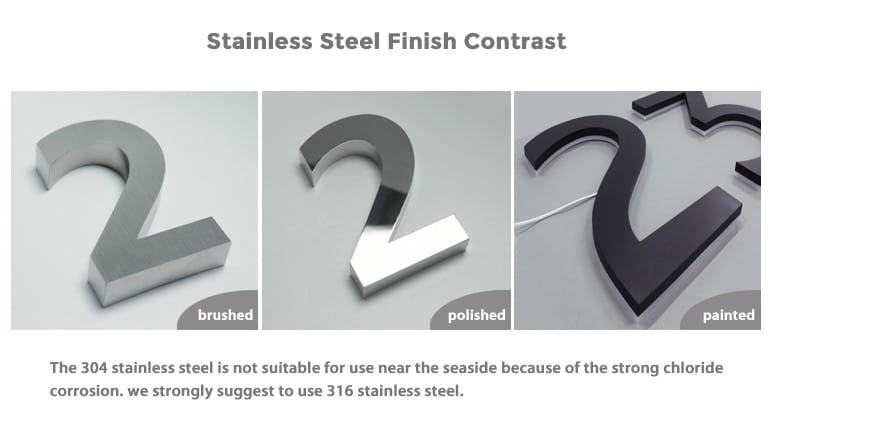
Stainless steel is another place where the cost-cutting knives come out. 304 grade has 18% chromium and 8% nickel, a density of 7.93g/cm³, and will last 10+ years outdoors in most climates. For a strip mall in Ohio, 304 is absolutely fine. But if you’re installing stainless steel letters on a Miami Beach hotel or anywhere within five miles of salt spray, pay the 20-30% premium for 316 marine grade. It contains 2-3% molybdenum and will give you 15+ years. I’ve seen a competitor’s 304 letters on a coastal restaurant pitted to hell in

Real photo from our production floor — every sign we ship is made here.
Products mentioned or relevant to this topic — factory-direct, custom built.
Factory-direct since 2010. Free quote within 24 hours — no obligation.
Get a Free Quote → Copy EmailMOQ: 1 piece · Flexible lead time · 2-year warranty · Worldwide shipping
See pricing, specs, and get a free quote for the sign type you need. Built in our factory, shipped worldwide.