I've spent 16 years on a factory floor in Lu'an, Anhui. I've watched buyers overpay by 300% because they didn't know one thing: price isn't negotiated. It's engineered.
Here's what nobody tells you: when you email a sign factory asking for "your best price on 10 channel letters," you've already lost. Every factory on Alibaba gets 40 of those a day. You know what they send back? A number pulled from a price list for a spec you didn't define. Then you compare three numbers. That's not negotiation. That's gambling.
I'm going to tell you how I'd buy signs if I were on your side of the table.
This isn't a sales pitch disguised as advice. I'll tell you exactly where we make our margin. I'll tell you where we can cut and where we can't. And I'll tell you the one question that makes a factory rep sit up straight, because it tells them you've done this before.
Look, before you negotiate anything, you need to know what a letter actually costs us. Not retail. Not Alibaba. Factory floor cost. For a standard front-lit channel letter, our material and labor run between $8 and $30. We sell it for $20 to $80. That's the range. The spread depends on size, acrylic thickness, LED brand, finish, and whether you want it in 10 days or 4.
That gross margin isn't greed. It covers the 20% of orders that need rework, the UL audit fee, the plywood crate that costs $18, and the 3 hours our QC guy spends arguing with the LED supplier about a 5-lumen variance. But it's also not fixed. It shrinks fast if you make our life easy.
Here's the math on a 24-inch front-lit letter, 304 stainless return, 3mm acrylic face, Samsung LEDs. Factory price: $45. US installed retail: $200 to $700. Same letter. You're paying for someone else's lease, insurance, and installer truck.
The ugly truth is many importers don't want you to know that. They want you to think the factory price is a mystery. It isn't. If you can read a material gauge and count LEDs per meter, you can reverse-engineer 80% of a quote in 20 minutes.
If you send me "3D acrylic sign, silver, 2ft," I'm going to quote you the domestic acrylic, no-name LEDs, and 1.0mm stainless. Because that's what my competitor will quote. You'll pick the lowest number and then complain in 18 months when it yellows and the LEDs flicker.
Send me this instead: "304 stainless, 1.2mm, brushed #4, 3mm Mitsubishi acrylic, white 6000K SMD 2835 at 120 LEDs/meter, IP65 sealed, UL-approved driver, 24" x 18" x 3", QTY 8, ship to Dallas." I know you're not a tourist. I won't waste your time with the garbage quote. And I'll sharpen my pencil because I know you're comparing apples to apples.
That's how you get better pricing. Not by saying "too expensive." By saying "here's the exact spec, three other factories are bidding it."
Look, I'll give you the levers that actually change my quote, in order of impact.
The ugly truth is some factories will let you push on LED brand and then substitute a "compatible" module. You'll pay for Samsung and get Shenzhen Sunrise. Ask for the LED reel label in your QC photos. If the factory won't send it, they're hiding something.
Don't negotiate on acrylic brand. Domestic acrylic yellows in 1-2 years. Mitsubishi or Degussa UV-resistant lasts 5-8 years. The price difference is maybe $3-6 per letter. That's not where you save.
I can't absorb a 30% Section 301 tariff. That's US customs, not my margin. I can't ship a UL 48 listed sign in 7 days when the certification alone takes 4-9 months. If you need a UL label for an inspector, start that conversation 6 months before you order, not 2 weeks.
I can't offer a 5-year warranty on domestic acrylic. It'll yellow in 18-24 months. I tell you that upfront because I'd rather lose the order than ship a sign I know will embarrass you. Mitsubishi or Degussa UV-resistant acrylic? That's 5-8 years. It costs more. That's not an upsell. That's physics.
I also can't make 316 stainless the same price as 304 in stainless steel letters. It costs 20-30% more because it has 2-3% molybdenum. If your sign goes on a Miami Beach condo balcony, pay for 316. If it's a strip mall in Ohio, 304 is fine. Don't let a factory sell you "marine grade" without the mill cert. Ask for it.
Here's what nobody tells you: factories don't negotiate. Reps do. And a rep's only job is to figure out if you're a one-time price shopper or a repeat buyer. The words you use in the first email determine which price bucket you land in.
Ask these before you ask for a discount:
When you ask that, you're not just negotiating price. You're negotiating risk. And risk costs more than money.
Then say: "I'm ordering 12 front-lit channel letters and 4 back-lit halo letters for a restaurant group. If this goes well, I have three more locations next quarter." Watch the quote sharpen. That's not flattery. That's leverage.
You negotiate the letter price down $4 and then pay $300 extra in shipping because you didn't ask if it's DDP or DAP. Don't be that buyer.
Express is $30-100 for small samples and takes about 5-15 days. Air freight runs $4-12/kg. Sea freight LCL is $80-200 per cubic meter, but it takes about 65 days. FCL runs $1,200-3,000, and if you're shipping a full container of acrylic light boxes, that's the only way to keep per-unit cost sane.
US Section 301 tariff is about 30% on most sign products. Some importers will tell you they'll "help with customs value" to lower your tariff bill. That's illegal. And if customs audits, your sign is sitting in a warehouse for 6 months while you explain yourself. Don't ask me to do that.
I've seen this go wrong: a sign shop sends the same vague drawing to five factories. They get five numbers from $35 to $120 for "halo letters." They pick the $35. Three months later they get a crate of rusty, dim, non-IP-rated junk. Then they tell everyone "Chinese signs are garbage." No, your spec was garbage.
Build a one-page spec sheet. Material, thickness, acrylic brand, LED brand and density, IP rating, driver brand, finish, dimensions, quantity, shipping terms, target date. Send that exact sheet to 3 factories, not 10. Aochuang Sign will answer it in 24 hours. So will any factory worth your time.
Then compare line by line. Not total. Total is a liar.
Let me be straight with you. I work at Aochuang Sign in Lu'an, Anhui. We're a 3,000m² facility with 50+ workers,

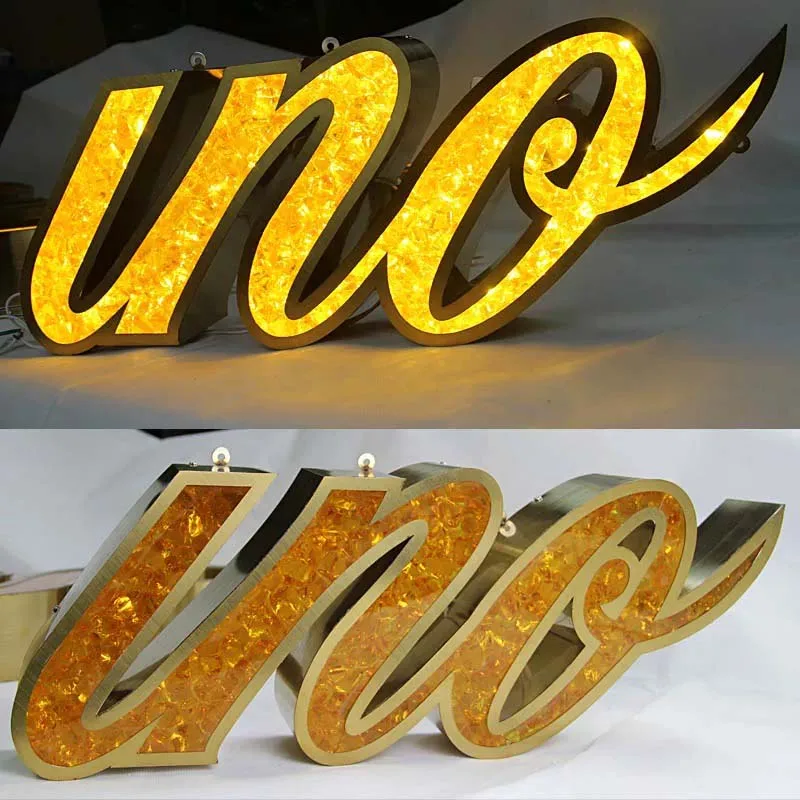
Real photo from our production floor — every sign we ship is made here.
From $24/letter · MOQ 1 piece · Flexible lead time · CE & UL certified · ships to 20+ countries
Custom sizes, colors, and finishes. Get a factory price in 24 hours.
Get a Free Quote Copy EmailWhatsApp +86 13865703472 · business@aochuangsign.cn
See pricing, specs, and get a free quote for the sign type you need. Built in our factory, shipped worldwide.