Let's cut through the bullshit right now. There's no universal "better" option between channel letters and lightbox signs. There's only what makes sense for your client's location, budget, and brand goals.
I've spent 16 years in this industry, watched contractors order the wrong sign for the wrong building, and watched importer after importer lose their shirt on cheap LED modules that died in 11 months. This guide is the straight talk I'd give you sitting across my desk in Lu'an, Anhui. No fluff, just real numbers you can put in a quote.
---
First, Let's Define What We're Actually Comparing
A
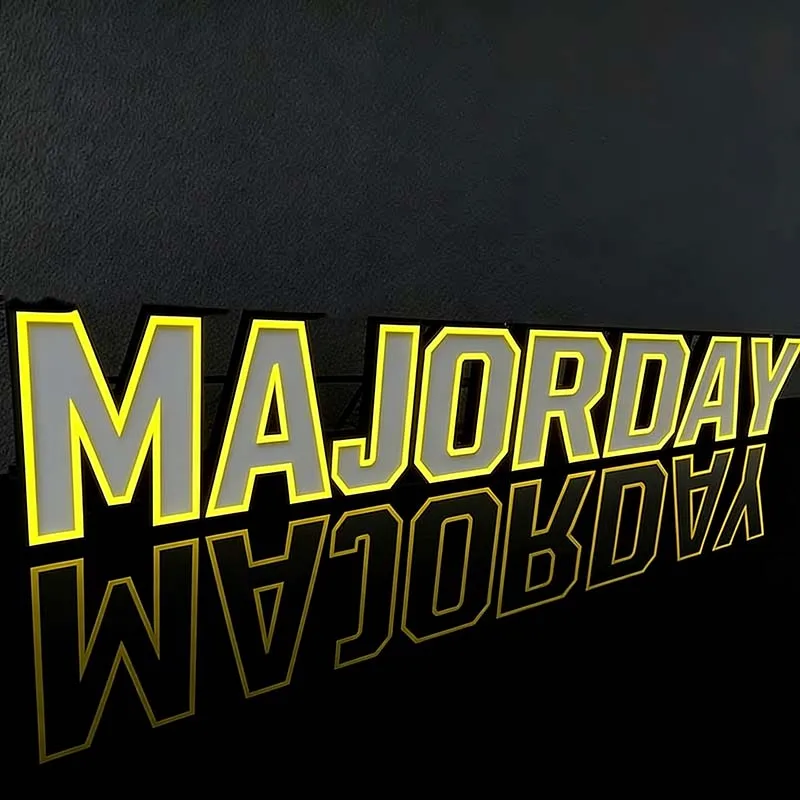
front-lit channel letter is a three-dimensional, individually fabricated letter. It's got an aluminum or stainless steel body, an acrylic face, and LED modules inside. Think of it as a sealed box with a glowing face that projects off the building.
A lightbox (or cabinet sign) is a larger, boxed structure. It's one big frame — usually aluminum — with a single acrylic face or a flexible vinyl face stretched tight. The whole thing is internally illuminated. McDonald's arches, gas stations, most fast-food drive-thrus. That's the lightbox world.
The ROI difference comes down to five factors: upfront cost, lifespan, energy consumption, maintenance, and curb appeal.
---
The Hard Numbers on Cost
The ugly truth is that front-lit channel letters will cost you more upfront. Factory-direct pricing for channel letters runs $20-80 per letter depending on depth, size, and finish. A typical 12-letter storefront sign with a simple logo runs maybe $600-1,200 at factory prices. Add your markup and installation, and you're looking at $200-700 per letter installed for the client.
Lightboxes are cheaper per square foot —$80-250 per square meter factory-direct. A standard 12-foot sign runs maybe $500-2,000 wholesale. That's why box signs dominate fast-food chains and shopping malls where the budget is tight but the building is big.
Here's what nobody tells you: the cheap option doesn't stay cheap. If your client is planning to be in that space for 5+ years, the calculus flips. Channel letters win the long game.
---
Lifespan and Durability
Front-lit channel letters built right — meaning 5mm acrylic over 1.2mm stainless or aluminum with quality silicone sealing — will last 10+ years outdoors. The stainless alone is rated 10-15 years in normal environments. If you use 316 stainless? 15+ years, even in coastal salt air. I've seen channel letters from the early 2000s still burning bright.
A lightbox has a shorter practical life for one simple reason: the face is one giant sheet. When it cracks, it's a full-face replacement. When the frame punctures, the entire cabinet suffers. 8-12 years is realistic for aluminum lightboxes, but expensive repairs hit far earlier.
I've seen this go wrong: a client saved 40% upfront on a lightbox from a cheaper factory, then had to re-lamp it in year two because the wiring burned out. The total cost of ownership made the "premium" channel letter look like the bargain.
---
The LED Factor Nobody Mentions
Both sign types rely on SMD 2835 modules — that's the industry standard, 100-150 lumens per watt. But here's where the "budget" sign gets dangerous. If you or your client buys a lightbox or channel letters with cheap LED modules, you get 12-18 months of life. Period. Quality modules from Samsung, Osram, or Lan Jing 5+ actual years.
Every factory claims L70 ≥50,000 hours. Most don't test. Ask for the data sheet. Ask for the module brand. If a supplier won't answer that question, walk away.
My rule of thumb: if the price seems 20% cheaper than every other quote, they're probably using crap LEDs. The modules alone account for 30-40% of my manufacturing cost. There's no magic discount.
---
Visibility: The True Purpose of a Sign
Here's the piece that gets ignored in 90% of ROI calculations. A sign's real job is selling, and the visibility difference between channel letters and lightboxes is massive.
Channel letters — especially
back-lit halo letters — have depth and dimension. They cast light that catches the eye at angles flat boxes can't. When lights are off during daytime, 3D letters still read as sculpted architectural elements. They look substantial, premium, permanent.
A lightbox is flat. During the day, it's either a white or colored box. It blends into the storefront architecture. It doesn't give brutal first impressions. For banks, law offices, high-end retail, and medical suites — channel letters build trust before your client even reads the name.
Lightboxes win one visibility game, though: distance. Large backlit cabinets are visible from further away because of the sheer surface area. That's why they're everywhere on highways, where a driver has 3 seconds to register a brand from 500 feet.
The dual-lit option — front and back-lit in one letter — gives you both. It's a premium product (that's why it's priced at $40-120 per letter) but it's the closest thing to "best of both worlds" I can offer. You get the glow of the letters and the halo. No compromise.
---
ROI: Run the Actual Math
Here's a concrete example. Let's say you're specing a sign for a 1,200 sq ft restaurant in Kansas City.
**Scenario 1: Channel Letters**
- Factory cost, 15 letters + logo: $1,400
- Shipping (air freight, ~$10/kg, 60kg): $600
- Tariff (Section 301, ~30%): $420
- Install (your cost): $600
- **Total landed: ~$3,020**
- Your quote to client: $8,500
**Scenario 2: Lightbox**
- Factory cost: $1,800
- Shipping: $800
- Tariff: $540
- Install: $500
- **Total landed: ~$3,640**
- Your quote: $7,200
The channel letter project gives you $5,480 gross margin. The lightbox gives you $3,560. Same building, same client, nearly same storefront.
Now factor lifespan. If that building lease runs 7 years, channel letters will likely require zero rebuilds. The lightbox will need at least one $400 LED replacement and maybe a new face. The ROI gap widens further if your client values the curb appeal that brings customers inside.
---
The Dreaded "Which Do I Recommend?" Conversation
This is where I'll annoy some clients, and I'm okay with that. If my own kids opened a restaurant tomorrow, I'd push them toward channel letters for most storefronts, especially in pedestrian-heavy areas. The 3D presence gives an upscale feel cheap boxes can't fake, and the long-term costs are friendlier.
The lightbox wins when visibility distance matters more than intimacy. A urgent care clinic on a highway feeder road, a 99-cent store in a stripmall, a franchise with brand standards mandating the cabinet. Then the box is the right choice — not the "good enough" choice, the actually correct choice.
I'd also put
stainless steel letters on your radar if the client wants no illumination at all. Non-lit metal letters run $15-40 per letter, and for many professional storefronts (law firms, accountants) that's the right call.
---
What Your Client Actually Cares About (But Won't Say)
They care about being seen, looking successful, and not having to think about their sign for a decade. Help them make a decision that satisfies those three things — not just the one that gets them to "yes" the fastest.
If they're comparing quotes and one factory is 30% cheaper, I'd send a red flag up. The production steps for a quality sign aren't negotiable: laser cutting at ±0.1mm, TIG welding for stainless, CNC-routed acrylic faces, neutral silicone for waterproofing, and an 8-12 hour aging test before shipping.
A proper sign should take about 5-15 days minimum to manufacture. If your factory quotes 4 days, they're cutting corners somewhere, and it'll show up in the client's parking lot 18 months later.
---
Specs Cheat Sheet (Save This Table)
- Channel Letters, Front-Lit: $20-80/letter factory. 90-92% transmittance acrylic. Best for: most storefronts, offices, retail.
- Channel Letters, Back-Lit Halo: $35-120/letter. Premium. Best for: luxury retail, banks, hotel signage.
- Aluminum Lightbox: $80-250/sq meter. Best for: highway, franchise, large-scale messages.
- Stainless Non-Lit Letters: $15-40/letter. Best for: medical, legal, industrial (no light needed).
---
Now Let's Talk About the Elephant: What I CAN'T Do
I can't sell you a UL-listed sign today if you ask me for one next week. UL certification costs $4,000-15,000 and takes 4-9 months. Most Chinese factories don't have it — I'll tell you straight that we're certified to CE, RoHS, and ISO 9001, not UL. If you need UL for a US jurisdiction, plan your project months in advance, and I'll tell you if what you need is actually achievable in your timeline.
I can't control your local electrical inspector. NEC Article 600 is real. An unlucky inspector can flag a sign if the installation doesn't meet local code. That's on you (or your licensed electrician), not the factory. But I can build to specs that pass inspection in most US jurisdictions.
I also can't make a sign invisible. If you're in a market where every competitor uses 3D letters, a lightbox might make you stand out... or look cheap. And if you're in a noisy sightline, the lightbox's flat face might be the wrong call. There's no formula that fits every building.
---
The Verdict From a Guy Who's Built Both
Choose channel letters for most storefronts that want to project stability and quality. They don't just look better; they last longer and deliver a stronger lifetime ROI for your client.
Choose a lightbox when the sign needs to communicate from a distance, when the brand standards demand it, or when the client's budget literally can't stretch to a set of letters. I'd rather sell you a properly built lightbox than a set of channel letters built on cheap materials just to hit a price point. That's a bad deal for you and a bad reputation for me.
And if you're still overwhelmed by options, let's talk direct. My team and I have exported worldwide from our 3,000 square meter facility in Lu'an. We know what works in your market, and more importantly, what doesn't. Send me a sketch of the storefront and a rough idea of the budget — I'll tell you what I'd build and why.
---
One Last Reality Check
If you're comparing quotes from five different factories and their prices are suspiciously spread out, that tells you exactly who's using Samsung LEDs and who's using no-name modules. It tells you who uses 5mm acrylic and who sells you 3mm because they think you won't check.
I've seen this go wrong too many times to stay quiet: a contractor saves $600 on a sign, then spends $900 on re-installation after the letters warp in summer heat. The "deal" becomes a liability.
Buy once. Cry once. Your client will call you when the neighbors ask who did their sign — and that's the moment your commission feels worth it.