I've burned my fingers on enough acrylic and argued with enough freight forwarders to know this: HS codes aren't paperwork bullshit.
They're the difference between your sign landing in four days or four weeks in a customs warehouse. One wrong digit on your entry, and US Customs doesn't care how good your front-lit channel letters look. They'll hold the crate, charge storage, and send your client somewhere else.
So let's talk classification like adults.
Look, the Harmonized System is a six-digit global language. Every country adds extra digits after that, but the first six stay the same whether you're importing into Dallas or Düsseldorf.
The US uses a 10-digit HTS code. China uses a different suffix on export. Your broker only cares about the first six for classification, then the tariff schedule for duty.
I'm not a licensed customs broker. But after 16 years on a factory floor, I've shipped worldwide, and I've learned which codes keep my crates moving.
These are the ones you'll actually use for sign products, not the textbook list of 5,000 codes.
Here's what nobody tells you: the code follows the primary function, not the material breakdown.
If the sign has LEDs and lights up, it's 9405.60. Doesn't matter if the face is acrylic and the return is stainless steel. The lighting function wins.
If it's non-illuminated metal letters, it's 8310. If it's non-illuminated plastic letters, it's 3926. If it's non-illuminated aluminum letters, it's 7616.
Got a light box with printed graphics and backlit LEDs? Still 9405.60.
So ask one question first: Does it light up?
The ugly truth is most customs delays aren't tariff problems. They're lazy descriptions.
Your broker gets an invoice that says "sign." That's it. No material, no dimensions, no whether it's illuminated. Now he's guessing.
I've seen this go wrong: a sign shop in Texas ordered $8,000 worth of stainless steel channel letters. Factory's invoice said "metal letters." Customs pulled it for exam because the description matched 9405.60 but the weight and value pointed to 8310. That crate sat for 17 days. Storage fees cost $1,200.
So put the full description on the commercial invoice. "Illuminated stainless steel channel letters with acrylic faces and LED modules, HS 9405.60." That's what we do from our factory.
I've seen this go wrong too: a buyer in Miami ordered marine-grade stainless steel letters for a beachfront hotel, described them as "metal letters" on the invoice. Customs held them because the value didn't match the description. Took three weeks to clear.
Here's what nobody tells you: your HS code doesn't just trigger duty. It also affects whether your shipment gets flagged for anti-dumping, Section 301, or other trade measures.
US Section 301 tariffs on Chinese signage products are around 30% on top of the normal duty rate for many of these codes. That's a real number, not fearmongering.
One of my customers in Florida orders back-lit halo letters for hotel projects. He budgets 30% tariff, about 10 days air freight, and then the install. He still saves 50-65% versus US retail installed quotes of $400-$1,000 per letter.
But if the broker uses the wrong code, you might pay 5% instead of 30%, or 30% instead of 0%. Both are a problem.
Brutal honesty #1: Some factories will offer to put a lower value on your invoice to reduce duty. Don't. US Customs audits importers, not factories. You're the one who gets the penalty letter, and it can be triple the lost duty plus your shipment seized.
Brutal honesty #2: Don't trust a factory that says they know your local tariff rates better than your broker. We handle export from Lu'an, Anhui. We don't sit in your country's customs office. We can give you the HS code we'd use for export, and we'll write the invoice right. But your broker owns the entry classification.
Look, I'm not going to promise you duty-free customs clearance. That's not how this works.
What we can do: ship from our 3,000m² facility in Lu'an, Anhui, with 50+ skilled workers. We provide a commercial invoice with accurate HS codes, product descriptions, material breakdown, and value. We pack signs with export-grade foam, cartons, and plywood crates. We run an 8-12 hour aging test before any LED sign leaves the floor. We can put one sign on a pallet or fill a full container.
What we can't do: be your licensed customs broker in the US, EU, or Australia. We can't guarantee a specific duty rate at your border. We can't get your sign through FDA or electrical safety certificates for you, though we do hold CE, RoHS, ISO 9001, and can provide those certificates.
And we won't lie on an invoice. If you need to under-declare value to make the numbers work, find another factory. We're still here after 15 years because we don't play that game.
MOQ is 1 piece. Lead time is about 5-15 days for most orders. Try getting that from a domestic shop with a 300-sign backlog.
Our warranty is 2 years on LEDs, 1 year on power supplies. If a driver dies, we replace it. If a cheap LED module from a low-bid factory dies at 14 months, that's on you.
Know your HS code, describe the sign properly, and don't be an idiot with the commercial invoice. Do that, and your container moves faster than you expected.

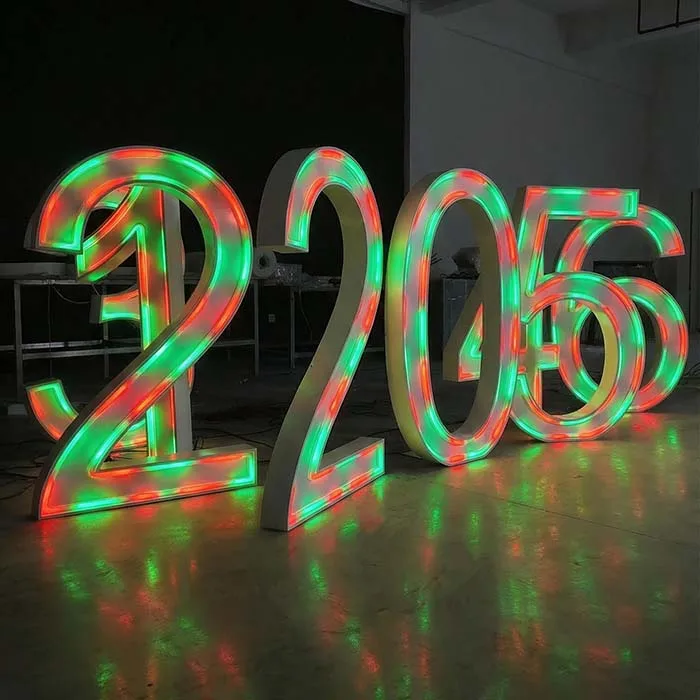
Real photo from our production floor — every sign we ship is made here.
From $24/letter · MOQ 1 piece · Flexible lead time · CE & UL certified · ships to 20+ countries
Custom sizes, colors, and finishes. Get a factory price in 24 hours.
Get a Free Quote Copy EmailWhatsApp +86 13865703472 · business@aochuangsign.cn
See pricing, specs, and get a free quote for the sign type you need. Built in our factory, shipped worldwide.