You're Getting Screwed on Sign Pricing (Probably)
I've watched sign shops pay $800 for a front-lit letter. Same 304 stainless, same Samsung LEDs. We ship that letter for $120. That's not a brag—that's math. But here's what nobody tells you: the cheapest quote on your desk right now? That one's also the most likely to leave you holding a box of garbage in six months.
I've been in this industry since before SMD LEDs existed. I've burned my hands on hot acrylic, argued with suppliers about lumen output, and watched a shipping container of "premium" signs arrive with half the modules dead on arrival. I know every corner a factory can cut because I've watched other factories cut them.
Don't worry. I'm going to show you exactly what to ask for.
What "Factory Direct" Actually Means (And Doesn't)
Every factory on Alibaba claims they're "factory direct." Half of them are trading companies with a warehouse and a website. A real factory? They'll show you the production floor on a video call without flinching.
We're Aochuang Sign in Lu'an, Anhui. Founded 2010, 3,000 square meters, 50+ workers. We cut, bend, weld, paint, wire, and test everything in-house. When I send you a quote, that's our cost plus a margin. No middleman.
Request a video walkthrough before you order. If they say no, that's your answer. I've seen this go wrong: a buyer in Texas paid a 40% deposit for 200
channel letters from a "factory" in Shenzhen. Turned out to be a broker in a WeWork. He lost $8,000 and three months.
The Real Cost Breakdown (Stop Guessing)
Let me save you the email tag. Factory prices per letter:
- Front-lit channel letters — $20-80 per letter
- Back-lit halo letters — $35-120 per letter
- Stainless steel non-lit — $15-40 per letter
- 3D fabricated letters — $40-120 per letter
- Aluminum letters — $10-25 per letter
- Light boxes — $80-250 per square meter
- Neon flex signs — $30-200 per sign
Your local sign shop will quote you $200-700 per letter for front-lit. That's not robbery—they've got overhead, labor, permits, and a mortgage. But if you're ordering 50 letters for a hotel project? Factory-direct savings hit 50-65% on product. That's the difference between winning a bid and eating the loss.
How to Get a Quote That's Actually Worth a Damn
Here's what nobody tells you: the quality of the quote you get depends entirely on the quality of the info you send. Send "I need letter signs" and you'll get a garbage quote. Send measurements, materials, and photos, and you'll get something you can take to the bank.
Send these seven things:
- Letter height, depth, and total quantity
- Material spec (stainless 304 vs 316 vs acrylic faces)
- Illumination type (front-lit, halo-lit, dual-lit)
- Color of acrylic face and metal trim
- Photos or CAD of your building/storefront
- Your city/state for shipping calculation
- Target budget (so I don't quote you platinum when you need aluminum)
The ugly truth is most buyers don't know what material they need. They think stainless steel is stainless steel until their coastal sign rusts in 18 months. Type 304 is fine for most applications. Type 316 adds 20-30% in cost and has 15+ year marine-grade life. If you're within a mile of saltwater, pay the premium. If you're in a strip mall in Ohio, 304 is all you need.
Materials: Where You Can Save and Where You Get Burned
Let's talk acrylic. Mitsubishi and Degussa acrylic gives you 90-92% light transmittance and survives 5-8 years of UV without yellowing. Domestic Chinese acrylic? It starts yellowing in 1-2 years. That's the difference between a $400 upcharge that keeps your sign looking new versus customers asking why your logo looks like a nicotine stain.
Common acrylic thickness: 2mm, 3mm, 5mm. Over 2.5 meters tall? Use 5mm. I've seen signs bow and crack because someone saved $60 on thinner acrylic.
For metal, we use TIG welding that leaves seams so clean you can't feel them blindfolded. Grinding and polishing runs 1-2 days for a reason. Mirror finish (#8) and brushed finish (#4) are entirely different animals. And powder coating beats painted every day of the week.
Now, regarding
stainless steel letters: brushed stainless is the bread-and-butter of the industry. Just remember, there's "stainless" and there's "stainless." 18% chromium, 8% nickel, density 7.93 g/cm³. I don't care which factory you choose—verify the grade before you pay. I've seen cheap "304" that was actually 201 grade. Fails in three years.
LED: The Component That Makes or Breaks Your Reputation
Here's something that keeps me up at night: cheap LEDs. The market is flooded with modules that claim 50,000 hours of life. They last 12-18 months. That's a real statistic, not hyperbole.
Quality LED modules using Samsung, Osram, or our preferred brand Blueview (Landscape)? Those last 5+ years in real conditions. The difference is about 15-20% on component cost. That's the difference between a client who reorders from you and one who calls your competitor.
SMD 2835 is the industry standard at 100-150 lumens per watt. SMD 5730 is brighter but less efficient. Color temperature matters more than people think:
- 3000-3500K warm — hospitality, restaurants
- 4000-5000K neutral — corporate, retail
- 6000-6500K cool — industrial, highway
If your quote doesn't specify the LED brand and part number, you're gambling. Ask. Every reputable factory will tell you.
Smart Specs for Serious Buyers
Back-lit Halo Letters: The "Invisible" Premium
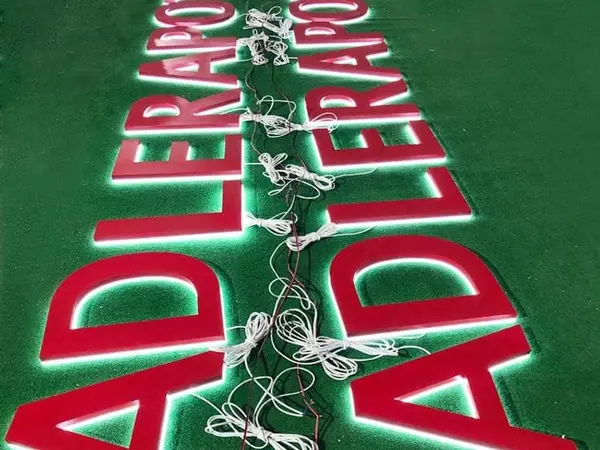
Halo letters are what you want when you need "expensive-looking" without being loud. They're called "halo" because the light glows behind the letter, casting a shadow that creates depth. Mounted flush against the wall on studs, using
back-lit halo letters is the architectural standard for banks, law firms, and any brand making a "we're established" statement.
They cost $35-120 per letter, take longer to fabricate, and require more precise installation. But the visual return is worth it. The most common screw-up here? Wrong mounting stud length. Measure your wall gap before ordering, not after.
Dual-Lit Letters: The Day/Night Solution
The best of both worlds: front-lit face + back-lit halo from the same letter. A white acrylic face on brushed stainless steel trim with diffused illumination throughout. Front-lit in daylight, halo-lit at night. Most expensive option per letter, but you cover every lighting condition.
Acrylic Light Boxes: The Versatile Classic
For
acrylic light boxes, you're looking at $80-250 per square meter, depending on frame construction and LED density. These are ideal for gas stations, convenience stores, and quick-service restaurants. Simple, bright, and serviceable. The cheapest reliable option when you need serious visibility on a budget.
Neon Flex: The Trend That's Here to Stay
If your client wants the neon look without the glass-tube fragility,
neon flex signs are your answer. Silicone-encased LEDs that bend and curve like traditional neon, but survive shipping, weather, and the occasional collision with a cleaning cart. Great for bars, taprooms, and trendy retail. Just don't expect the true character of hand-bent glass.
Production Timeline: The Honest Version
The standard lead time for a typical order is 10-15 days production from the date you approve the digital proof. Not 5 days—anyone quoting 5 days is risking quality or lying. On a per-stage basis:
- Design confirmation — 1 day
- Laser cutting (±0.1mm precision) — 1-2 days
- Bending and TIG welding — 1-2 days
- Grinding and polishing — 1-2 days
- Acrylic face CNC cutting — 1 day
- LED assembly and wiring — 1-2 days
- Silicone sealing — 1 day
- Aging test, 8-12 hours on all LEDs
- 100% QC inspection
- Foam + carton + plywood crate packaging
I'm giving you the inside numbers because I want you to hold other factories to the same standard.
Certifications: The BS Detector
Here's where I get angry. CE marking costs 20,000-50,000 RMB (about $3,000-7,000). It takes 2-8 weeks. Most factories say they have it. Walk through their office and ask to see the certificate with today's date. We do it gladly.
That "CE.UK" or "CE.something" you see on a competitor's price sheet? It's just a custom printed logo sticker on a box. It means nothing.
The real ones matter:
- UL 48: required for US electrical. Costs $4,000-15,000 and 4-9 months plus quarterly audits. That's why you pay more for UL-listed product. ETL is a UL alternative at 10-30% lower cost.
- CE: required for Europe. Not a product mark, it's a manufacturer's self-declaration. Still doesn't mean it's independently tested.
- IP65: minimum for outdoor signs. Dust-tight and protected against water jets.
- IP66: more powerful water jets. Good for coastal environments.
- IP68: submersible. Extreme environments.
IP65 sounds impressive. It means water jets from any direction. It does NOT mean your sign survives a Florida hurricane. People think "waterproof" means "weatherproof." It doesn't. If you're in a wind zone, ask about the mounting brackets and interior bracing, not just the IP rating.
And don't forget NEC Article 600 for US electrical work. If you're installing signs in the US, your local inspector will want to see that the power supply is listed. We don't mess with that on our end—we build the sign, your licensed electrician handles the connection.
Shipping: The Hidden Budget Killer
The quote is cheap, shipping eats your lunch. This is where new importers lose their shirts.
Express shipping (DHL/FedEx/UPS): about 5-15 days, $30-100 for small samples. Air freight: about 10 days, $4-12 per kg. Sea freight: about 65 days, $80-200 per cubic meter for LCL, or $1,200-3,000 for a full container.
And now, the part that makes everyone angrier than a miswired ballast:
US Section 301 tariffs. Around 30% on steel and aluminum signs. You can't dodge them, so stop trying. Build them into your budget and pass them to your client. The factory-direct savings still make landed cost 30-40% less than buying domestic.
I've seen this go wrong: a contractor in Florida ordered $15,000 of channel letters, factored in shipping, forgot the tariff. When the bill of lading arrived with a $4,500 customs bill, he nearly had a stroke. Plan for it.
ADA Signs: Don't Build That Restaurant's Bathroom Sign Wrong
If you're shipping to the US and the signage is for a public building, you need ADA compliance—Grade 2 Braille, tactile letterforms, mounting height. Don't just design signs blind. Requirements are:
- Tactile characters, minimum
- Sign height: 48-60 inches from the floor to the baseline of the tactile characters
- Non-glare finish
- Grade 2 Braille
Yes, we can do ADA signs. No, that's not where our margin is. But get it wrong and the inspector will hold up your entire certificate of occupancy.
MOQ and Payment: The Real Talk
Our MOQ is 1 piece. Want one halo letter to test? Fine. If you want a custom sample before committing to a full run, pay for the sample + express shipping. That's fair. If a factory says "no samples," how do they expect you to trust them with five figures?
Standard terms: 30-50% deposit, balance before shipment. That's how the industry works. If a factory asks for 80% upfront, walk away. If they offer "net 60" financing, they're either desperate or building that risk into your price.
The Actual Process, Step by Step
Here's what happens after you send the quote info:
- We send a detailed quote within 24 hours (you might need to prompt us if it's the weekend)
- You approve, pay deposit, and we send digital proofs for approval
- We order materials, cut, weld, fabricate
- We assemble LEDs and test for 8-12 hours
- 100% QC inspection, you receive photos and video of the completed work
- We pack everything: foam + carton + plywood crate
- Ship, track, and deliver
- You handle installation to local code (or your electrician does)
That's the whole dance. No mystery. No magic.
The Bottom Line on Wholesale Orders
If you've got a project with more than 5 letters, you should be getting factory quotes. If you've got 20+ letters, you can't afford not to. The
front-lit channel letters that your local shop is selling for $400 installed? They paid somewhere between $60-100 for the product itself (if they're smart). That margin is what you're competing against.
Start with a small order. Test the waters with 5-10 letters. Then scale up once you've verified quality on your own wall.
Here's what I want you to take away: the factory with the lowest price isn't the cheapest option. The factory that tells you the truth—including when your spec is wrong—is worth every dollar.
Send me the measurements and drawings. We'll tell you if your spec is wrong. We'll tell you where you're overspending. And if you don't need our product, we'll tell you that too.
Now go make some signs.