I’ve burned my hands on hot acrylic and argued with LED suppliers about binning tolerances. I don’t do fluff.
When you’re comparison shopping for illuminated storefront signs—real channel letters, not the cheap printed boxes that fade in 14 months—the price tags you see stateside are packed with markups that have nothing to do with quality. A standard front-lit channel letter that costs us $45 to produce in 304 stainless steel with Samsung LEDs will show up on a US quote for $450 to $700. Installed. The difference isn’t magic. It’s layers: regional distributor, sales rep, brick-and-mortar showroom, local labor. Strip those away and buy factory-direct, and your numbers change fast.
Here’s what nobody tells you: the same aluminum backer, the same acrylic face, the same IP65-rated LED module. We ship it for $120 including crating, and you handle the install with your local crew. That’s not a loss-leader. That’s just us not pretending we’re a boutique agency.
Look, I’m not going to claim every sign we build is a museum piece. What I will tell you is exactly what materials we use, how long they last, and where we’ve cut corners on purpose because the client didn’t need a 15-year marine-grade solution for a coffee shop in Phoenix.
An illuminated storefront sign isn’t one product. It’s a stack of a dozen decisions. And most factories will hide behind a single line item until you ask.
Acrylic face thickness. Trim cap material. LED module brand and density. Power supply quality. Wiring gauge. Silicone sealant type. Paint or anodized finish. Return depth. UL or ETL labeling if you need it. Each one moves the price $5 to $30 per letter. The ugly truth is that two signs can look identical on a PDF proof but one will warp within a year and the other will outlast the lease.
I’ve seen this go wrong: a contractor ordered 80 back-lit halo letters for a Miami hotel lobby. Beautiful mirror-polished 304 stainless, 3000K warm white. Four months later, the return cans started rusting. The factory had used 201-grade stainless where the spec said 304. Raw material cost difference? $2.70 per letter. The contractor ate $24,000 in replacement labor. You don’t get that money back from a supplier who ghosted you on WhatsApp.
That’s why our quotes break out the substrate grade, the metal thickness, the LED CRI and color temp, the driver IP rating. No ball-of-wax pricing that lets them swap garbage later. Ask any factory for a BOM-level quote, and watch how many suddenly need three more days.
When you request a quote online for wholesale illuminated letters, don’t send a napkin sketch. Send dimensions, Pantone or RAL colors, material preference (if you know it), mounting surface, and at least an idea of whether you need UL. It saves two rounds of email ping-pong and I can turn a real quote in under 90 minutes.
Our standard factory prices, right now, for a single 10-inch letter: front-lit channel letters run $20 to $80 depending on thickness and finish. Back-lit halo letters like our back-lit halo letters hit $35 to $120 because the internal baffle and precision standoffs take more labor. Non-lit stainless steel letters sit at $15 to $40, and aluminum as low as $10. That’s FOB our factory in Lu’an, Anhui. You add shipping, you add any tariff (US Section 301 is hovering around 30% for aluminum and steel signage, last I checked), you add local setup.
Here’s what nobody tells you: sea freight for a typical storefront sign package—say 30 front-lit letters in a plywood crate—runs about $200 LCL, door to door in about 65 days. Air freight triples speed and cost. Express like DHL will get a small batch of letters to your shop in 7 days for $30-100. No, that’s not a typo; we’ve shipped 3-letter test sets to Boston for $45 just so a contractor could feel the weight of the stainless before committing to a $15,000 order. We don’t make money on shipping. We make it on repeat orders when you realize the product’s solid.
I’ve been on both sides of the RFQ. Here’s what separates a smart buyer from a mark.
1. “Show me the LED bin and brand.” If they say “high-quality SMD,” run. Samsung, Osram, or Lan Jing modules have traceable lot numbers. Cheap 2835 chips deliver 100 lm/W for about 18 months, then lumen depreciation kicks in and the sign looks half-finished. We spec L70 at ≥50,000 hours on all standard builds and give you the module cut sheet.
2. “What’s the exact stainless grade?” I can get 304 for 18% Cr, 8% Ni, density 7.93. Or I can get 201 that looks the same polished, costs 40% less, and pits after one Chicago winter. Our standard for outdoor stainless steel letters is 304. For coastal or industrial, 316 with molybdenum—20-30% cost premium, zero rust regrets.
3. “Is the power supply IP-rated for the installation?” An IP65 sign with an IP20 driver tucked inside a non-ventilated soffit will cook itself by August. We match the driver to the location: wet, damp, or dry. Mean Well or equivalent, trapped pressure equalization if needed.
4. “How do you seal the acrylic face?” Silicone is not all the same. Neutral-cure silicone won’t etch the acrylic like acetic-cure will. Stupid little detail, and I’ve repaired signs where the face cracked along the edge because someone used the cheap stuff. Our 10-step production flow includes a dedicated sealant station and a 8-12 hour aging test with the LEDs on to heat-cycle the joint.
5. “Can I get a UL or ETL label?” Here’s the brutal honesty: our facility carries CE, RoHS, ISO 9001. We build to UL 48 standards daily. That does not mean every sign leaves with a UL sticker. A full UL file costs $4,000-$15,000 and quarterly audits; if your local inspector requires it, we can coordinate a submittal through an approved shop, or we can price the compliance into the job. But if a factory claims “UL listed” for a $600 total order, they’re lying. Ask for the file number and confirm it on UL’s database right there.
Look, I get it. Budgets matter. But some shortcuts are just deferred problems that land on your reputation.
Domestic acrylic that’s not UV-stabilized will start yellowing within 18 months. Mitsubishi or Degussa acrylic costs more, gives 5-8 years of clarity. If the sign faces west, pay for the good face. Cheap LED modules might draw more current, overheat the driver, and fail at 12 months. Our power supply warranty is 1 year, LEDs 2 years—real-world, not marketing. I’ve replaced modules in signs that were built by a competitor who used recyclable PCB material and the traces corroded from humidity.
I’ve seen this go wrong: a franchisee ordered 200 rimless channel letters for a rollout. Price per letter was $22. The return depth was 20mm with LEDs pressed right against the acrylic. By month six, hot spots and shadow halos everywhere. UL would have required a minimum 40mm depth for heat dissipation. The franchisee’s own manual specified 45mm. They paid $11,000 in rework to fix a $3,000 savings. That’s not a bargain; that’s a business lesson.
Another lie: “IP66 waterproof.” IP66 means powerful water jets. It doesn’t mean you can submerge it. For a coastal location with salt spray, you want IP66 on the module and 316 stainless. For a standard storefront under an awning, IP65 is sufficient if the seals are done right. Don’t pay for ratings you don’t need, but know what the numbers actually mean.
Every sign we ship follows a 10-step sequence that hasn’t changed much in 15 years because it works. But each step has a failure mode.
1. Design confirmation (1 day): We digitize your file to a ±0.1mm cutting path. If you send low-res JPEG, don’t be surprised when “g” looks like “q.” Vector files. Every time.
2. Laser cutting (1-2 days): Stainless, aluminum, or acrylic are cut on a fiber laser. Tolerances hold to 0.1mm. On cheap orders, some shops skip de-burring; we don’t.
3. Bending and TIG welding (1-2 days): The return can is formed and welded. A bad weld bead gets ground down. Slag left inside starts rust. Our QC pokes every can before polishing.
4. Grinding and polishing (1-2 days): For mirror #8 finish, it’s multiple grits. Brush #4 is standard and hides fingerprints. Powder coating adds a day, baked at 200°C.
5. Acrylic face CNC (1 day): Face cut, edge polished, trim cap applied. If the face is over 2.5 meters, we step up to 5mm thickness so it doesn’t bow.
6. LED assembly (1-2 days): Modules are mounted inside the can, spacing depends on depth. Over 100mm deep, we use SMD 5730 with lenses for highest brightness. Standard 80mm depth gets 2835 at 120 lm/W. Wiring is soldered and heat-shrunk, not twisted.
7. Sealing (1 day): Neutral silicone, forced into the joint, not just a bead on top. Leaks start here if the temperature’s wrong, so the shop stays climate-controlled.
8. Aging test (8-12 hours): Sign is powered up, LEDs run at operating temperature. We check for flicker, hot spots, voltage drop. About 2% of units fail here—driver mismatch, cold solder joint—caught before it hits your dock.
9. 100% QC inspection: One person examines the finish, the seams, the electrical connection. If it’s a 50-letter order, she’ll check every single letter. I’ve rejected a batch because the powder coat showed a 0.5mm fisheye on one “E.” You’d never notice from 10 feet. She noticed.
10. Export packaging: Foam wrap, individual carton, then a plywood crate with steel banding. Freight handlers at Long Beach will drop it from waist height. Ours have survived that.
Our factory sits on 3,000 square meters in Lu’an, Anhui. 50-plus workers. We ship worldwide, and we’ll sell you a single letter if that’s what you need to vet us. MOQ is one piece. Lead time is 7 to 15 calendar days, not business days, and if we slip, we tell you before the deadline, not after.
Send an email with your quantity, height, material preference, illumination type, and any mounting details. Tell me if you need a warm 3000K for a bakery or a 6500K cool for a highway pylon. Tell me if you’re mounting to a brick wall or a raceway. I’ll reply with a line-by-line quote, a realistic shipping estimate, and no pressure. If you want to talk through the specs, I’ll give you my direct number. You’ll get a 52-year-old sign guy who’s argued with suppliers about LED quality, not a chatbot.
The guide is this simple: know your grades, demand a BOM, test the seals, and never pay retail markup for a product that can come straight from the floor. We’ve got the calluses to prove it.

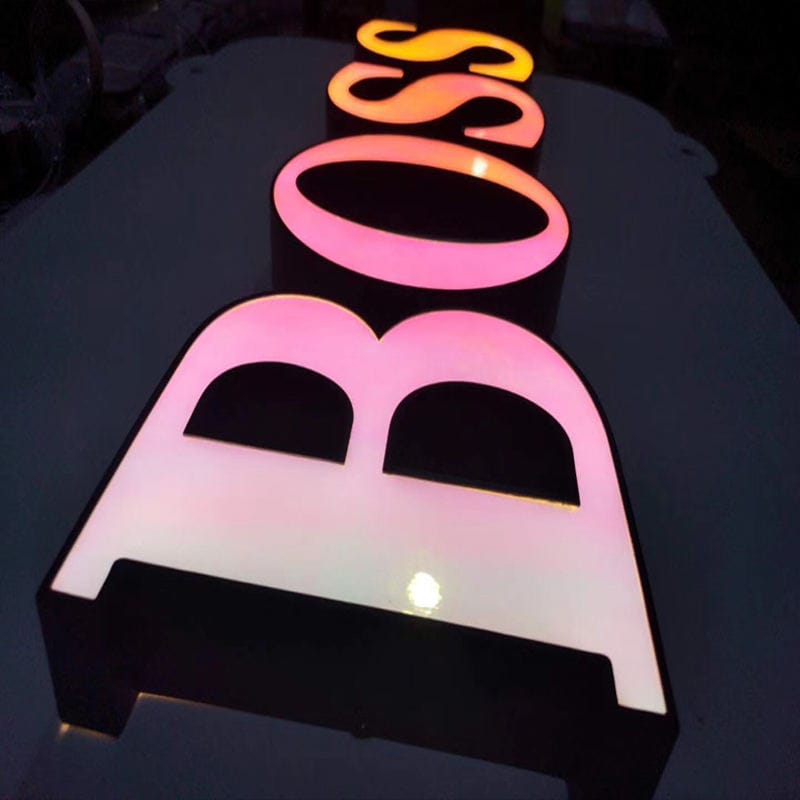
Real photo from our production floor — every sign we ship is made here.
Products mentioned or relevant to this topic — factory-direct, custom built.
Factory-direct since 2010. Free quote within 24 hours — no obligation.
Get a Free Quote → Copy EmailMOQ: 1 piece · Flexible lead time · 2-year warranty · Worldwide shipping
See pricing, specs, and get a free quote for the sign type you need. Built in our factory, shipped worldwide.