Look, the IP rating on a spec sheet is a promise, not a guarantee.
I've pulled apart a competitor's back-lit halo letter after a Florida rain season. The LED module had green corrosion on the contacts. The buyer paid $2,400 for that sign. The factory said IP67. Sure. In a lab, maybe. On a wall facing Atlantic salt spray? Not a chance.
This guide is for sign shop owners, contractors, and importers who don't have time for marketing fluff. You need to know what IP65 actually protects against, what it doesn't, and how to avoid buying a rust bucket with a fancy sticker.
I'll give you numbers, not adjectives. I'll tell you what our factory in Lu'an can do, what we can't, and where I'd tell you to spend your money instead.
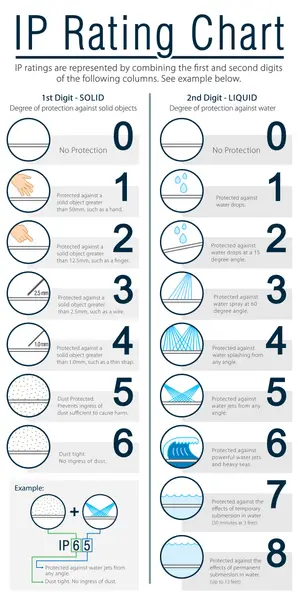
IP stands for Ingress Protection. Two digits. First digit is solids, second is water. That's it.
For outdoor illuminated signs, you only care about a few combos. IP65 means dust-tight and protected against water jets from any direction. IP66 means stronger jets, like a pressure washer at close range. IP67 means temporary immersion up to 1 meter for 30 minutes. IP68 means continuous immersion—usually a depth and duration specified by the manufacturer, not a standard number.
Here's what nobody tells you: IP67 and IP68 are not automatically better for signage. I've seen IP68 enclosures sweat internally from temperature swings, condense water inside the lens, and kill LEDs faster than a cheap IP65 box with a drain hole. Water that gets in needs a way out. Sealed completely means trapped humidity.
The ugly truth is most sign buyers overpay for IP68 thinking it means hurricane-proof. It doesn't. It means the enclosure can sit underwater. Last time I checked, your storefront sign isn't a submarine.
Our front-lit channel letters leave the factory with IP65 sealing: neutral silicone around the acrylic face, closed-cell foam gaskets on the back, and a 8-12 hour aging test. That handles rain, snow, and the occasional car wash overspray.
But IP65 has limits. The test uses a 6.3mm nozzle spraying 12.5 liters per minute from 3 meters for at least 3 minutes. That's a hard rain, not a pressure washer held 2 inches from the seam. If your client's crew blasts the sign with 3,000 PSI every month, you need IP66, not IP65.
I've seen this go wrong: a contractor installed back-lit halo letters under a roofline with a gutter leak. Water hit the top seam for 6 hours during a storm. IP65 didn't save it because the test doesn't simulate constant pooling. The fix? Install a drip edge, use stainless 304 returns, and add drainage holes at the lowest point. Then even if water gets in, it leaves.
If you're near the ocean, IP65 with 316 stainless is non-negotiable. 316 has 2-3% molybdenum. 304 doesn't. In Miami Beach, 304 pits and rusts within 2-3 years. I don't care what IP rating you stamp on it.
We're Aochuang Sign in Lu'an, Anhui. 3,000㎡ production floor. 50+ workers. We've exported worldwide since 2010. I'm not going to tell you we're the cheapest or that we can make a $30 channel letter with Samsung LEDs and marine-grade stainless. We don't do that.
What we can do: standard IP65 on every outdoor illuminated sign—front-lit, halo, acrylic light boxes, you name it. We use neutral silicone, not cheap acid-cure stuff that eats LED coatings. We run an 8-12 hour aging test on every unit. 100% QC inspection before packing. CE and RoHS certificates are real, not a PDF from 2019.
What we can't do honestly: I won't sell you an "IP68" outdoor sign as a standard product. If you need IP66 for pressure-washing, we can do it—extra silicone, different gaskets, and a TUV test report. That adds cost and 2-3 days. If you need UL 48 listing for the US, that's $4,000-15,000 and 4-9 months of quarterly audits. Most factories say they're UL listed. Ask for the certificate number and check it. Nine times out of ten, it's expired or belongs to a supplier's component, not the finished sign.
The brutal honesty moment: A $40 front-lit letter with a fake CE mark is still a $40 letter. You get cheap domestic acrylic that yellows in 1-2 years, LED modules that fail at 18 months, and a power supply with a 1-year warranty that dies right after. Our factory-direct price for a front-lit channel letter is $20-80 depending on size. That's product only. US retail installed runs $200-700 per letter. If you're paying $200 installed per letter, someone's cutting corners hard.
CE marking for our factory cost 20,000-50,000 RMB and takes 2-8 weeks. RoHS is cheap. ISO 9001 is a management cert, not a product cert. None of those prove water resistance.
IP65 test report from a third party like TUV or SGS is what you ask for. Not a factory "self-declaration." Not a screenshot. A current report with the sign model number, date, and test house logo. I'll send you ours if you ask. If a factory hesitates, that's your answer.
UL 48 is the US electric sign standard. It's expensive and slow. ETL is a legit alternative, 10-30% cheaper. If you're importing to the US, NEC Article 600 governs installation. Your electrician needs to follow it regardless of what the factory sticker says. The Section 301 tariff adds about 30% on top of product cost. Plan for that, don't cry about it later.
Here's what nobody tells you: a CE mark doesn't mean the sign is legal in the EU. It means the manufacturer claims conformity. Enforcement is spotty. I've seen importers get stopped at Rotterdam because the CE certificate was for the power supply, not the whole luminaire. Buy the finished sign with certification, not a pile of parts.
UV kills outdoor signs faster than water does. Acrylic face panels: Mitsubishi or Degussa UV-resistant sheet lasts 5-8 years before yellowing. Domestic Chinese acrylic can start yellowing in 12-18 months. We offer both. Guess which one goes on a sign for a client who checks warranty claims?
LED modules: SMD 2835 at 100-150 lumens per watt is the industry standard. Samsung, Osram, or Blueview-brand modules run 5+ years real lifespan. Cheap no-name modules fail at 12-18 months. The L70 rating of 50,000 hours means brightness drops to 70%—it doesn't mean the module doesn't corrode from moisture. Sealing with neutral silicone is what keeps the solder joints alive.
Stainless steel letters: 304 is 18% chromium, 8% nickel. Good for 10+ years outdoors. 316 is marine grade with 2-3% molybdenum. It costs 20-30% more. For a strip mall in Ohio, 304 is fine. For a hotel sign 200 meters from the Gulf, pay for 316 or you'll replace it in 5 years. Our stainless steel letters use real 304 or 316, not the nickel-plated mild steel some factories call "stainless." Bring a magnet. 304 is slightly magnetic, 316 is not. If your "316" letter sticks hard to a magnet, it's not 316.
Aluminum is one-third the weight of steel and naturally rust-proof. 8-12 year outdoor life with proper powder coat. Common thickness 1.0-1.6mm. If a factory quotes you aluminum letters at $8 each, you're getting 0.5mm foil that dents in a hailstorm.
I've been on this factory floor for 16 years. Here's the failure order I see in warranty claims, from most to least common:
The ugly truth is no IP rating fixes poor installation. If your contractor doesn't caulk the top of the raceway, water runs behind the sign and into the wiring. IP65 on the letter doesn't matter. I've had importers blame our factory for water in the junction box when the installer left it open. That's not a factory defect; that's a lazy sparky.
Ask these exact questions before you send a deposit:
Our MOQ is 1 piece. Lead time 7-15 days. Express shipping on a sample letter runs $30-100 and arrives in 7-15 days. Sea freight for a full order is $80-200 per cubic meter LCL, 50-70 days. You'll save 50-65% on product versus US retail installed prices. But you're the importer of record—tariff is on you.
If you're comparing quotes, here's a factory-direct price range for product only: front-lit channel letters $20-80 per letter, back-lit halo $35-120, stainless non-lit $15-40, acrylic light boxes $80-250
Factory-direct since 2010. Free quote within 24 hours — no obligation.
Get a Free Quote →MOQ: 1 piece · 7-15 days · 2-year warranty · Worldwide shipping
See pricing, specs, and get a free quote for the sign type you need. Built in our factory, shipped worldwide.