Last year a contractor in Houston called me panicking. His client’s $30,000 monument sign had water sloshing inside the illuminated letters after the first rainstorm. The sign was rated IP65 — on paper. The real problem? The factory had sealed the face with cheap hot-melt glue instead of neutral silicone, and nobody tested it on an actual angled letter can. Don’t let that be you.
The ugly truth is most outdoor sign buyers think an IP rating is some magic shield. It’s not. It’s a number that tells you what standardised lab test the sign housing passed — nothing more. If the factory cuts corners on post-test production, your IP66 sign can flood faster than a cardboard box. I’ve been on the factory floor for 16 years, burned my fingers on acrylic, argued with LED suppliers, and watched $20,000 installations fail because a screw hole wasn’t gasketed.
Here’s what nobody tells you: a genuine IP66 rating on a custom 3D letter costs real money in materials and labor. Don’t expect your average $85 backlit letter from a trade platform to survive a pressure washer. Don’t fall for a CE certificate from 2018 that shows a flat light box, then assume your curved “P” and “S” letters will stay dry. At Aochuang Sign we build outdoor illuminated signs every day, shipping worldwide from our 3,000m² facility in Anhui. I’m going to walk you through exactly what IP65, IP66, and IP67 mean for the sign in your hand, what we can deliver, what we won’t pretend to deliver, and how to make sure your next order doesn’t turn into a warranty nightmare.
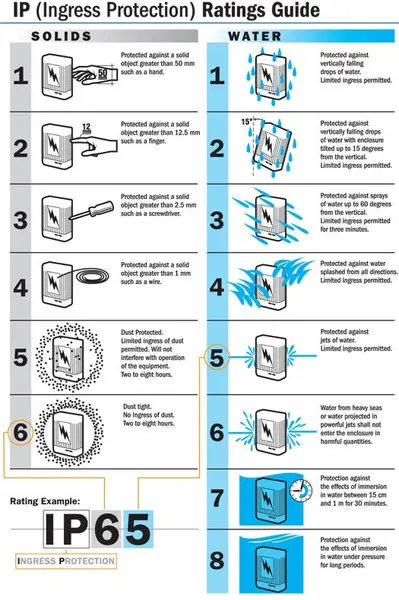
IP stands for Ingress Protection. First digit: solids (dust). Second digit: liquids. For outdoor illuminated signs you always want a 6 first — completely dust-tight. LED drivers and solder joints hate fine dust almost as much as water. So IP6X. Then the second digit tells the water story: 5 is water jets from a 6.3mm nozzle at 12.5 liters/min, 6 is powerful jets from a 12.5mm nozzle at 100 liters/min, 7 is immersion in 1 meter of water for 30 minutes, and 8 is continuous submersion beyond 1 meter (specified by manufacturer). Our kind of work rarely needs IP67 or IP68. If your sign is underwater, you’ve got bigger problems than the warranty.
Look, every year I see importers obsess over the IP number while ignoring the mechanical reality. A back-lit halo letter mounted on a wall at a 5-degree tilt creates a tiny shelf where water can pool. No IP rating covers that. The test sprays water for a few minutes, then checks for ingress. It doesn’t simulate months of damp air, thermal cycling, and UV turning the rubber gasket into brittle crackers. The test is a snapshot — useful, but incomplete.
IP65 means the sign housing can withstand low-pressure water jets from any direction. For a storefront under an awning in Denver or a retail chain where signs are cleaned with a damp cloth, IP65 is totally adequate. We build thousands of IP65 front-lit channel letters every year and they last 5-8 years without moisture issues — provided the installer doesn’t drill extra holes in the top of the can without sealing them.
But here’s the fine print. IP65 tests use a 6.3mm nozzle at about 12.5 liters per minute, distance 2.5-3 meters. That’s like a garden hose on a gentle shower setting. It won’t cope with a monsoon driving rain sideways at 50 mph or a worker blasting the letter with a pressure washer from two feet away. I’ve seen this go wrong: a fast-food franchise in Florida ordered IP65 stainless letters. The building maintenance crew pressure-washed the facade monthly. Within eighteen months, three letters had water inside and the LEDs started flickering like a disco. The dirty secret? The factory’s silicone bead was too thin on the bottom corners—exactly where the pressure washer hit hardest.
For most stainless steel letters installed on a vertical surface in a normal climate, IP65 does the job. We cut the 304 stainless returns with ±0.1mm laser precision, TIG weld the seams, and run a continuous 3-4mm bead of neutral-cure silicone around the acrylic face before riveting. Then every single letter goes through 8-12 hours of aging test with the LEDs on, and we check for condensation inside the face. If you’re not seeing that QC step from your supplier, you’re gambling.
IP66 is the rating for powerful water jets — think 100 liters per minute through a 12.5mm nozzle. This covers heavy rain, coastal spray, and overenthusiastic pressure washing from a reasonable distance. If your sign faces the North Atlantic, sits within half a mile of the Gulf, or gets cleaned with powered equipment, IP66 isn’t an upsell. It’s cheap insurance.
Upgrading from IP65 to IP66 on a typical channel letter isn’t just about more silicone. You need a full rethink of the drainage and sealing. At our factory, we add a secondary internal gasket channel on the acrylic face return, and we double-seal the cable entry using IP66-rated nylon glands with rubber compression rings — not just a dab of silicone. We also change the LED module mounting: instead of self-tapping screws that can allow capillary creep, we use aluminum standoffs bonded with marine-grade adhesive. These details add maybe 12-18% to the fabrication cost of a letter. For a $65 front-lit letter, that’s roughly $8-12 extra. Compare that to the cost of sending a crew with a boom lift to replace four letters two years later.
Here’s what nobody tells you: most factories’ “IP66 upgrade” is just a thicker blob of silicone and a nicer label. They don’t change the gland, they don’t re-run a water test on your specific letter shape, and they certainly don’t submerge the finished sign in a test tank unless you pay for it. We’ve invested in an in-house water jet test rig — nothing fancy, just a pump, a nozzle, and a controlled angle jig — but it lets us verify that the actual production sign, not some pre-approved sample, can take the spray. When a client orders 50 IP66 back-lit halo letters for a Miami hotel, we test 3 random pieces from the batch before packing the crate. That’s trust you can see.
IP67 means the sign can be dunked in 1 meter of water for 30 minutes. IP68 means continuous submersion beyond 1 meter, negotiated between buyer and manufacturer. For an illuminated channel letter mounted on a building wall 10 feet above the ground, IP67 is largely a marketing vanity number. The only time I’d genuinely recommend IP67 is for ground-level monument signs in flood-prone areas, or signs embedded horizontally in paving where standing water can pool for hours. Even then, the power supply and wiring need to be IP67 too, and good luck finding a waterproof LED driver that fits inside a 2-inch deep letter. You’ll end up remote-mounting the driver in a separate sealed enclosure.
Look, I’ll be blunt. We can build you an IP67 letter. It’s a lot of work — fully potted LED cavities, welded stainless backbox with no seams, industrial O-rings on the face — and it costs about 40% more than our standard IP66. I’ll take your order if you insist, but I’ll also tell you that in 14 years of exporting, I’ve had exactly two requests for true IP67 illuminated letters, and both were for a fountain installation where the letters got splashed constantly from below. Most of the time, a properly engineered IP66 sign with a breathable Gore vent to equalize pressure will survive everything short of a hurricane. Spend your budget on thicker stainless and quality LED modules, not on a rating that looks impressive in the spec sheet but never gets tested in real life.
Most sign factories show you a glossy CE or IP certificate. It’s often for a generic 200x200mm flat light box panel. It is not for your curved letter “S” with a return depth of 80mm and a cable entry on the bottom left. I’ve seen importers wave a certificate that expired three years ago and think they’re protected. When water inevitably gets in, the factory says, “The test sample passed. Your installation probably cracked the seal.” You’re left holding a bucket of rusty LEDs.
At Aochuang Sign, our ISO 9001 system forces us to be honest. We hold certificates for CE and RoHS compliance on our LED systems, and we can provide factory inspection reports with batch numbers. But I won’t show you an IP66 certificate for a standard rectangular box and pretend it covers every letter shape we cut. If you need documented IP66 for a specific project, we can arrange third-party testing — budget about $800-1,200 and add 10-14 days to your lead time. I’ll tell you this straight: many customers thank me for the honesty and then realize that our in-house water jet video, with the letter serial number and today’s newspaper in frame, gives them more confidence than a two-year-old piece of paper.
Upgrading from IP65 to genuine IP66 on a typical front-lit channel letter adds $10-20 per letter in materials and labor. That covers the better cable glands, the extra silicone pass, the labor to mask and seal every screw hole, and the time for the extended aging test. Over an order of 40 letters, you’re looking at $400-800 extra. A service call to replace two leaking letters, with a boom lift and city permits, starts at $1,200 and goes up fast. You do the math.
The materials matter. We use neutral-cure oxime silicone, not the acidic stuff that smells like vinegar and corrodes copper LED traces over time. Our standard front-lit channel letters have 304 stainless steel returns — 18% chromium, 8% nickel — that won’t rust even if a tiny amount of water sneaks in. The LED modules are SMD 2835 chips delivering 100-150 lm/W with an L70 rating above 50,000 hours, but only if they stay dry. Corroded solder joints kill an LED strip in weeks, not years. I’ve seen cheap IP65 signs where the factory used domestic acrylic (1-2 years before yellowing) and crimped the wire connections with pliers instead of sealed connectors. They passed a visual inspection but failed the first thunderstorm.
Look, there’s zero margin in re-shipping replacement letters under warranty. We offer 2 years on LEDs and 1 year on the power supply precisely because our sealing process works. If it didn’t, we’d be bankrupt. We can’t afford to lie about IP ratings.
Our 10-step production run isn’t marketing fluff. For every outdoor illuminated letter, after laser cutting the 304 stainless to ±0.1mm, our welders TIG the seams with no pinholes. Then the grinding and polishing crew smooth the returns so the acrylic face sits dead flat against the silicone. If the metal lip isn’t flat, you’ll get a gap wider than a business card — and water finds it. We CNC the acrylic face from Mitsubishi or Degussa sheet with 90-92% light transmittance and a UV-resistant cap layer, which won’t warp under thermal expansion and break the seal. After LED assembly, the silicone bead goes on, the face is riveted gently, and the letter sits in the aging bay for 8-12 hours with power on. Each letter is inspected under magnification for gaps, then wrapped in foam and packed in a plywood crate. If we’re shipping IP66, we’ll film the water jet test on sample letters and email you the unedited file.
Here’s a buyer’s checklist you can use with any supplier:
Any factory that hesitates on these questions is selling a promise printed on a sticker.
IP ratings are useful shorthand, but they’re not warranty. The best IP66 sign with a sloppy installation — a top-mounted hole drilled by the installer, no drip loop on the cable, silicone dabbed over a dirty surface — will leak anyway. I’ve screamed at contractors who drill into the top of a $400 letter without asking. Water follows gravity. Always bring cables out the bottom or back, and always use a sealed junction box rated for wet locations. The sign is just one link in the chain.
When you’re ready to order, we ship factory-direct worldwide with a minimum of 1 piece, 7-15 days production, and honest pricing: $35-120 for a back-lit halo letter, $20-80 for a front-lit channel letter, plus freight. You’ll save 50-65% versus US retail installed costs, and you’ll get a sign built by people who actually understand what IP66 has to withstand. No corporate speak. No fake certificates. Just letters that stay dry.
Factory-direct since 2010. Free quote within 24 hours — no obligation.
Get a Free Quote →MOQ: 1 piece · 7-15 days · 2-year warranty · Worldwide shipping
See pricing, specs, and get a free quote for the sign type you need. Built in our factory, shipped worldwide.