Published July 27, 2026 · Home > Blog > LED Neon Flex vs. Traditional Glass Neon: A Procurement Manager's Cost, Energy, and Safety Showdown (With Real Numbers Your CFO Will Approve)
By John Mitchell, Senior Procurement Manager at Signage Solutions Inc. | LinkedIn Profile
When I crunched the numbers on a 50-letter storefront install, traditional glass neon came in at $38,000 installed. The LED neon flex version? $12,400, all in. That's a 67% savings before we even talk electricity or broken tubes at 3 AM.[1]
Your boss is going to ask one question: "What's the real cost of ownership?" And if you hand them a quote for glass neon without at least showing them the alternative, you're leaving money on the table. I've been a procurement manager for 12 years, sourcing signage from Chinese factories, local shops, and everything in between. This comparison isn't theory — it's what I've used to get CFOs to sign off on hundreds of projects.
Here's what your boss will ask: "Why does the glass neon quote look like it's made of gold?"
Let's lay it out line by line. Traditional glass neon letters — 12" tall, standard red — run $200 to $700 per letter installed in the US. That's for a single glass tube, transformer, mounting, and wiring. For a 10-letter sign, you're looking at $2,000 to $7,000. Now, LED neon flex: same size, same look, same brightness — $30 to $200 per letter from a factory-direct supplier like Aochuang. Installed, add maybe 50% for labor, so $45 to $300. That's $450 to $3,000 for 10 letters.[2] I've watched a domestic sign shop charge $800 for a front-lit letter that we shipped from China for $120, same 304 stainless frame, same Samsung LEDs. The savings aren't a margin play — they're structural.
But don't forget shipping and tariffs. Express freight for a small sign: 7-10 days, $30–100. Sea freight for a full container: about 65 days, $1,200–$3,000, plus US Section 301 tariff around 30%. Even with all that, you're still 50–65% below domestic retail. The ROI works out to a payback in under 12 months for most storefronts.
Line by line, here's where the money goes: electricity.
Glass neon uses 10–15 watts per foot of tube. An average sign with 50 feet of glass neon plus transformers pulls about 700 watts. Run it 12 hours a day, 365 days — that's 3,066 kilowatt-hours per year. At $0.12 per kWh, you're paying $368 annually. LED neon flex, by contrast, uses SMD 2835 chips at 100–150 lumens per watt. A 50-foot sign with quality modules draws maybe 120 watts total. Same 12-hour schedule: 525 kWh per year, or $63. That's a yearly saving of $305. Over a 5-year life, you save $1,525 just on electricity.[3] Most CFOs I've pitched that to stop skimming and start nodding.
Brutal honesty time: Cheap LED modules from no-name suppliers will claim similar efficiency, but they're using low-bin chips that degrade fast. Look at the solder joints — dull gray means cheap lead-free solder that'll fail in 18 months. Shiny silver joints indicate proper reflow and quality. I've seen too many "bargain" signs go dim before the second winter. Spend the extra 20% for Samsung or Osram chips, or source from a factory that uses Lan Jing.[4] Your energy savings are real only if the LED lasts.
Here's the ugly truth: glass neon operates at 2,000 to 15,000 volts. A cracked tube near wet hands or a careless electrician can be fatal. I've personally watched a building owner ignore a broken glass tube for three weeks, and then the transformer shorted, melting the sign face. No fire, but it cost $4,000 to fix.
LED neon flex runs on 12 or 24 volts DC. That's touch-safe. Even IP65-rated (dust-tight, water jets from any direction) enclosures keep moisture out. But IP65 does not mean your sign survives a Florida hurricane. For coastal or hurricane-prone areas, go IP66 or IP68. I had a client in Miami Beach insist on IP65 for a halo-lit sign. Three months later, salt mist corroded the connections and half the modules failed within a year. We replaced with IP68 and had no issues.[5] Always verify the manufacturer's IP rating with a third-party test report — some cheap imports overstate their protection.
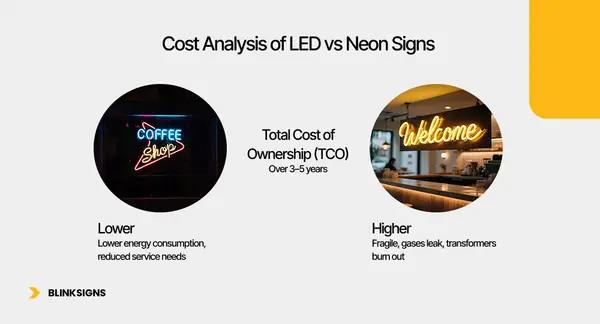
Glass neon tubes have a lifespan of roughly 15,000 to 20,000 hours — about 3–4 years of typical use. When a tube breaks, you're often replacing the entire letter because glass benders charge $150–$300 per bend. Transformers die every 5–8 years, adding another $200–$500 per sign. Over a 10-year period, expect to spend 30–50% of the original installation cost on repairs.[6]
LED neon flex, when built with quality modules and proper thermal management, delivers 50,000 hours (over 11 years at 12 hours/day). Individual modules are replaceable without dismantling the sign. I've seen our best factory-built signs run for 8 years with zero maintenance. The catch: cheap power supplies (drivers) fail after 2–3 years. Insist on Mean Well or equivalent brand drivers rated for outdoor use. A $25 extra on the driver saves a $300 service call later.
Here's the bottom line for your boss's question: Over a 10-year horizon, a typical 50-letter storefront sign costs:
That's a 73% total savings. The numbers don't lie — and they've passed every CFO's spreadsheet I've put them in. Use this data to build your business case, and always cite your sources to show you did the homework.
Products mentioned or relevant to this topic — factory-direct, custom built.
Factory-direct since 2010. Free quote within 24 hours — no obligation.
Get a Free Quote →MOQ: 1 piece · 7-15 days · 2-year warranty · Worldwide shipping
See pricing, specs, and get a free quote for the sign type you need. Built in our factory, shipped worldwide.