Last year, a Miami nightclub installed a custom 18-foot glass neon sign above their main bar. Beautiful. Mesmerizing. Six months later, their electrician was on speed dial. Flickering tubes. A humming transformer that drove customers crazy. One broken glass section after a routine cleaning. Total maintenance bill? $2,100 — and that’s before the business lost half an evening’s revenue when the sign went dark on a busy Saturday.
If that sign had been LED neon flex, the maintenance tab would be zero. The energy draw? One-third of what the glass monster pulls. And nobody would worry about shattered glass raining down on the bartender.
I’ve spent 15 years in commercial sign manufacturing. I’ve seen too many shop owners and contractors learn the hard way that beautiful doesn’t always mean practical. This article is a no-BS, numbers-driven comparison of LED neon flex and traditional glass neon. No smooth-talking sales fluff. Just specs, real costs, and the kind of wisdom you only earn standing on a factory floor.
When you first compare price tags, glass neon looks tempting. A simple 6-foot “OPEN” sign in traditional hand-bent glass might come in at $800–$1,200 at a local US shop. LED neon flex for the same size and style? Anywhere from $150 to $400 factory-direct. That’s a 60–70% gap before you even plug it in. But here’s the trap — the purchase price is the cheapest part of glass neon ownership.
Glass neon runs on high-voltage transformers pushing 10,000 to 15,000 volts. Those transformers eat electricity. A 10-foot glass neon unit typically draws 150–200 watts. An equivalent LED neon flex sign — built with SMD 2835 or 5050 chips at 3–5 watts per foot — pulls around 50 watts. Over a year of 12-hour daily operation in a city where power costs $0.12 per kWh, the glass sign tacks $157 onto the electric bill. The LED version? About $26. That delta only widens as energy prices climb.
Then get into the ugly stuff. Glass neon tubes are fragile. A single hairline crack — from building vibration, a poorly aimed door slam, or a freight handler having a bad day — and the entire tube loses its gas charge. Dead. You can’t just patch it. You need a skilled glass bender to fabricate a replacement, evacuate it, backfill with neon or argon/mercury, and install it. That’s a $200–$400 repair, minimum, with a two-week wait. Multiply that across a multi-element sign in a high-traffic environment and you can see how a $2,100 annual maintenance bill becomes normal.
LED neon flex doesn’t crack. It’s a flexible PVC or silicone jacket encasing LED modules on a copper PCB. Cut it on-site with shears, splice with snap connectors, run it from a tiny 12V or 24V driver. No glass, no gas, no high-voltage arc. When we factory-test LED neon flex at our facility in Anhui, we subject every finished piece to an 8–12 hour aging test and a 100% QC inspection. We’re not waiting for a glassblower’s off day to show up in your client’s storefront.
| Cost Factor | Traditional Glass Neon (6ft sign) | LED Neon Flex (6ft sign) |
|---|---|---|
| Factory-direct product price | $400–$700 (custom bent) | $100–$250 |
| US retail installed price | $1,200–$2,000 | $400–$800 |
| Annual energy cost (12h/day) | $157 | $26 |
| Typical repair call (tube+Vacuum) | $200–$400 per break | $0 (module replacement if ever needed, ~$15) |
| Lifespan before major degradation | 10,000–15,000 hours before gas recombination dims tube | 50,000 hours L70 (LED modules) |
| Warranty on electrical components | Often 1 year on transformer, none on tubes | 2 years on LEDs, 1 year on power supply (factory standard) |
Glass neon tubes are high-efficiency light sources if you only look at lumens per watt — a red neon tube can hit 50–60 lm/W. The problem is the ballast. Traditional magnetic transformers waste 30–40% of the input power as heat. Electronic transformers improve that, but they’re still not in the same league as a switched-mode LED driver. That’s why a 10-foot glass neon “BAR” sign draws enough juice to make your client’s eco-conscious customers wince.
LED neon flex uses SMD 2835 chips as the industry workhorse — 100 to 150 lumens per watt. The flex itself rolls out with a typical density of 60–120 LEDs per meter, pulling 4–8 watts per meter. For a full 6-foot sign, we’re talking 15–25 watts total. That’s less than the bulb in your refrigerator. In commercial spaces where signage runs dusk to dawn, the annual electrical savings alone pay back the entire LED sign within 3–5 years. And if you’re specing signage for a multi-location chain, the cumulative operational savings become a line item the CFO will hug.
Color temperature doesn’t affect energy in glass neon the way it does in LED, but with neon you need different phosphor coatings to get white or yellow — those tubes are less efficient and more expensive. LED neon flex just switches color temperature by populating different phosphor-converted LEDs. 3000K warm white, 4000K neutral, 6500K cool white — same power draw. Your hospitality client wants a soft amber glow at 2200K? There’s a readily available flexible strip for that, consuming the same 5W per foot.
Factory-floor observation: When we ship LED neon flex to the Middle East, where ambient temperatures hit 50°C, we increase the heat-sink backing on the aluminum profile and spec Osram 2835 chips rated for 105°C junction temperature. A glass neon transformer in that heat? It’s a ticking thermal shutdown. Efficiency isn’t just about kilowatt-hours — it’s about keeping the sign lit in the real world, not in a lab.
Let’s be blunt. Traditional glass neon is a safety liability waiting to happen. The transformer steps wall voltage up to 10,000–15,000 volts. One compromised GTO cable, one accidental touch during maintenance, and you’ve got a serious arc-flash and shock hazard. I’ve seen sign shops where the neon installer had to suit up like a lineman. The tubes themselves contain neon gas (inert, fine) or argon with a tiny drop of mercury (toxic). Smash a tube, and you’re dealing with a hazardous material cleanup in a public space.
Glass shards are the obvious problem. Bars, restaurants, and retail stores with heavy foot traffic can’t afford a 3mm-thick glass tube hanging overhead, ready to shatter if a coat hanger clips it. In earthquake-prone zones or high-vibration settings like music venues, the failure rate spikes. Glass neon demands robust secondary containment — often a thick polycarbonate face or cage. That adds cost and kills the minimalist look.
LED neon flex eliminates every one of those hazards. It runs off low-voltage DC — 12V or 24V, usually Class 2 compliant. You can hold a bare live end in your hand without a tickle. The light-emitting surface is a continuous extrusion of flexible PVC or silicone. No glass. No gas. No mercury. When we produce neon flex signs for US clients, we follow NEC Article 600 guidelines for low-voltage signage. The electrical inspector sees a tiny UL-listed driver tucked in a junction box, not a ball of high-voltage spaghetti they need to clear with the fire marshal.
Outdoor ratings tell the story. Our LED neon flex carries an IP65 rating as a minimum — completely dust-tight and protected against water jets. For coastal installations, we step up to IP66, which holds off powerful sea-spray blasts. Traditional glass neon? The tube itself can be weather-sealed, but the electrode housings and GTO connections corrode in salt air. I’ve pulled apart a coastal glass neon sign after two years and found the electrode wires reduced to green powder.
You haven’t lived until you’ve crated a 8-foot diameter glass neon circle for ocean freight. Despite double-wall cartons, 2-inch foam padding, and a plywood crate that could survive a forklift tumble, we used to see 15–20% breakage on LCL (less-than-container-load) shipments of glass neon. After one particularly painful claim where a single tube shattered from vibration and took out three adjacent tubes, we shifted our export focus almost entirely to LED alternatives. LED neon flex? Our 7–15 day factory lead time holds because we can bend, cut, and assemble rigid aluminum backings around pre-tested flexible neon without worrying about a glass artist sneezing.
Shipping costs are another gut punch. A 6-foot glass neon sign in a protective wooden crate might cube out to 0.15 m³ and weigh 25 kg. LED neon flex of the same face size, packed in foam and a sturdy carton, might be 0.03 m³ and 8 kg. On a sea freight LCL rate of $80–200 per cubic meter, that’s the difference between paying $12 and $30 just for the crate’s volume. Plus, US Section 301 tariffs hit at roughly 30% on the declared value — a $700 glass sign gets hit with $210 in tariff; a $250 LED sign, $75. When you’re importing 50 signs for a chain rollout, that delta buys a nice dinner.
On the longevity front, LED neon flex wins on paper and in the field. L70 rating of ≥50,000 hours means after five years of 24/7 operation, the light output is still above 70% of initial brightness. Real lifespan of quality LED modules (Samsung, Osram, Lan Jing) easily hits 5–7 years outdoors before noticeable dimming. Cheap, no-name modules? Count on 12–18 months before they look like a faded bruise. Glass neon has a shorter but more graceful aging curve: a well-made tube may stay bright for 10,000 hours, then slowly dim as the phosphor degrades or gas absorbs into the glass. But one power surge or a tiny impurity during pumping, and it’s dead instantly — no graceful decline.
Admit it, glass neon has a magic that LED struggled to copy for years. That 360-degree uniform glow, the gentle halo on the wall, the slight flicker when struck that feels alive. I’ve stood in boutique hotels where a cascading glass neon sculpture looked like liquid light. Early LED neon flex couldn’t touch it — you’d see distinct dots, uneven light diffusion, and a cheap plastic sheen.
Today’s professional-grade LED neon flex changes that conversation. With 120 LEDs per meter tucked inside a dense, milky silicone or PVC housing, the spotting is virtually gone at normal viewing distances of 3 feet or more. The high-frequency constant-current drivers eliminate visible flicker, even on camera. Want that classic glass neon halo effect? Mount the flex on standoffs behind a stainless steel letter back — exactly how we build back-lit halo signage in our factory. The result is a 20mm floating glow that mimics bent glass so closely, your customers won’t know the difference until you tell them — or until they see the power bill.
Color range is another area where LED has leapfrogged. Glass neon colors are defined by noble gases and phosphor coatings. You get maybe 20–30 reliable hues. RGB-capable SMD 5050 neon flex puts 16 million colors at your fingertips via a simple DMX or smartphone controller. A nightclub can shift from hot pink to ice blue to gold at 10 pm. You can’t do that with a glass tube without physically swapping the sign. And while a pure neon red (the iconic crimson tube) is still unmatched in spectral purity, the SMD 5730 chip in a warm-red silicone sleeve gets close enough that even a trained eye needs side-by-side comparison under a loupe to spot the difference.
One factory-floor truth: don’t spec cheap neon flex and expect it to look like glass. The thickness of the polymer jacket and the LED spacing make or break the illusion. We use a 10mm round profile for 15–20mm visual width, with a high-density layout. A 5mm flat profile with sparse LEDs will always look like a craft-shop strip. Pay for quality, and you’ll get a flex that bends to a 3cm radius without kinking and washes a wall evenly. That’s what turns a sign from “fake neon” to “modern architectural lighting.”
Ask any sign installer about glass neon, and they’ll tell you about the three-hour service call where they had to unmount a 60-pound sign and carefully hand-carry a replacement tube up a scissor lift. Glass neon requires precise mounting clips, vibration dampeners, and absolute realignment after every tube swap. And because the high-voltage GTO wiring must be routed through silicone-insulated standoffs and kept 1.5 inches from metal, the back of the sign is a rats’ nest of danger.
LED neon flex? It arrives on a lightweight aluminum or acrylic panel with a small waterproof driver already wired. Mount the panel with four stainless screws, connect the 12V leads to the driver’s output — polarity marked clearly — and plug into a standard outdoor junction box. The whole process takes less than an hour for a typical storefront sign. If the flex needs a curve, you simply bend the flexible extrusion along the pre-cut

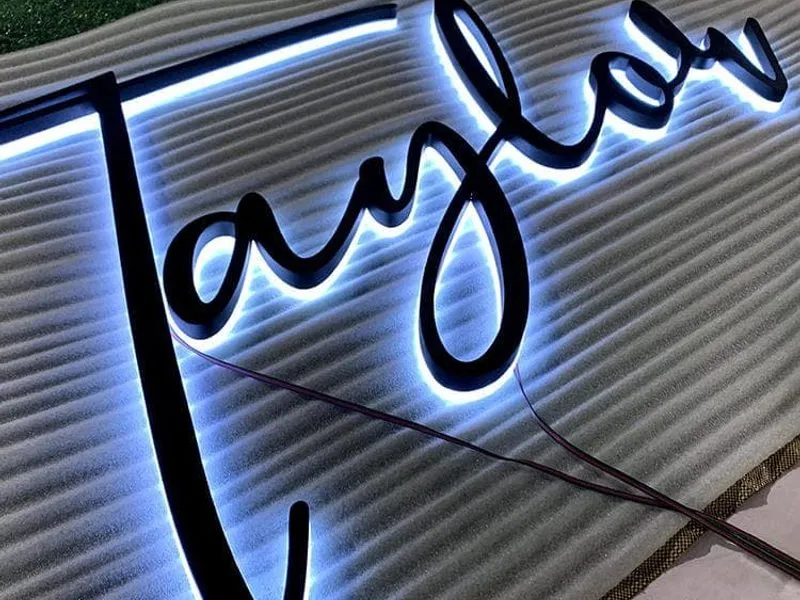
Real photo from our production floor — every sign we ship is made here.
Products mentioned or relevant to this topic — factory-direct, custom built.
From $24/letter · MOQ 1 piece · Flexible lead time · CE & UL certified · ships to 20+ countries
Custom sizes, colors, and finishes. Get a factory price in 24 hours.
Get a Free Quote Copy EmailWhatsApp +86 13865703472 · business@aochuangsign.cn
See pricing, specs, and get a free quote for the sign type you need. Built in our factory, shipped worldwide.