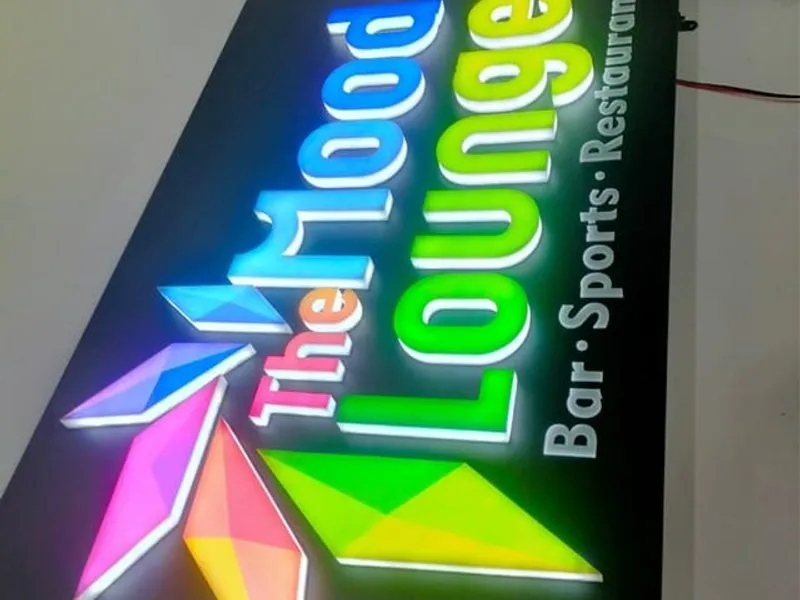
Here's what nobody tells you: the cheapest sign isn't the one with the lowest price tag. It's the one that costs you the least after five years of electric bills, dead modules, and midnight service calls.
I've watched a sign shop owner pay $6,000 for a set of LED channel letters, then get stuck with a $300/month electric bill because the installer used cheap SMD modules that pulled twice the wattage of the Samsung units he quoted. That's not a hardware problem. That's a math problem.
This guide is for anyone about to sign a purchase order — sign shop owners, contractors, importers, and business buyers. We make both types at our factory in Lu'an, Anhui. We'll sell you either. We won't help you justify a bad decision.
Let's start with a baseline: five letters, two feet tall, typical storefront. One option is LED front-lit. The other is non-illuminated stainless steel. We'll use real market numbers — our factory prices and US retail installed prices.
What Actually Counts in a 5-Year Cost
Five numbers decide which sign wins: upfront product cost, installation, annual electricity, annual maintenance, and lifespan. Add them up. You'll be surprised.
From our shop floor: front-lit channel letters run $20-80 per letter factory-direct, $200-700 per letter installed in the US. Stainless steel non-lit letters: $15-40 per letter from us, roughly $100-250 installed if you're not getting ripped off. Light boxes: $80-250 per square meter. Neon flex signs: $30-200 for the full sign.
Now run the math on a five-letter sign. LED front-lit at $400 per letter installed: $2,000 upfront. Stainless non-lit at $180 per letter installed: $900 upfront. Already a $1,100 gap.
But that gap shrinks when you turn on the lights.
LED Signs: The Real Upfront and Operating Costs
LED signs cost more to build. You're paying for aluminum or stainless cans, acrylic faces, power supplies, modules, and labor to weatherproof everything. A quality front-lit channel letter is $20-80 factory-direct. Add an electrician, permits, and a mounting frame, and you're at $200-700 per letter installed.
The electricity part is where most people guess wrong. A typical five-letter LED sign draws about 200 watts when it's actually on. Run it 12 hours a day, and that's 876 kilowatt-hours per year. At $0.15/kWh, you're paying $131 each year. Over five years: $657. That's the price of two cheap module replacements.
Then there's maintenance. SMD 2835 modules are rated L70 at 50,000 hours — that's 11 years at 12 hours a day, if you buy quality LEDs from Samsung, Osram, or a reputable brand like Blueview. Cheap modules die in 12-18 months. I've seen it happen in a strip mall outside Phoenix. The sign was barely brighter than the rusting frame holding it.
Quality LEDs have a real lifespan of 5+ years. When one module goes, the sign doesn't go dark. It just gets a dim spot. You climb a ladder, pop the acrylic face, replace the module and reseal it. That costs $50-150 per service call if you hire it out. Cheap LEDs? You'll be up there every six months, and the power supply will fail in year one.
You can cut the electric bill by adding a photocell so the sign turns off at dawn and runs only from dusk to close. That cuts hours from 12 to 8, bringing five-year electricity down to $438. But you still have the upfront cost and maintenance.
Non-Illuminated Signs: The Hidden Costs Nobody Quotes
Non-illuminated metal signs are brutally simple. Stainless steel 304 with a brushed #4 finish will last 10+ years outdoors. No electricity, no modules, no power supplies. A 1.0-1.2mm stainless letter costs $15-40 factory-direct. Installed, you're at $100-250 per letter depending on your city and mount.
The hidden cost is visibility. If your storefront has no ambient light after sunset, a non-illuminated sign is just a dark rectangle. You'll add floodlights or gooseneck lamps. That costs $200-500 to install and draws maybe 150 watts. Over five years, lighting the sign costs roughly $650 — nearly the same as running an LED version.
If you skip the floodlights, you've bought a sign that disappears at night. That's the real cost: a sign that doesn't work for a third of the day.
Maintenance on a stainless steel sign is close to zero. Wipe it down twice a year. If the sign sits in a coastal or industrial zone, use 316 stainless — it has 2-3% molybdenum and lasts 15+ years instead of 8-10. It costs 20-30% more than 304, but it won't pit and stain. For a strip mall in Ohio, 304 is fine. For Miami Beach, pay for 316.
Run the Numbers: 5-Year Cost Breakdown
Let's put it in hard numbers. We're using average US retail installed prices, $0.15/kWh, and 12 hours of operation per day.
- LED front-lit channel letters (5 letters) — $2,000 upfront, ~$657 electricity, ~$200 maintenance over 5 years. Total: ~$2,857.
- Non-illuminated stainless steel (5 letters) with floodlights — $900 upfront, $300 floodlight install, ~$650 electricity for the lights. Total: ~$1,850.
- Non-illuminated stainless steel without any lighting — $900 upfront, $0 electricity, $0 maintenance. Total: $900. But it's invisible at night.
The gap between LED and a floodlit non-illuminated sign is about $1,000 over five years. That's the price of being seen in the dark.
Now look at the business model. A bar, a dental office, or a retail store open past 7pm needs the LED sign. If one extra customer per week spends $30, that's $1,500 a year. The LED sign pays for itself in a month. If you're a law firm open 9 to 5, the non-illuminated sign is the wiser spend.
When LED Signs Make Sense (And When They Don't)
The ugly truth is: most business buyers over-buy. You don't need a 3D halo-lit, brushed-gold emblem for a scooter repair shop. You need something that shouts "OPEN" from a dark side street. A
front-lit channel letter sign is the storefront standard for one reason: it works. It's bright, legible, and cheap to repair.
If you want the premium halo glow, our
back-lit halo letters run $35-120 per letter factory-direct. They look sharp on glass and dark stone. But they cost more to build and install, and they draw more power. Use them for architectural work, not for price-sensitive clients.
For non-illuminated jobs,
stainless steel letters offer the best durability for the money. If you need something lighter and naturally rust-proof,
aluminum letters are $10-25 per letter from us. Both are fine for daytime visibility.
Here's what nobody tells you:
neon flex signs look modern but burn through LEDs faster. The flexible silicone tubing bends around tight corners, which puts stress on the internal LED connections. A spot failure is common after 2-3 years. For a trendy bar sign, it's perfect. For a sign that must last a decade, choose channel letters.
Hidden Costs That Kill Good Sign Decisions
I've seen this go wrong: a buyer picks a $50 LED letter, then pays $200 in oversized shipping, another $150 for the 30% US Section 301 tariff on Chinese steel, and $500 in electrical work for a 120V connection that should have cost $200. The sign itself was the cheapest part of the project.
Shipping is the second biggest hidden cost. Express runs $