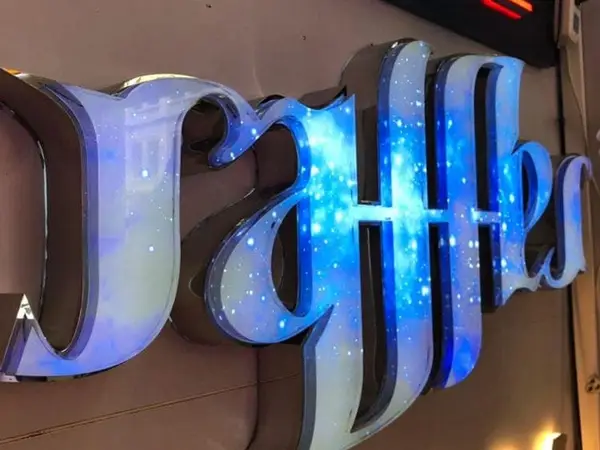
Look, I've been on a factory floor in Lu'an for 16 years. I've watched sign shop owners buy the cheapest letter and then curse themselves for five years. Cost comparison isn't about the invoice. It's about year three, when the cheap LEDs are dead and the building owner is calling you at 8pm.
Here's what nobody tells you: a non-illuminated
stainless steel letter can outlast a cheap LED module by a decade. 304 stainless has a 10+ year outdoor life. Cheap LED modules? 12-18 months before they start flickering. You do the math on labor. I don't get paid for your service calls.
If you want lit signage,
front-lit channel letters are the storefront standard. They cost $20-80 per letter at our factory. The same letter installed by a US sign shop runs $200-700. That gap is why importers exist. But it's not the whole story.
The Price Gap, Straight Up
Factory price per letter, no middleman: front-lit
channel letters $20-80. Back-lit halo letters $35-120. Non-illuminated stainless steel letters $15-40. Aluminum letters $10-25. Light boxes $80-250 per square meter. Neon flex $30-200 per sign.
Those are our real production prices from a 3,000m² facility with 50+ workers. We ship worldwide. MOQ is 1 piece. Don't let a factory minimum force you into 10 pieces you don't need.
Shipping eats into that savings. Express takes 7-10 days and runs $30-100 for small packages. Air freight is about 10 days at $4-12 per kilogram. Sea freight takes about 65 days, $80-200 per cubic meter LCL, or $1,200-3,000 for a full container. Then the US Section 301 tariff hits at roughly 30% on top. Even with all that, factory-direct typically saves you 50-65% on product compared to US retail installed pricing. I've watched sign shops pay $800 for a front-lit letter. Same 304 stainless, same Samsung LEDs. We ship that letter for $120.
The ugly truth is most factories quote you a price without the UL certification you need for a US commercial install. UL 48 costs $4,000-15,000 and takes 4-9 months, with quarterly audits. We don't pretend that's included. Ask any supplier. If they say "UL ready" but won't show you the file number, walk. We build to CE, RoHS, and ISO 9001 out of the box. That's real. UL is a separate project.
Materials and the 5-Year Trap
Materials decide whether you're paying once or paying every year. For non-illuminated,
stainless steel letters in 304 grade last 10+ years outdoors. Density 7.93g/cm³. 18% chromium, 8% nickel. Common thickness is 1.0-3.0mm. Finishes: brushed #4, mirror #8, PVD, powder coated. All of them hold up if you use real 304.
If your project is within five miles of salt water or heavy industry, pay for 316 stainless. It contains 2-3% molybdenum and lasts 15+ years marine grade. It costs 20-30% more than 304. For a strip mall in Ohio, 304 is fine. For Miami Beach, pay for 316. That's not upselling. That's saving you a warranty claim.
Aluminum letters weigh one-third of steel and last 8-12 years outdoors. Thickness runs 0.040-0.063 inches (1.0-1.6mm). Finishes: anodized, powder coated, brushed. It's naturally rust-proof and cheaper than stainless. If you're ordering 200 letters for an office park and the budget is tight, aluminum does the job. It won't look as rich as steel, but it won't rot.
For
LED signs, acrylic is the weak point. UV-resistant acrylic from Mitsubishi or Degussa lasts 5-8 years before yellowing. Domestic acrylic? 1-2 years. I'm not guessing. I've pulled yellowed faces off signs in less than 24 months. Common thickness is 2mm, 3mm, 5mm. If your sign is over 2.5 meters wide, use 5mm or thicker. Thin acrylic bows in wind and cracks at the studs.
LED modules are where factories cheat. Quality modules from Samsung, Osram, or Lan Jing L70 ≥50,000 hours. That means after 50,000 hours, light output drops to 70% of original. Run a sign 12 hours a day, that's over 11 years of theoretical life. Real lifespan: 5+ years. Cheap modules? 12-18 months. Same voltage, same footprint, one-fifth the price. They fail. I've seen this go wrong: a restaurant chain bought cheap LED modules to save $1,200 on an order. Year two, half the letters were dark. They paid $3,800 in labor to replace modules. The savings never existed.
The Hidden Cost: Power Supplies and LEDs
Warranty tells you what the factory expects to fail first. Our LED warranty is 2 years. Power supply warranty is 1 year. That's not a coincidence. Power supplies die before LEDs. Budget for one power supply replacement in year two or three if you run the sign every night. A power supply costs $15-50 depending on size. The labor to swap it is more than the part.
Here's what nobody tells you: a non-illuminated sign doesn't have a power supply to replace. No driver. No flicker. No electrician. But it also doesn't sell anything after dark. That's the tradeoff. If your business operates only from 9am to 5pm, don't pay for LEDs you don't need. Buy non-illuminated
metal letters and move on.
If you do need light, pay for quality modules upfront. Our 10-step production includes an 8-12 hour aging test before 100% QC inspection. We catch dead modules before they ship. Most cheap factories skip the aging test entirely. They ship you a box of problems and call it "quality control."
Power consumption is another chunk of the five-year cost. SMD 2835 modules run 100-150 lumens per watt. That's efficient. SMD 5050 is RGB capable for color-changing signs. SMD 5730 pushes 40-60 lumens per chip for highest brightness. But if a client compares a lit sign to a non-lit sign, the non-lit sign uses zero watts. Don't let a salesman convince you that LED "energy savings" justify a lit sign when you don't need light. That's a rookie mistake. Energy savings only matter if you were already going to light it.
Color temperature matters for retail. 3000-3500K warm white works for hospitality and restaurants. 4000-5000K neutral is corporate and retail standard. 6000-6500K cool white is for industrial and highway. The wrong color temperature makes a sign look cheap even with good materials.
Certifications You Actually Need
IP ratings are the most abused spec in this industry. IP65 means dust-tight and protected against water jets from any direction. That's the minimum for outdoor signs. It does not mean your sign survives a Florida hurricane. IP66 handles powerful jets, good for coastal areas. IP68 is submersible, for extreme weather or flood zones. Don't pay for IP68 if your sign is mounted eight feet above a sidewalk in Arizona.
CE marking costs 20,000-50,000 RMB and takes 2-8 weeks. Most factories say they have it. Ask to see the certificate with today's date. If the certificate is three years old or the factory name doesn't match, it's worthless. We have CE, RoHS, and ISO 9001. We'll show you.
For US installs, NEC Article 600 governs electrical signage. ADA tactile signs need mounting between 48-60 inches, non-glare finish, and Grade 2 Braille. That's for interior wayfinding, not channel letters. But if you're ordering both, know the difference.
ETL is an alternative to UL. It's 10-30% cheaper and accepted in most US jurisdictions. If UL is breaking your budget, ask your local inspector if ETL is okay. Don't assume.
What We Can and Can't Do
We can do MOQ 1 piece. We can turn a custom design in about 5-15 days: design confirmation in 1 day, laser cutting ±0.1mm in 1-2 days, TIG welding and bending in 1-2 days, grinding and polishing in 1-2 days, acrylic CNC in 1 day, LED assembly in 1-2 days, sealing with neutral silicone in 1 day, aging test 8-12 hours, 100% QC inspection, then export packaging with foam, carton, and plywood crate.
We can't pull permits in your city. We can't install your sign. We can't give you a UL file number overnight. We can build to UL spec—materials, LED modules, IP65 minimum—so your local inspector doesn't reject it. For US electrical compliance, plan for UL 48 at $4,000-15,000 and 4-9 months. If your project needs that, start it before you order the signs.
We also can't control customs delays or tariff rates. We quote the product price and let you calculate the import cost. Some customers ask us to under-declare value to save tariffs. We won't. It's illegal and it puts your shipment at risk.
The Decision Matrix
If your sign is for a storefront that operates after dark, buy
front-lit channel letters or
back-lit halo letters. Pay for quality LEDs now. The five-year cost is lower than buying cheap twice.
If your business is daytime only or your landlord provides external lighting, non-illuminated
stainless steel letters or
aluminum letters are the cheapest 5-year play. No power supply. No LED replacement. Just metal doing its job.
If you want visibility day and night with one fixture,
dual-lit channel letters give you both. They're more expensive upfront but they replace the need for a separate daytime face.
Look, I'd rather lose a sale than ship you a sign that fails in 18 months. Cheap LEDs and domestic acrylic are how factories hit rock-bottom prices. We won't. Ask for a material certificate before you order. If they won't give it, that's your answer.
The 5-year cost of a sign isn't the price on the quote. It's the replacement modules, the power supply swap, the yellowed face, the angry tenant. Buy cheap if you have to. But don't come back in 18 months saying nobody warned you. We did.