Look, I've replaced enough burnt-out LED modules to know heat is the real killer.
Not voltage spikes, not water ingress. Heat. Every LED datasheet promises L70 ≥50,000 hours. That number assumes the junction temperature stays under control. Push it past 85°C and your 50,000 hours becomes 8,000. I've seen it happen on signs in Phoenix and Riyadh. The LEDs didn't die from age; they cooked from the inside.
The ugly truth is most cheap outdoor signs don't fail because of bad LEDs. They fail because the factory slapped modules onto a steel can with no thermal path and shipped it.
The heat stays trapped. The solder joints crack. The phosphor degrades. Year one, bright. Year two, half the letters look like rotten teeth. I know because I've had to fix enough of them that a client trusted another shop over us. Steel backs, sealed plastic, no weep hole. A recipe for a warranty claim.
Here's what nobody tells you: thermal management isn't one thing. It's five things stacked together. Aluminum backing material. Module spacing. Driver placement. Ventilation. Silicone sealing that breathes instead of trapping heat.
Use 1.0mm aluminum backing as your heat sink. It weighs one-third of steel and sheds heat fast. We use 1.0-1.6mm aluminum for most channel letter backs. For front-lit channel letters, the aluminum return and back panel double as the heat sink. That's why aluminum letters last 8-12 years outdoors, not because aluminum is pretty. It's because heat doesn't pool inside.
Steel traps heat. Don't let anyone sell you a cheap steel-back channel letter for a hot climate. You'll be back in two years asking why half the modules are dark.
Stainless steel is worse for heat than you'd think. 304 stainless has about 18% chromium and 8% nickel. Great for corrosion, terrible for heat transfer. A stainless letter with no ventilation is basically a small oven with a shiny exterior. We build stainless letters with open backs and standoffs, not sealed boxes. Or we use aluminum for the back panel and stainless for the face. Mixing metals isn't a downgrade. It's a heat strategy.
I've seen this go wrong: a contractor bought 200 modules from Alibaba for $0.08 each. Installed them in dark bronze aluminum letters on a west-facing wall in Dallas. August ambient: 104°F. Letter surface: 160°F. Modules lasted 11 months.
Quality LED modules from Samsung, Osram, or Blueview reach 5+ years real lifespan. Cheap modules last 12-18 months. The difference isn't the LED chip itself. It's the PCB thermal pad, the solder quality, the adhesive backing that transfers heat instead of insulating it. You can't see that difference in a photo. You feel it in the warranty claim.
We install modules with screws and thermal tape, not just sticky foam. Foam is an insulator. Insulator kills. It's that simple.
Look, you can buy a SMD 2835 module for 10 cents or 40 cents. Same piece of silicone on top. The 10-cent one has a paper-thin PCB and no thermal pad. The 40-cent one has an aluminum core and a heat-conducting adhesive. Guess which one survives a Texas summer. Guess which one the factory brags about in the product photo. Exactly.
Look, IP65 sounds impressive. It means dust-tight and protected from water jets from any direction. It does not mean your sign survives a Florida hurricane. And it definitely doesn't mean the sign stays cool inside. A fully sealed IP65 sign can cook LEDs faster than an open one if there's no thermal path.
The industry lie is that higher IP rating automatically means longer life. Wrong. A sealed stainless steel letter with bad heat sinking is an oven. I've measured internal temps of 70°C inside a white acrylic face sign in direct sun. The LEDs weren't failing from water. They were being slow-roasted.
Minimum outdoor rating is IP65, fine. But ventilation matters more than sealing. A drain hole at the bottom or a breathable membrane beats an airtight plastic box every time. We seal with neutral silicone around the face, but the back has a small weep hole. That's not lazy. That's thermal engineering.
IP66 is for powerful jets, coastal or industrial areas. IP68 is submersible, extreme weather. Neither one means heat management. If a sign is IP68 but sealed tight, it'll fail from heat before water ever gets a chance. I'd rather install an IP65 sign with a weep hole than an IP68 sealed brick. And I've done both.
Here's what nobody tells you: CE marking costs 20,000-50,000 RMB. Most factories say they have it. Ask to see the certificate with today's date. And CE doesn't test thermal performance in Arizona. UL 48 costs $4,000-15,000 and takes 4-9 months. It tests electrical safety, not 10-year heat survival.
I've watched shops pay $800 for a front-lit letter because a supplier flashed a UL file number. Same 304 stainless, same Samsung LEDs. We ship that letter for $120 factory direct. The UL mark matters if your local inspector demands it. Otherwise you're paying for paper, not performance.
For thermal management, ask for the aging test report. We run every sign through an 8-12 hour aging test at full brightness. If a module's going to fail early from heat, it usually shows up in the first 12 hours. Cheap factories skip this because it costs electricity and time.
No certification tests what happens inside a dark bronze sign on a 110°F day. That's what the aging test approximates. We can't simulate your exact wall, but we can catch the module that dies at hour six instead of month six.
Back-lit halo letters look premium. They also trap heat behind the letter because the LEDs face the wall and the letter body acts like a reflector oven. That's why we use aluminum backs and stand-off pins that create an air gap. The air gap is the heat sink.
For back-lit halo letters, we insist on minimum 20mm standoff from the wall. If the wall is dark brick or gets afternoon sun, we recommend 30mm. The extra gap drops internal temperature by 10-15°C. That means your halo sign lasts five years instead of three.
Don't let a designer talk you into flush-mount halo letters. Flush mount looks clean until the modules inside reach 90°C and start dropping like flies.
Look, I've had architects argue that flush mount is "architecturally superior." Fine. They can explain to the client why the sign is half-dead in two years. I'll build it flush if you sign a waiver, but I'll also tell you the gap is cheaper than a service call. Your call.
Dark acrylic faces absorb heat. A black face in direct sun can be 20°C hotter than a white face. Acrylic with 90-92% light transmittance is great for brightness, but thermal expansion kills the silicone seal if you don't leave a gap. We use UV-resistant Mitsubishi or Degussa acrylic for 5-8 years before yellowing. Domestic acrylic yellows in 1-2 years. Heat accelerates that.
For acrylic light boxes, we build in ventilation slots at the top and bottom. The chimney effect pulls cool air in and pushes hot air out. A sealed light box is a solar collector. I've opened up sealed light boxes where the internal temp was 75°C at 2pm. The power supply was rated for 60°C. Guess what failed first.
Power supplies don't like heat either. We warranty power supplies for 1 year, LEDs for 2. If you put a power supply inside a hot sign with no airflow, expect it to fail in 18 months. Keep it in a ventilated raceway or mount it in the shade. That one decision buys you years.
Here's what nobody tells you: the power supply is the most common failure point after LEDs. Electrolytic capacitors dry out from heat. Every 10°C above rated ambient cuts their life roughly in half. A 60°C-rated driver running at 75°C will fail in about a quarter of its rated life. So we put drivers outside the hot letter, or in a raceway with airflow. It's not rocket science. It's just not being lazy.
Rookie mistake number one: asking for "maximum brightness" and not understanding that more current equals more heat. A SMD 2835 module rated 100-150 lm/W at 60mA. Push it to 100mA and brightness goes up 30%. Heat goes up 60%. Lifespan drops 70%. I've seen importers demand more LEDs per letter to win a bid, then wonder why the sign dims in 14 months.
We calculate module spacing based on face size, not brightness bragging rights. A 3-inch stroke gets one row of modules. A 6-inch stroke gets two. More than that and you're building a space heater. SMD 2835 is the industry standard for a reason. If you need high brightness for a highway sign, use SMD 5730 with proper heat sinking, not double 2835s.
Here's the honest math: SMD 5730 gives 40-60 lm per chip, highest brightness. But it generates more heat. We only spec it for signs with aluminum channel and open backs. Put a 5730 in a sealed stainless letter and you'll be replacing modules before the warranty card fades.
Look, some clients ask for 6500K cool white because it looks "brighter." Cool white doesn't run hotter per se, but it makes people think the sign is dimmer when it degrades. Warm white 3000-3500K hides lumen loss better. That's not thermal management, but it's perception management. For outdoor industrial, 6000-6500K is fine. Just don't overdrive it.
I've seen our letters die early because the installer siliconed the entire back to the wall. No gap, no lifespan. You need at least 10mm of airflow behind any outdoor LED sign. A sign mounted flat against a black metal fascia with no air gap will fail, no matter how good our thermal design.
We can't control how you install it. We can advise on standoffs, ventilation, and color choice. We can't warranty a sign against an installer who wraps it in plastic for a paint job and forgets to remove it. Heat doesn't care about your contract.
For brick or masonry walls, use 15-20mm standoffs. For dark walls or west-facing exposure, go 30mm. For vinyl or wood siding, leave a larger gap or use a raceway. The gap is your cheapest heat sink. It costs $2 in hardware and saves you $800 in replacement modules.
Also, don't mount a sign under an awning that reflects heat, or directly above a heat pump exhaust. I've seen an air conditioner discharge cook a sign in one summer. The modules were fine, the driver wasn't. Location matters as much as build quality.
Look, I'll be straight with you. We can build outdoor signs that survive Saudi Arabia summers and Canadian winters. We use aluminum heat sinks, quality modules, proper ventilation, aging tests. We can't make a $30 letter perform like a $120 letter. Physics doesn't negotiate.
We also can't guarantee 5 years in Phoenix direct sun if the sign is poorly vented or dark colored. We can tell you what will happen. You can ignore us and save $50. Then you'll pay $500 in service calls. That's your choice, but don't call it a factory defect.
We can build stainless steel letters for coastal Florida with 316 stainless, 20-30% more cost than 304, 15+ year marine grade. We can't make 316 stainless shed heat like aluminum. So we add more ventilation and standoffs. The cost goes up. The sign lasts. That's the trade.
MOQ is 1 piece. Lead time about 5-15 days. Our 10-step process includes 8-12 hours aging test and 100% QC inspection. Warranty: 2 years LED, 1 year power supply. If a supplier offers a 5-year warranty on a $40 letter, they're lying or they'll be out of business by year three.
Here's the part most suppliers won't tell you: proper thermal management costs maybe $3-8 per letter in materials. It's not a premium option. It's the difference between aluminum and steel backs, or between ventilation slots and a solid box. Some factories charge you "heat-resistant design" as a line item. We call it Tuesday.
Our factory prices per letter: front-lit channel letters $20-80, back-lit halo $35-120, stainless steel non-lit $15-40, aluminum letters $10-25. Light boxes run $80-250/sqm. US retail installed runs $200-700 for front-lit, $400-1,000 for halo. You save 50-65% buying factory direct. That savings is real, but don't spend it all on the cheapest quote. Spend it on quality modules and proper ventilation.
Sea shipping takes about 65 days and costs $80-200/m³ LCL. Express is about 5-15 days for small orders. US Section 301 tariff is about 30%. Factor that into your landed cost before comparing to domestic. But even with tariff and shipping, you're still ahead buying from a factory that builds thermal management into every sign.
Look, I've been on this floor for 16 years. I've burned my hands on hot acrylic and argued with suppliers about LED quality. Thermal management isn't a feature. It's the difference between a sign that lasts a decade and one that becomes a wall ornament in eighteen months. We build signs that don't embarrass us in year two. That's the whole job.

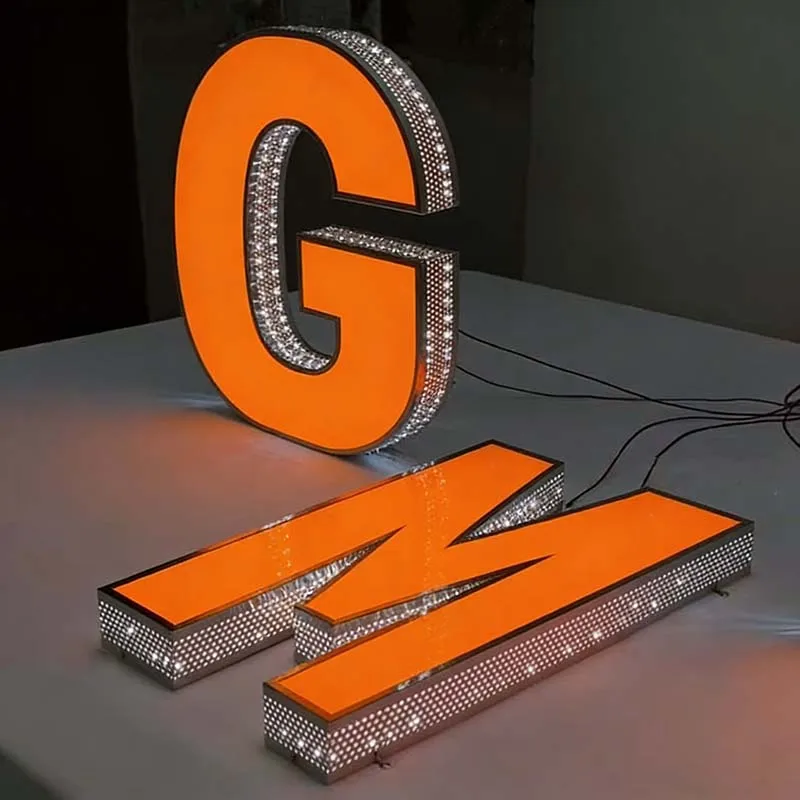
Real photo from our production floor — every sign we ship is made here.
From $24/letter · MOQ 1 piece · Flexible lead time · CE & UL certified · ships to 20+ countries
Custom sizes, colors, and finishes. Get a factory price in 24 hours.
Get a Free Quote Copy EmailWhatsApp +86 13865703472 · business@aochuangsign.cn
See pricing, specs, and get a free quote for the sign type you need. Built in our factory, shipped worldwide.