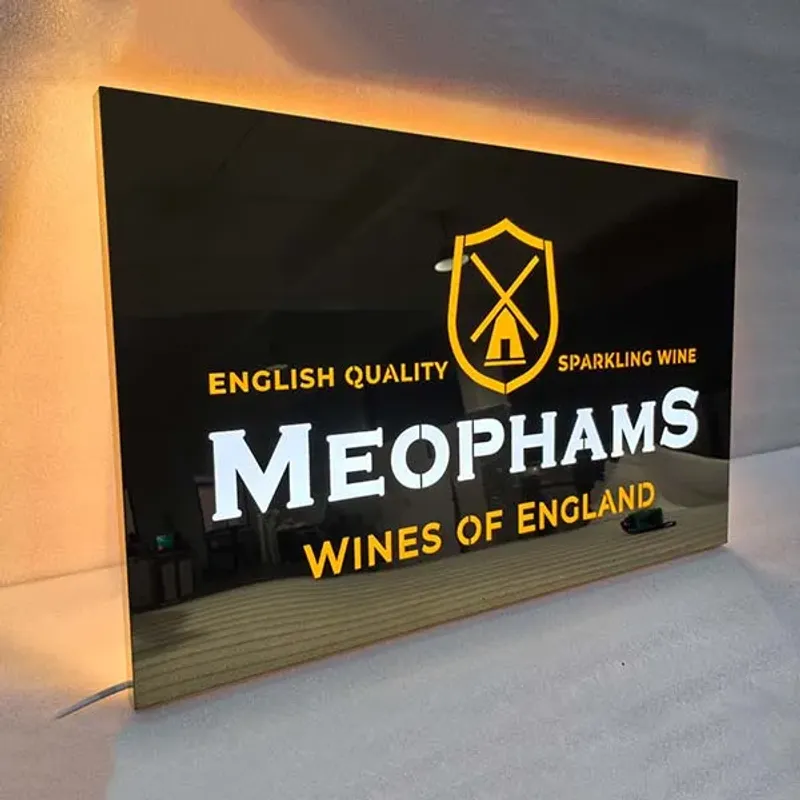
Three years ago, a hotel chain called me in a panic. Their brand-new double-sided lightbox sign—four feet tall, $6,000 installed—had gone dark on one face after just 14 months. I pulled the LED modules out and the solder joints were chalky gray. The back of the acrylic was yellow-brown like toasted marshmallow. The power supply inside the enclosure had a thermometer reading of 187°F when I cracked the seal. The sign had an IP65 rating, good silicone gaskets, brand-name drivers. Looked bulletproof on paper. The ugly truth is none of that matters if you treat an outdoor sign like a sealed coffin. Heat killed that sign. Not water. Not UV. Heat.
Here’s what nobody tells you: LEDs don’t fail like old incandescent bulbs. They don’t suddenly pop. They just get dimmer. And dimmer. Until your 150-lumen-per-watt SMD 2835 is pumping out 70, and your customer is squinting at their own logo.
LED lifespan is rated L70—that’s the point where light output drops to 70% of original. Quality modules from Samsung or Osram can hit that after 50,000 hours, roughly 5.7 years running 24/7. But that rating assumes a junction temperature of 85°C or lower. Here’s the factory-floor truth: every 10°C increase above that threshold halves the remaining life. Run your LEDs at 105°C inside a sealed aluminum can, and your “50,000-hour” modules will be toast in under 12,000 hours. That’s 16 months. I’ve seen it happen with cheap modules that started at 40 lumens per chip and wound up like a dying firefly after one Texas summer.
Look, LEDs are efficient, sure—100-150 lumens per watt out of a good SMD 2835. But that other 60-70% of input power? It becomes heat. If you don’t give that heat a path out, it builds up on the PCB, cooks the phosphor coating, and accelerates chip degradation. And once the phosphor browns, light output tanks, color temperature shifts, and your crisp 5000K white turns dingy. No amount of cleaning fixes that.
I’ve seen this go wrong: a contractor specs an IP65 sign because “it’s dust-tight and can handle water jets.” True. But IP ratings only measure ingress protection—dust and water. They say nothing about heat dissipation. You can build a perfectly sealed sign with a rubber gasket, neutral silicone, and O-rings, and you’ve just created an oven.
Outdoor signs in Dallas or Phoenix hit internal temperatures of 140°F before you even turn on the LEDs. Add the heat from the diodes and the power supply, and you’re pushing 175°F inside that enclosure. The LEDs might survive for a while, but the electrolytic capacitors in your driver won’t. Standard capacitor lifetime is 2,000-3,000 hours at 105°C. For every 10°C drop in operating temperature, that lifespan doubles. So keeping the driver compartment at 75°C instead of 105°C can take your power supply from a 2-year failure to a 7-year run. Yet I still see manufacturers cramming the driver inside the same sealed letter cavity as the LEDs, baking both components together.
The brutal honesty moment: many sign shops will sell you “outdoor-rated” channel letters without a single vent or thermal break. They’ll point to the IP65 sticker and shrug. It’s not malicious—they just don’t know any better. But that’s the rookie mistake that nets you a call-back in 18 months.
Metal is your best friend in thermal management. If you’re ordering stainless steel letters for a storefront, you already have an advantage: 304 stainless steel may not be as thermally conductive as aluminum, but it still sinks heat away from the mounting surface. Aluminum, at one-third the weight of steel, does it even better. We use 0.063” (1.6mm) aluminum backplates on front-lit channel letters specifically because it spreads heat laterally and radiates it out the back. Combined with standoffs that create an air gap between the letter and the wall, you get passive cooling that costs nothing.
Acrylic faces are a different animal. A 3mm acrylic sheet cuts light transmittance by only 8%, leaving you 92% brightness. A 5mm face over a large span adds strength but can trap more heat near the LEDs. I’ll use 5mm for anything over 2.5 meters tall, not for thermal reasons but structural. The real heat trap is the paint or vinyl on the back of the acrylic. Opaque backers to create day/night contrast block heat from escaping the letter interior. I’ve seen a 30% increase in cavity temperature just from a thick black vinyl layer. If you need contrast, choose perforated metal or dual-lit designs that allow heat to escape upward.
Look, there’s an industry lie that says “any IP67 driver is fine for outdoor.” Bull. An IP67 power supply can sit in an inch of water and survive, but it still generates heat. And many of these drivers are rated for full load at 60°C ambient, not 60°C inside a black metal box on a July afternoon. Once the internal temperature exceeds 70°C, the driver starts throttling output to protect itself. That means your LEDs dim without anyone touching a dimmer. The customer thinks the sign is failing; the problem is the driver cooking itself.
Here’s what nobody tells you: remote mounting the power supply—inside the building, in a vented weatherproof box on the ground—extends the entire sign’s life by 2-3 years. I’ve done it for front-lit channel letters where the driver went in the attic, and the only thing on the sign was low-voltage wiring. Yes, it adds labor during install. But you know what else adds labor? Rebuilding an entire sign after 20 months because the power supply melted down and took 23 LED modules with it.
Also, pay attention to driver efficiency. A 90% efficient 150W driver wastes 15 watts as heat. An 85% driver wastes 22.5 watts. Over the span of a 10-hour day, that extra 7.5 watts is like adding a small soldering iron inside your sign. Multiply that by 50 modules and you’ve got a real problem.
Real photo from our production floor — every sign we ship is made here.
Products mentioned or relevant to this topic — factory-direct, custom built.
Factory-direct since 2010. Free quote within 24 hours — no obligation.
Get a Free Quote → Copy EmailMOQ: 1 piece · Flexible lead time · 2-year warranty · Worldwide shipping
See pricing, specs, and get a free quote for the sign type you need. Built in our factory, shipped worldwide.